What Dimensions: Exact A0 Paper Size Dimensions
Explore the exact A0 paper size (841 × 1189 mm) and how it anchors the ISO A-series. Learn precise measurements, scaling rules, and practical tips for design, printing, and layout workflows.


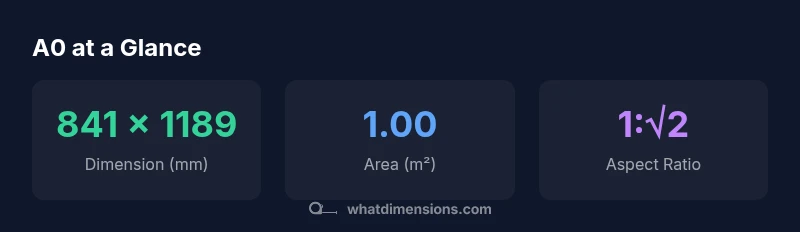
The base size in ISO 216 is A0, defined as 841 mm by 1189 mm (33.1 in by 46.8 in) with an aspect ratio of 1:√2. This exact geometry makes A0 the anchor for all A-series sizes, enabling precise scaling when reducing to A1, A2, and beyond. Designers rely on these measurements for consistent grids, bleeds, and typography across formats.
What is A0 and why it matters
The phrase what dimensions is a0 is often the starting point for designers and printers. A0 is the base size in ISO 216’s A-series, defined by the geometric principle of the square root of two. Understanding its exact dimensions helps ensure consistent scaling from posters to architectural drawings and guarantees predictable output when reducing or enlarging for different formats. For anyone working with large formats, this knowledge improves layout grids, margins, and typography decisions. In short, knowing A0 makes every downstream size more reliable and repeatable.
ISO 216 and the A-series: how A0 fits into the system
ISO 216 standardizes the A-series, from A0 up to A10, using a fixed aspect ratio of 1:√2. Each size is produced by halving the longer edge of the previous size. This systematic approach means that A0, when reduced to A1 or enlarged to A- something, preserves proportions exactly. Designers rely on this principle to create consistent templates, avoid distortion, and simplify file templates for multi-format outputs.
Exact A0 dimensions and their meaning
The canonical A0 size is 841 millimeters by 1189 millimeters, which converts to approximately 33.1 inches by 46.8 inches. The area is defined as about 1.0 square meter, a deliberate choice that makes the math clean when scaling to other sizes. The aspect ratio is 1:√2, a unique property that ensures every halving yields a precisely proportional next size. These numbers are documented in ISO 216 and widely used by printers and designers worldwide.
How A0 relates to A1, A2, A3: a scale-down path
To move from A0 to A1, halve the longer side: 841 mm becomes the height and 594 mm becomes the width when oriented as A1. This halving rule repeats for A2 (420 × 594 mm) and beyond. Because the area of each step is half of the previous, the full family remains proportionally identical. Practically, this makes it straightforward to plan posters at A0 and deliver handouts in A3 or A4 with exact scaling.
Practical implications for design and printing workflows
Knowing A0 dimensions supports precise margin setup, bleeds, and safe zones in print workflows. When preparing layouts in software, set up templates at 841 × 1189 mm with 3–5 mm bleeds, then use automatic scaling to create A1–A4 versions. This approach minimizes distortion, preserves typography legibility, and reduces guesswork when distributing artwork across formats.
Measuring, verifying, and converting A0 in common tools
Always measure in millimeters to avoid rounding errors from inches. In design software, use document units of millimeters or points and check the inch equivalents if required. When exporting, verify that the output device or printer can handle 841 × 1189 mm sheets, or plan for tiling across multiple pages. For digital previews, use scaled proofs to simulate the final print.
Use cases: posters, blueprints, and academic posters
A0 remains a preferred choice for large posters, architectural drawings, and academic displays. Its generous area supports large typography and detailed imagery while maintaining legibility. In exhibitions, A0 can be displayed directly or used as the basis for modular layouts that combine multiple A0 panels to form a large wall composition.
Practical tips for choosing paper and finishing with A0
Select paper weight and finish that complement your project: heavier paper (180–300 g/m²) for posters, matte coatings for reduced glare, or satin finishes for photography. Consider mounting or framing options that accommodate the 841 mm width. When you bind or fold content, remember A0 scales neatly into smaller formats without reformatting layouts.
Swapping to other sizes and maintaining quality: a quick guide
When transitioning from A0 to smaller sizes, keep the same aspect ratio to avoid distortion. Use scale factors of 1:0.5, 1:0.25, etc., to derive A1, A2, and beyond. For large-scale printing, verify resolution requirements; for example, a poster printed at 100 ppi will require fewer details than one at 300 ppi. Always test print a proof to ensure color and layout accuracy.
Comparison of A0, A1, and A2 sizes
| Size | Dimensions (mm) | Approx. Area (m²) | Notes |
|---|---|---|---|
| A0 | 841 × 1189 | 1.00 | Base size of ISO A-series; derived by halving the longer side |
| A1 | 594 × 841 | 0.50 | Halved from A0 along the longer side |
| A2 | 420 × 594 | 0.25 | Halved again |
Quick Answers
What are the exact dimensions of A0?
A0 measures 841 mm by 1189 mm, with an area of about 1.0 m² and an aspect ratio of 1:√2. These values are defined by ISO 216.
A0 is 841 by 1189 millimeters, with a 1 to square root two ratio.
How does A0 relate to other A-series sizes?
Each A-series size is derived by halving the longer edge of the previous size. This keeps proportions consistent from A0 down to smaller formats like A1, A2, and beyond.
Each size is halved along the longer edge to stay proportional.
What is A0 used for in practice?
A0 is ideal for large posters, architectural drawings, and academic posters where high detail and readability are needed at close viewing distances.
Great for large format posters and blueprints.
Can I print A0 on a standard home printer?
Most consumer printers cannot handle true A0 size. Use tiling, a wide-format print service, or scale down to A1/A2 and print in sections as needed.
Home printers usually can't print A0 in one sheet.
How do I verify A0 size in software?
Set the document to 841 mm by 1189 mm in millimeters, then check the export/output settings to ensure the target device matches the dimensions.
Set the document to 841 by 1189 mm and confirm export size.
Is A0 exactly 1 square meter?
A0 is defined so that its area is 1 square meter. The exact 841 × 1189 mm dimensions produce nearly 1.00 m², which is the standard.
A0 is designed to be about one square meter.
“A0 is the anchor of ISO 216; its precise 841 × 1189 mm dimensions enable scalable design workflows across print and digital formats.”
Main Points
- Know A0 exact size: 841 mm × 1189 mm
- Recognize ISO 216's 1:√2 ratio
- Use A0 as the base for scaling other sizes
- Plan printing with halving in mind for clean scaling
- Verify dimensions in millimeters for precision