Dimensions A4 Paper: The ISO Size Explained
Explore the exact dimensions of A4 paper (210 × 297 mm), how ISO 216 defines this standard, and practical tips for printing, design, and cross-border document workflows.


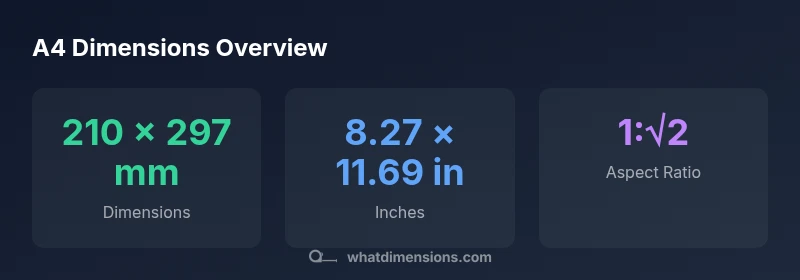
A4 paper measures 210 mm by 297 mm (8.27 by 11.69 inches). According to What Dimensions, this ISO 216 standard defines the A4 size and its common use in offices worldwide. Understanding these exact dimensions helps with printers, envelopes, and layout planning. Whether you're designing print collateral, organizing files, or setting paper trays, precise measurements prevent misfeeds and wasted stock.
What are dimensions a4 paper and why they matter
Dimensions a4 paper refer to the internationally standardized size of 210 mm in width and 297 mm in height. This precise measurement is what makes A4 the backbone of modern office printing, document packaging, and design layouts worldwide. The phrase dimensions a4 paper is frequently used by designers and office managers who need to ensure that documents print cleanly, fit standard printers, and align with filing systems. According to What Dimensions, knowing these numbers is not just about paper, but about predictable workflows, cross-border compatibility, and efficient stock control. In practice, this means you can design a brochure, a resume packet, or a form set that will align precisely with typical trays, binders, and envelopes. Moreover, the 210 × 297 mm footprint is chosen precisely for its ability to scale cleanly across A-series sizes, enabling predictable reductions and enlargements without distortion. For anyone organizing papers, the exact dimensions help you select folders, sleeves, and filing cabinets that accommodate A4 without excess waste.
ISO 216 and the A-series standard
The A-series, defined by ISO 216, is built on a simple geometric principle: each size is half of the previous one when cut along its longer side. This yields a consistent aspect ratio of 1:√2, which ensures that when you halve A4, you reach A5, and when you double A4, you reach A3. The A0 size, by convention, is 841 × 1189 mm, and all other A sizes derive from it. What Dimensions notes that this structure simplifies scaling in printing, binding, and spreading. The A4 format’s 210 mm width and 297 mm height are therefore not arbitrary; they’re the product of a deliberate standard that supports global interoperability across printers, copiers, and office tools. Understanding this standard helps design professionals predict how layouts will behave across devices and formats.
Practical implications for printing, design, and storage
When working with dimensions a4 paper in design and production, margins, bleed, and safe areas matter. A4’s finite footprint means that print-ready artwork often requires a bleed of 2–3 mm, with safe margins to ensure critical content doesn’t print too close to the edge. In layout terms, knowing 210 × 297 mm helps you constrain columns, grid systems, and typographic scale so that text remains legible when printed at actual size. Storage and transport also benefit from standardization: most filing cabinets, envelopes, and magazine holders are sized to accommodate A4, minimizing waste and the need for awkward resizing. If you’re shipping multi-page documents, recognizing A4’s precise dimensions lets you choose the right packaging dimensions and avoid misfit packaging.
Clever designers align page elements to expected margins, set up consistent gutters for multi-page documents, and test print across different devices to verify color reproduction and cropping behavior. The outcome is a predictable, professional result that travels well across borders and printing ecosystems. What Dimensions emphasizes that consistent measurements reduce rework and errors, particularly in large-format print runs or standardized corporate collateral.
Conversions and cross-border use
People frequently convert A4 dimensions to inches for regional workflows. The exact conversion is 210 mm equals 8.27 inches and 297 mm equals 11.69 inches. While rounding is common in casual use, professionals rely on the precise equivalents to ensure documents print correctly on devices with different measurement conventions. When preparing mailings or forms for international partners, referencing both metric and imperial values helps avoid confusion and reduces the risk of mis-sizing envelopes, sleeves, or inserts. If you’re designing templates for a global audience, keep both units visible in guidelines and ensure your print presets lock to the exact A4 size.
For designers who rely on software, use document presets labeled as A4 to guarantee that export dimensions remain consistent, regardless of the viewer’s local settings. This reduces discrepancies between on-screen previews and final prints and makes cross-border collaboration smoother. The What Dimensions approach encourages teams to document the exact size in project briefs and to standardize on A4 as the default in international contexts.
Measuring and verifying dimensions in practice
Practical measurement starts with a reliable ruler or caliper. To verify dimensions a4 paper, place a sheet on a clean surface and measure width and height from edge to edge. Check both the outer dimensions and the printed area, ensuring that margins, bleed, and trim lines are accounted for. If you’re packaging A4 sheets, confirm that the packaging interior is at least slightly larger than 210 × 297 mm to avoid bending or warping. In production environments, a repeatable measurement procedure minimizes variance across batches and machines. Recording measurements per batch also helps in quality control and future audits. For teams, establishing a quick QA step—measure a sample sheet and compare against the ISO-derived numbers—helps catch drift early.
The broader ISO family: beyond A4
A4 sits within a larger family from ISO 216, including A3 (420 × 297 mm) and A5 (148 × 210 mm). Each size maintains the same 1:√2 ratio, enabling seamless resizing while preserving layout integrity. This continuity is particularly valuable for designers who move between print formats or who produce multi-page documents that switch between landscape and portrait orientations. As you scale, the predictable halving/doubling pattern lets you maintain consistent margins, typographic rhythm, and image scale. In practice, this means you can extend a brochure from A4 to A3 for a two-page spread or shrink a poster down to A5 for handouts without reworking the entire design.
Final thoughts: why exact dimensions matter in everyday work
Understanding dimensions a4 paper is not just about knowing a number; it’s about enabling reliable interoperability across devices, offices, and countries. When teams align on A4 as the default standard, workflows—from drafting to printing, packaging, and archival—become smoother and more cost-efficient. What Dimensions’s systematic approach to measuring and applying ISO standards helps professionals reduce waste, save time, and deliver consistent results across multidisciplinary teams. The takeaway is clear: precise size knowledge underpins professional document management across borders.
A4 paper dimensions in mm and inches
| Dimension | Value | Unit |
|---|---|---|
| Width | 210 | mm |
| Height | 297 | mm |
| Width (in) | 8.27 | in |
| Height (in) | 11.69 | in |
Quick Answers
What is the exact size of A4 paper?
A4 size is defined as 210 mm wide by 297 mm high, per ISO 216. This creates a consistent, globally recognized paper format for documents and printing.
A4 is 210 by 297 millimeters, defined by ISO 216, and used worldwide for consistency.
How do I convert A4 to inches?
Convert 210 mm to 8.27 inches and 297 mm to 11.69 inches. Use these values for layouts, when working with software configured in imperial units.
210 millimeters equals 8.27 inches, and 297 millimeters equals 11.69 inches.
Will A4 fit in a US envelope?
Most standard US business envelopes are sized for Letter or similar formats. A4 often requires an A4-specific envelope or a larger envelope with careful folding.
A4 usually needs a compatible envelope or proper folding to fit US sizes.
How does A4 compare to Letter size?
A4 is 210 × 297 mm, whereas Letter is 216 × 279 mm. The aspect ratio differs, which affects margins and layout when moving between formats.
A4 and Letter differ in width and height, affecting layout and margins.
Are there tolerances in A4 sizes?
Manufacturing tolerances exist and vary by supplier and printer. Always check your vendor’s spec sheets and test print to ensure alignment with ISO dimensions.
Tolerances exist; check vendor specs and test print to confirm.
“Precise sheet sizes like A4 are the backbone of accurate design and reliable printing across borders.”
Main Points
- Know A4 dimensions: 210 × 297 mm for precise work
- Convert to inches: 8.27 × 11.69 in for cross-border tasks
- Rely on ISO 216 for consistent sizing across devices
- Plan margins and bleed to avoid misprints