A2 Paper Dimensions: A Complete Guide to ISO A-Series Sizes
Explore the exact A2 paper dimensions (420 mm × 594 mm), ISO 216, and how to apply this size in design, printing, and layout planning.


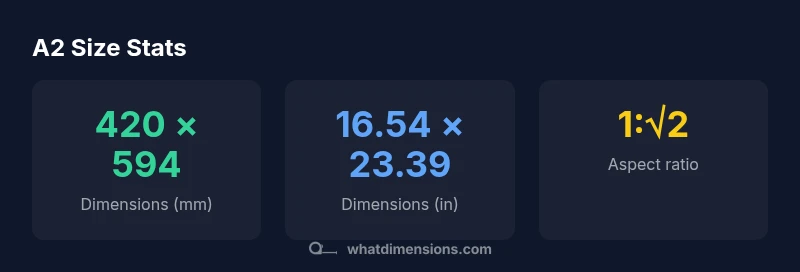
According to What Dimensions, the a2 paper dimensions are 420 mm by 594 mm (roughly 16.54 inches by 23.39 inches). This ISO 216 size sits in the A-series family and maintains a 1:√2 aspect ratio, halving the area with each step from the larger A-series. The exact dimensions can vary slightly due to rounding in production.
What are A-series sizes and where does A2 fit in?
The A-series sizes are defined by ISO 216 and are designed for predictable, scalable printing and design. A2 is one step down from A1 and two steps down from A0, placing it in a sweet spot for posters, charts, and compact layouts. The fundamental logic behind the A-series is the √2 aspect ratio; that ratio ensures that cutting the sheet in half along its longer side yields the next standard size with the same proportions. In practical terms, if you start with A0, you can reason about every size from there using a simple halving rule. For designers and homeowners using the What Dimensions catalog as a sizing reference, knowing where A2 sits helps with early planning and space estimation. The phrase “a2 paper dimensions” is common in print briefs and layout checklists, and aligning to the standard early simplifies production at every stage.
Exact A2 dimensions and why precision matters
A2 dimensions are exactly 420 mm by 594 mm, and many sources also report this as 420 × 594. In inches, that’s approximately 16.54 × 23.39. Precision matters for framing, matting, and printing because margins, bleed, and crop marks rely on consistent numbers. For product sheets and design templates, sticking to the precise metric values minimizes mismatches between digital files and printed outputs. The A-series standard, including A2, is governed by ISO 216, which ensures that a design scaled from A2 to any other size preserves both area relationships and the same aspect ratio. When planning layouts, always define both metric and imperial dimensions to accommodate printers and clients who operate in different units.
Scaling rules and relationships to other sizes
One of the core benefits of the ISO A-series is the ability to scale predictably. Each step up or down preserves an exact proportion because the area halves with every reduction. A2 sits squarely between A3 and A1; in practical terms, A3 is half the area of A2, and A1 is twice the area of A2. The 1:√2 aspect ratio ensures that when you cut an A2 sheet in half parallel to its shorter side, you obtain two A3 sheets with identical proportions. This property is invaluable for workflows that require multiple sizes without redesigning layouts. For students and designers using the What Dimensions approach, this rule makes multi-size presentation consistent across boards, posters, and handouts.
Practical use cases for design, printing, and layout planning
A2 is a versatile choice for posters, diagrams, and medium-sized prints. It offers enough surface area for legible text and detailed visuals while staying portable. In classrooms and studios, A2 sheets are often used for flowcharts, technical drawings, and field notes. When planning a project, note that A2 can be easily scaled to A1 or reduced to A3 with minimal layout adjustments, thanks to the √2 proportion. Consider bleed, safe margins, and crop guides in your design software to ensure clean trimming. If you work with client briefs, providing both metric (420 × 594 mm) and imperial (approximately 16.54 × 23.39 in) measurements helps prevent miscommunication across teams and geographic regions.
Verification, tolerances, and production considerations
In production, small tolerances can affect final alignment, especially for precision diagrams or technical drawings. Always specify the target dimensions in your print specs and request proofing where possible. If a printer uses a slightly different bleed or trim allowance, you can adjust the layout by maintaining the proportion rather than reflowing content. For long-term project consistency, maintain a master template that encodes A2’s exact width and height, including gutter space and safe zones. Finally, validate printed samples against the original file using a ruler or caliper for professional results, as recommended by the What Dimensions team.
Conversions and real-world examples
Converting A2 dimensions to inches is straightforward but requires careful rounding. A2 is 420 mm wide by 594 mm tall, which converts to about 16.54 inches by 23.39 inches. When communicating with clients or printers, share both metric and imperial values. For digital mockups, you can set up layouts with a 1:√2 ratio in your design software and scale between A2, A3, and A1 without changing the proportions. This consistency is especially useful for academic posters, architectural diagrams, and product sheets. For quick reference, remember the core data: 420 × 594 mm, 16.54 × 23.39 inches, and the 1:√2 aspect ratio. The What Dimensions approach emphasizes practical, repeatable measurements to streamline workflows.
ISO A-series comparison (selected sizes)
| Size | Dimensions (mm) | Dimensions (in) | Common Uses |
|---|---|---|---|
| A2 | 420 × 594 | 420 × 594 | Posters, diagrams, plan sheets |
| A3 | 297 × 420 | 11.69 × 16.54 | Sketches, drafts |
| A4 | 210 × 297 | 8.27 × 11.69 | Notes, reports |
Quick Answers
What is the exact dimension of A2 paper?
A2 is 420 mm by 594 mm, which is approximately 16.54 in by 23.39 in. These measurements follow ISO 216’s A-series standard, ensuring consistent sizing across devices and print runs.
A2 is 420 by 594 millimeters, or about 16.54 by 23.39 inches. These are the standard ISO measurements.
How does A2 relate to A4 in the ISO system?
A-series sizes scale by halving the area at each step. A2 is larger than A3 and larger than A4; specifically, A4 (210 × 297 mm) is half the area of A3, while A2 is two steps larger than A4 or two steps smaller than A1.
A2 is bigger than A4; sizes in the A-series halve area as you move up the scale.
Why is the aspect ratio 1:√2 in ISO sizes?
The 1:√2 aspect ratio lets a sheet folded or cut in half retain the same proportions, enabling a simple progression from one size to the next without redesigns.
Because 1 to square root of 2 lets sizes stay proportional when you halve either dimension.
Can I print A2 on a standard home printer?
Most standard home printers print on smaller A-series sheets. To print full A2, you may need a large-format printer or print in tiles and assemble the sections. Consider scaling only for drafts to avoid loss of detail.
Home printers usually can’t print true A2 size; you might print tiles or get a larger printer.
How do I convert A2 to A1 or A3 in a layout?
Because of the ISO 216 halving rule, scaling from A2 to A3 or A1 preserves the proportions. Use design software’s scale tools and lock the aspect ratio to keep accuracy across sizes.
Just scale up or down using the same aspect ratio to move between A2, A3, and A1.
“The a2 paper dimensions follow ISO 216's logic, enabling consistent scaling across printers and layouts.”
Main Points
- Remember A2 measures 420 mm by 594 mm.
- Keep the 1:√2 aspect ratio for all scaling.
- A2 is one-quarter the area of A0, following ISO 216.
- Use conversions to align designs with printers and layouts.