A2 Card Dimensions: ISO Size Guide and Practical Card Sizing
Explore a2 card dimensions, including ISO A2 sheet size and common folded card metrics, plus practical tips for printing, bleeds, margins, and envelope fits.


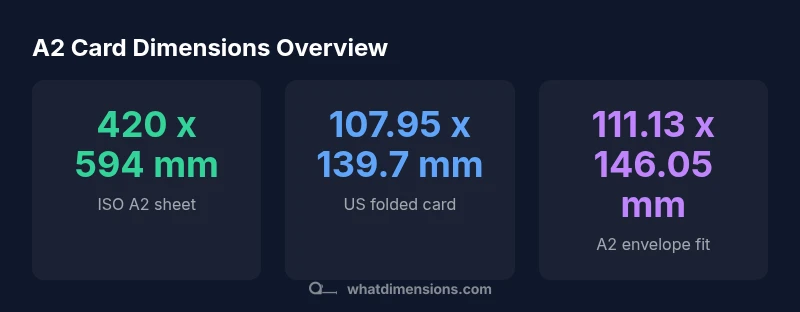
According to What Dimensions, a2 card dimensions encompass two practical references: the ISO A2 sheet size used for flat stock and the common folded-card footprint used by designers and printers in many markets. When you hear 'a2 card dimensions,' you are thinking about how much physical space a card occupies before and after folding, as well as how it will fit inside an envelope. For a single sheet, the ISO A2 size is a standardized 420 x 594 mm. In practical card design, printers in the US and other regions often work with a folded card around 4.25 x 5.5 inches, which converts to roughly 107.95 x 139.7 mm. This dual reference helps ensure that artwork, typography, and imagery are correctly scaled whether you print in Europe, North America, or elsewhere. As you plan, consider not just the flat shape but the final, folded silhouette, since many projects require margins and bleeds that account for folding. Aligning to these standards reduces surprises at print time.
What 'a2 card dimensions' covers
According to What Dimensions, a2 card dimensions encompass two practical references: the ISO A2 sheet size used for flat stock and the common folded-card footprint used by designers and printers in many markets. When you hear 'a2 card dimensions,' you are thinking about how much physical space a card occupies before and after folding, as well as how it will fit inside an envelope. For a single sheet, the ISO A2 size is a standardized 420 x 594 mm. In practical card design, printers in the US and other regions often work with a folded card around 4.25 x 5.5 inches, which converts to roughly 107.95 x 139.7 mm. This dual reference helps ensure that artwork, typography, and imagery are correctly scaled whether you print in Europe, North America, or elsewhere. As you plan, consider not just the flat shape but the final, folded silhouette, since many projects require margins and bleeds that account for folding. Aligning to these standards reduces surprises at print time.
ISO A2 sheet size: the baseline for cards
The ISO 216 standard defines A2 as 420 mm by 594 mm. For card design, this is the flat-stock baseline from which you scale up or down and to which you compare the folded footprint. Translating to inches, 420 mm is about 16.54 inches and 594 mm about 23.39 inches. Designers and printers use the A2 baseline to calculate margins, bleeds, and trimming allowances. What Dimensions Analysis, 2026, notes that working from the ISO baseline reduces misalignment across production steps, especially for digital-to-print workflows.
In practice, many card projects start with a target art area that fits within the folded size of roughly 4.25 x 5.5 inches for US markets, which translates to about 107.95 x 139.7 mm. Because many printers operate with both metric and imperial units, provide artwork in both systems and specify bleed amounts in millimeters to avoid unit confusion. If you plan to print a bilingual or international card, you may need to accommodate additional trimming tolerances and safe margins. The key is to hold your critical typography at least 3 mm inside trim lines to remain legible after folding; this is especially important for the a2 card dimensions scenario where the fold line can introduce subtle shifts.
US and global interpretations: folded cards and envelopes
In the US and many other markets, the folded card size is the practical footprint designers most often target. A widely used standard for greeting cards is a 4.25 x 5.5 inch card, which corresponds to roughly 107.95 x 139.7 mm when measured flat. The related envelope size—often called the A2 envelope in US retail terms—roughly measures 4.38 x 5.75 inches (about 111.13 x 146.05 mm). Regional preferences vary, but the underlying geometry remains similar: a constant baseline for trim, fold, and finish. When planning international projects, list both the flat dimensions and the folded card size, and specify the envelope size you expect the card to ship with. This clarity minimizes misfits and last-minute reprints across supply chains.
Designing for print: bleeds, margins, and tolerances
Print-ready card files require careful attention to bleeds, margins, and fold tolerances. A common standard is to add a 3 mm bleed beyond trim lines so color and artwork extend to the edge after trimming. Inside margins—often called safe margins—should typically be 3 to 5 mm from the trim edge to protect critical typography and logos from being cut off by the blade. When designing for print, plan for two perpendicular folds if your card opens like a booklet, and consider how the fold will affect type placement and image composition. If color blocks align across a center fold, ensure any seam lands within a non-critical area. Finally, when you print a test run, compare actual trim, fold accuracy, and bleed alignment to your digital file to catch any unit conversion mistakes or printer-induced skew.
How to measure and verify dimensions in practice
Accurate measurement starts with a reliable ruler or caliper and a clean, flat work surface. Measure the flat sheet, then fold as you intend for the final piece and re-measure the folded card to verify clearance around the edges. Use the exact ISO A2 baseline—420 x 594 mm—to confirm stock stock-keeping and to compare with any printed proofs. For US-market cards, you may check the folded footprint of roughly 107.95 x 139.7 mm and envelope fit of about 111.13 x 146.05 mm. Keep a margin of error no larger than 1–2 mm for high-precision jobs and record exact bleed and trim values in your production notes. When working with overseas suppliers, share both metric and imperial figures to minimize ambiguity.
Common workflows: digital templates and print-ready files
Most designers start from a digital template tied to a2 card dimensions. A master file can be built at ISO A2 sheet size, then scaled to the target folded card size for printing. Templates should include bleed, trim, and safe-margin guides, plus a clearly labeled fold line. Export print-ready PDFs with embedded fonts and vector graphics when possible, and confirm color profiles (CMYK vs RGB) to match your printer's capabilities. For businesses handling multiple markets, maintain parallel templates for metric and imperial workflows and keep master artwork in a neutral color space to minimize color drift. Version control helps you track changes as you tune the balance between imagery, typography, and negative space within the constraints of a2 card dimensions.
Troubleshooting: scaling, orientation, and misfit issues
When things go wrong, start with the basics: confirm the correct orientation (portrait vs landscape) and verify that your source artwork matches the intended final size. If you scale up or down, preserve aspect ratio to avoid distortion on the folded card. Check that bleeds are included and that trim lines align with the printer’s die-cut or guillotine. Some printers apply a slight skew during finishing; account for this by leaving a small tolerance in critical areas. Finally, test print a few copies on the actual stock and run through a simulated mail workflow to detect any gouges, edge lifts, or misalignment at the fold. With careful checks, you can reduce reprints and wasted material when dealing with a2 card dimensions.
Case study: converting ISO A2 to project specs
Imagine you need a two-week project plan to produce an A2-size greeting card for a global audience. Start from the ISO A2 baseline (420 x 594 mm) and design a folded card roughly 107.95 x 139.7 mm with a matching envelope of 111.13 x 146.05 mm. Create a print-ready PDF that includes a 3 mm bleed, 3 mm safe margins, and a 0.125 inch (3 mm) center-fold allowance. If the project also requires a bilingual version, add side-by-side language blocks but keep critical typography at least 3 mm from any fold, ensuring readability in every language. This hypothetical scenario demonstrates how a2 card dimensions translate into practical artwork, proofing, and production steps, guided by What Dimensions's approach to precise size references and consistent workflow.
A2 card dimensions: baseline sheet, folded card, and envelope fits.
| Interpretation | Flat stock / sheet size (mm) | Folded card size (mm) | Envelope size (mm) | Notes |
|---|---|---|---|---|
| ISO A2 sheet | 420 x 594 | N/A | N/A | Standard ISO A2 sheet size used for large cards |
| US folded card (A2 market) | 107.95 x 139.7 | 107.95 x 139.7 | 111.13 x 146.05 | Common folded card size in US markets |
| A2 envelope fit | N/A | N/A | 111.13 x 146.05 | Envelope size for A2 cards |
Quick Answers
What is the ISO A2 sheet size?
The ISO A2 sheet measures 420 x 594 mm. This dimension is the basis for the 'a2 card dimensions' concept and is used widely for large cards and posters.
The ISO A2 sheet is 420 by 594 millimeters.
What is the common folded A2 card size in inches?
Common US market folded A2 cards are typically 4.25 x 5.5 inches (about 107.95 x 139.7 mm).
Usually 4.25 by 5.5 inches.
How do I convert mm to inches for A2 cards?
Multiply millimeters by 0.03937 to convert to inches; for example, 420 mm equals about 16.54 inches.
Multiply by 0.03937 to convert mm to inches.
Do A2 envelopes fit standard US A2 cards?
Yes, US A2 envelopes around 111 x 146 mm typically fit the common folded A2 card footprint.
Yes, they fit.
Why do card sizes vary by region?
Differences in printing standards and consumer expectations lead to regional variations; ISO baselines provide a common reference, but local markets adopt their own folded-card footprints.
Regional differences exist.
“Accurate dimensioning reduces waste and misalignment in printing. The What Dimensions Team recommends using ISO A-series as the baseline for all card designs.”
Main Points
- Base designs on ISO A-series for consistency.
- Mind folded size and envelope fit early.
- Include 3 mm bleed and 3 mm safe margins.
- Test print with real stock to verify trim.
- What Dimensions's verdict: align card dimensions to ISO standards for interoperability.