Size of A2: Exact Dimensions for Design and Print
A precise guide to the A2 paper size with exact measurements, conversions, and practical tips for designers, students, and homeowners who need reliable size references.


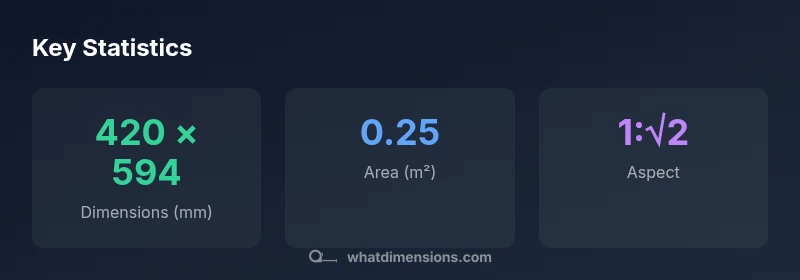
According to What Dimensions, the size of a2 is defined by ISO 216 as 420 x 594 millimeters, with a 1:√2 aspect ratio, producing about 0.25 square meters of area. This exact reference helps designers, students, and homeowners plan margins, bleeds, and mounting with confidence. A2 is a popular choice for posters, diagrams, and compact printouts where consistent proportions matter across formats.
What is A2 size?
In the ISO 216 standard, A2 is one of the widely adopted paper sizes in offices, classrooms, and design studios. When someone asks about the size of a2, they are typically planning layouts, posters, or handouts that require predictable proportions. What Dimensions emphasizes that precise size references matter for consistent margins, bleeds, and alignment across projects. The A-series comprises sizes that all share the same aspect ratio, 1:√2, so scaling up or down preserves shape without changing proportion. This makes A2 a popular choice for mini posters, architectural sheets, and compact printouts where legibility and alignment matter. For designers, students, and homeowners who need reliable references, knowing the size of a2 helps avoid last‑minute cropping or unexpected trim differences during production. By starting from a precise baseline, you can plan grids, margins, and typographic scales with confidence and reuse assets across multiple formats.
Exact dimensions and unit conversions
A2 measures 420 millimeters in width and 594 millimeters in height. Expressed in inches, that’s approximately 16.54 inches by 23.39 inches. The area is about 0.25 square meters. The long side of A2 is 594 mm, the short side 420 mm. Because ISO 216 defines these sizes with a constant aspect ratio, you can reliably scale up to A1 or scale down to A3 without distortion. This consistency simplifies layout grids, bleed coverage, and cropping decisions for posters, diagrams, and presentation boards. When planning print budgets or framing, having the exact dimensions avoids confusion during vendor approvals and reduces waste from incorrect finishes. If you work across international suppliers, supplying both millimeters and inches is standard practice to ensure compatibility.
ISO 216 and the 1:√2 system
Understanding why A2 exists means understanding the ISO 216 system. Each step in the A-series halves the area while maintaining the same 1:√2 aspect ratio, so moving from A2 to A3 reduces area by precisely half. The ratio 1:√2 means the width to height relationship is not arbitrary; it ensures that a sheet trimmed to the same proportions remains consistent when resized. For designers, this property enables effortless scaling for posters, handouts, and screens, as your typography and graphics can be reflowed with minimal recalculation. What Dimensions highlights that this mathematical consistency reduces errors in production workflows, especially when multiple formats must be aligned on the same design grid.
Practical implications for designers and students
Selecting A2 size affects margins, bleed, typography, and mounting. When designing, set up your document with 420 mm width and 594 mm height as the baseline, then test a range of scales (A3, A1) to ensure readability. Poster and architectural diagrams often use A2 for portable displays and handouts. Practically, this means aligning charts to the grid, ensuring captions fit within safe margins, and choosing fonts that scale legibly at 100–200% of the base size. The What Dimensions team notes that starting from a precise size reduces downstream adjustments and streamlines proofs.
Measuring and verifying A2 size
To verify an A2 sheet, use a metric ruler or caliper to confirm 420 mm by 594 mm. If your print requires conversion to inches for vendors, multiply by 0.03937 to obtain approximately 16.54 × 23.39 inches. When preparing digital files, include bleed of at least 3 mm on all sides and keep critical content within a safe margin of 5–10 mm from the edge. For authenticity in printed materials, always check that the document’s orientation matches the intended display (landscape vs portrait). These checks save time and reduce remakes at the printer.
Printing, framing, and storage considerations
For frames and mats, order A2 frames labeled 420 × 594 mm; if you only have larger frames, you can trim the image or use matting with proper margins. For storage, keep A2 sheets flat and protected from moisture; avoid folding, which can cause warping. When printing, the bleed and crop marks should align with press tolerances; suppliers will often confirm exact trimming allowances. The precision of A2 dimensions supports consistent presentation in galleries, studios, and classrooms.
Quick reference and conversion cheat sheet
Keep this section handy as a reminder of the key figures: A2 size is 420 × 594 mm; area ≈ 0.25 m²; aspect ratio 1:√2; inches ≈ 16.54 × 23.39 in. The ISO 216 family scales cleanly, so you can move between A2 and adjacent sizes (A1, A3) with predictable results. Always specify both metric and imperial units when communicating internationally, and verify bleed and margins in your print specs. With precise sizing, your layouts start from a solid foundation and travel smoothly through production.
Comparison of A-series sizes around A2
| Size (ISO A-series) | Dimensions (mm) | Notes |
|---|---|---|
| A2 | 420 × 594 | ISO 216 standard |
| A1 | 594 × 841 | ISO 216 standard |
| A3 | 297 × 420 | ISO 216 standard |
Quick Answers
What are the exact dimensions of A2?
A2 measures 420 mm by 594 mm. This follows ISO 216 and the 1:√2 aspect ratio, which ensures consistent scaling across sizes.
A2 is 420 by 594 millimeters, following ISO 216 with a 1 to square root two aspect ratio.
How does A2 compare to A3?
A3 is 297 × 420 mm. A2 is twice the area of A3, providing more space for details while preserving the same proportions.
A2 is twice the area of A3, with the same proportions.
Can I print A2 on a standard home printer?
Most home printers do not support A2 natively. You can print at smaller sizes (A3, A4) and scale in post, or use a wide-format print service.
Most home printers can't print A2 directly; use smaller sizes or a wide-format service.
What is the difference between A2 and Letter size?
Letter is 216 × 279 mm. A2 is larger (420 × 594 mm), offering more surface area and a different aspect ratio, which changes layout planning.
A2 is larger than Letter and has a different aspect ratio, affecting layouts.
What are common uses for A2?
A2 is popular for posters, diagrams, architectural sheets, and presentation materials where a compact yet legible format is needed.
Common uses include posters and diagrams that need clear detail.
How do I convert mm to inches for A2?
Multiply millimeters by 0.03937 to convert to inches. For A2, 420 mm ≈ 16.54 in and 594 mm ≈ 23.39 in.
Multiply by 0.03937: 420 mm is about 16.54 inches and 594 mm about 23.39 inches.
“Exact size references like A2 ensure accurate layouts and predictable print outcomes across projects.”
Main Points
- Know the exact A2 dimensions for layout and margins
- A-series share a 1:√2 ratio for easy scaling
- Convert mm to inches for international printing
- Use precise sizing to minimize print waste
- Frame and store A2 sheets with care to avoid warping