How Much Is A4 Dimensions? A Practical Guide to Paper Size
Discover the exact A4 dimensions (210 x 297 mm), how they translate to inches, and how this standard affects printing, design, and packaging across regions. A What Dimensions guide.


According to What Dimensions, the quick answer to how much is a4 dimensions is that A4 is defined by ISO 216 as 210 mm by 297 mm. In inches, that’s about 8.27 by 11.69. This standard helps ensure compatibility for printers, folders, and envelopes worldwide. Knowing this baseline helps designers, students, and businesses plan layouts and packaging confidently.
A4 Dimensions: Exact Measurements and ISO Standard
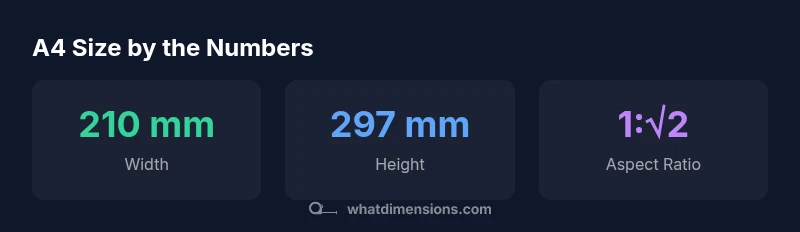
According to What Dimensions, how much is a4 dimensions? The standard defines A4 as 210 mm by 297 mm. This tidy rectangle, with an aspect ratio of 1:√2, is designed to scale without losing proportion when sheets are halved or enlarged. In practical terms, the A4 size is roughly 8.27 by 11.69 inches, a dimension you’ll see in printers, envelopes, and most office paperwork worldwide. Understanding these base measurements helps you design layouts, select paper stocks, and coordinate with print vendors. Designers often plan templates with a 3- to 5-mm bleed to ensure color runs reach the edge after trimming. For households or campuses, recognizing the exact size minimizes mismatches when filing, scanning, or archiving documents.
How A4 Size Is Used Across Regions and Industries
A4 is the default paper size for most of Europe, Asia, and much of the world outside North America. It’s the standard for letters, reports, invoices, forms, and academic handouts, making cross-border collaboration smoother. In design, A4 is favored for brochures and posters in compact dimensions; in education, assignment sheets and syllabi use A4 to maintain consistent margins. Packaging, binding, and even shipping labeling can be optimized around A4’s predictable footprint. When working with vendors, confirming A4 alignment helps prevent cropping or misalignment during production runs.
How to Measure A4 Accurately
To measure A4 accurately, use a clean ruler or caliper and check both dimensions at several points along the edge. Confirm the corners are square; misalignment here can cause printing or cutting errors. If you are converting from millimeters to inches, ensure you apply the exact conversion (1 inch = 25.4 mm). For digital workflows, set up templates with a 210 mm by 297 mm canvas and include a standard 3–5 mm bleed to accommodate trimming. Finally, verify that your stock’s thickness (caliper) matches your project requirements, since heavyweight paper behaves differently in printers and copiers.
A4 in Printing, Design, and Packaging
In printing, A4 templates typical include a 3–5 mm bleed and margins that account for printer drift. Designers often work at 300 dpi or higher to ensure crisp text and graphics when scaled. For packaging and forms, A4 provides a predictable sheet size that simplifies layout grids, fold lines, and perforations. When using color, plan color management across devices to keep tones consistent from screen to print. Understanding A4’s dimensions helps you estimate paper consumption, stock costs, and downstream processes such as trimming and binding.
Common Mistakes When Working with A4
One common error is assuming US Letter templates will fit A4 without adjustment. Another is mixing millimeters and inches without a clear conversion table, leading to misaligned margins. Failing to include bleed in print layouts often results in white borders after trimming. Finally, printers and copiers may have slightly different tolerances; always print a test page before a full run to verify alignment and color output.
Comparing A4 to Other Paper Sizes
A4 belongs to ISO 216’s A-series, characterized by the 1:√2 aspect ratio. Compared with US Letter (about 8.5 × 11 inches, 216 × 279 mm), A4 is slightly narrower but taller. A3 is double the area of A4, while A5 is exactly half. For international contexts, A4 remains the most widely used size outside North America, supporting cross-border document sharing and printing workflows. Understanding these differences helps when selecting paper stocks, designing templates, and planning archiving schemes.
Practical Tips for Working with A4 in Digital and Print
- Create document templates in 210 mm × 297 mm with a 3–5 mm bleed.
- Use consistent margins (e.g., 15–20 mm) to maintain balance on both sides.
- When exporting to PDF, embed fonts and preserve vector graphics for sharp results.
- For dense documents, consider 80–120 g/m² for everyday printing, or heavier stocks for covers and proposals.
- Test print on a production device to catch drift in color, ink spread, or edge cropping.
Authority and Standards for Paper Sizes
For formal certainty, A4 is defined by ISO 216, which sets global standard sizes for the paper family. The standard’s structure ensures that scaling, halving, and enlargement remain predictable across printers and copiers. Organizations and educational institutions often reference ISO 216 when specifying document templates, stationery, or packaging layouts. Reference resources and standards help keep projects compatible across borders and devices.
Key facts about A4 dimensions
| Aspect | Dimension / Value | Notes |
|---|---|---|
| A4 size (mm) | 210 x 297 | ISO 216 standard |
| A4 size (inches) | 8.27 x 11.69 | Global usage beyond NA |
| Aspect ratio | 1:√2 | Maintains proportions during scaling |
| Typical uses | Documents, letters, forms | Widely compatible |
Quick Answers
What are the exact A4 dimensions?
A4 measures 210 mm by 297 mm, defined by ISO 216. This size is the standard for most documents and forms worldwide. Always check margins and bleed for printing.
A4 is 210 by 297 millimeters, defined by ISO 216, the standard for most documents.
Is A4 size the same worldwide?
Outside North America, A4 is the dominant size due to ISO 216. In North America, Letter (8.5 x 11 inches) is still common for drafts and legal documents, which can lead to compatibility issues.
Mostly yes outside North America, but North America often uses Letter size.
What is the difference between A4 and A3?
A3 is exactly double the area of A4. If you halve A3, you get two A4 sheets. This relationship helps with scaling and batch printing.
A3 is twice the area of A4, sharing the same aspect ratio.
Can A4 be used for envelopes?
Yes. A4 papers typically fit many standard flyleaf envelopes and office folders, but for mailing, consider envelope sizes like C4 or DL depending on the cut and fold.
A4 fits many envelopes, but check the exact envelope size for mailing.
How do you convert A4 dimensions to inches?
Convert by dividing millimeters by 25.4. So 210 mm ≈ 8.27 inches and 297 mm ≈ 11.69 inches.
Convert mm to inches using 25.4 mm per inch.
What is the aspect ratio of A-series paper?
All A-series sizes use the 1:√2 aspect ratio, which keeps proportions constant when scaling up or down.
The A-series uses a 1:√2 ratio for scalable consistency.
“The A4 size is standardized to maintain consistent scaling across digital and print workflows, ensuring predictable results for design, packaging, and documentation.”
Main Points
- Remember A4 measures 210 x 297 mm.
- A4 uses a 1:√2 aspect ratio.
- In inches, it's about 8.27 x 11.69.
- Choose A4 for standard documents and envelopes.
- Account for bleed and margins in print designs.