Paper Dimensions: A Practical Guide to Sizes and Measurements
A practical guide to paper dimensions, covering ISO A-series (A4) and North American sizes (Letter, Legal), with precise measurements and practical tips for printing and design.


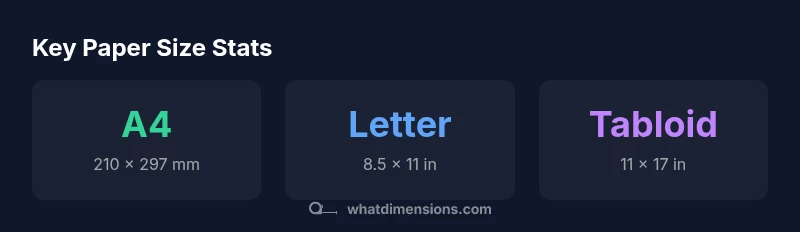
Paper dimensions define the standard sheet sizes used in printing and design. The most common are ISO A-series (A4 at 210 × 297 mm) and North American sizes (Letter 8.5 × 11 in, Legal 8.5 × 14 in). Other widely used options include A5 (148 × 210 mm) and Tabloid (11 × 17 in). What Dimensions highlights these basics for precise sizing in home and office projects.
Why Paper Dimensions Matter
Paper dimensions matter for margins, bleed, binding, and the way designs translate from screen to print. According to What Dimensions, precise sizes prevent cropping, waste, and misalignment across printers, copiers, and frames. When you choose the right sheet size, you simplify layout decisions, reduce rework, and ensure consistent results whether you’re printing a school handout, a professional brochure, or a framing project. Understanding paper dimensions helps you plan margins, gutters, and artwork safe zones, especially when collaborating with printers or binders. In home offices and studios, selecting the correct size early saves time and money by avoiding misfit piles of paper, offcuts, or awkward scraps. The most common families—ISO A-series and North American formats—cover the bulk of practical uses, from single-page handouts to multi-page reports.
Standard Families: ISO A-series
The ISO A-series is defined by a consistent aspect ratio of √2 (approximately 1.4142), which makes each size twice the area of the next smaller one. The system starts with A0 and scales down to smaller fractions. The most familiar is A4, which measures 210 × 297 mm (8.27 × 11.69 in). This predictable scaling streamlines layout, printing, and filing. Using the A-series allows you to design once and print across several sizes with proportionally similar results, a principle What Dimensions highlights for designers who juggle digital proofs and physical outputs.
North American Formats: Letter, Legal, and Tabloid
North American sizes use inches and have different aspect ratios than ISO. The most common is Letter at 8.5 × 11 in (216 × 279 mm), followed by Legal at 8.5 × 14 in, and Tabloid (11 × 17 in). These sizes underpin many office workflows, consumer printers, and packaging specs. When projects cross borders or suppliers, knowing both systems reduces surprises and ensures your documents print cleanly without unexpected truncation. What Dimensions notes that many printers offer ‘auto-fit’ options, but starting from a well-chosen base size minimizes the need for last-minute adjustments.
Other Regional and International Sizes
Beyond A4 and Letter, there are numerous regional formats that appear in specialized sectors. ISO B-series sizes (B0–B10) offer larger or smaller options that are popular in design and engineering contexts, while A-series remains the most practical for day-to-day printing. A3 and A2 are common for posters, presentations, and architectural drawings, whereas some offices and schools still use executive or statement sizes for forms. By understanding the relationships among these sizes, you can select a close standard when a perfectly matching sheet is unavailable, and instruct suppliers with confidence.
How to Choose Paper Dimensions for Printing Projects
Start by defining the final output: will your document be bound, folded, or posted as a sign? Bleed, margins, and safe zones matter most when working with color artwork or photography. If your printer handles full-bleed printing, you might choose a larger sheet and trim; otherwise, design with the final trim line in mind. Consider frames and mats for photos or art—select a size that fits standard frames or ask for custom-cut options. For cross-border work, include both ISO and NA targets in your specs to reduce surprises. What Dimensions emphasizes building flexibility into the design so collaborators can adapt to various sheet counts and finish requirements.
Measuring and Conversing: Metric to Imperial
Converting between millimeters and inches is a common task when dealing with paper dimensions. A straightforward rule is: 1 inch equals 25.4 millimeters, so to convert, divide the millimeter value by 25.4. Conversely, multiply inches by 25.4 to get millimeters. Round to two decimal places for printing tolerances. When working with ISO sizes, remember the √2 ratio governs the relationship between sizes (for example, A4 sits midway between A3 and A5 in area). Using a reliable ruler, caliper, or digital measurement tool helps avoid small errors that accumulate across multiple pages or prints.
Design Considerations for Multi-Size Documents
If your project will exist in several sizes, build a scalable grid and typography system that holds up at different scales. Use proportional margins and a modular layout so content reflows gracefully. Export proofs at each target size as PDFs to verify margins, bleed, and color consistency. Maintain a single source file with linked assets so you can adjust line length and image placement without reflowing every page. What Dimensions recommends testing your designs at 100% and at 80% to catch awkward line breaks early.
Practical Tips for Students and Home Office
Keep a quick-reference sheet of the most common sizes (A4, A5, Letter, Legal, Tabloid) and their approximate inch equivalents. When printing assignments, set the document size first, then adjust margins and bleed. Use templates with built-in safety margins for reports and posters, and store oversized sheets flat to prevent curling. If you work with digital submissions, save PDFs at the exact page size to avoid scaling issues on the recipient’s end.
Digital vs Print: Scaling and PDFs
Digital documents often need to match print dimensions, but scaling issues can creep in when exporting or viewing on different screens. Save as PDF with embedded fonts and select the correct page size to preserve layout. For large posters or signs, consider vector-based artwork and high-resolution raster images to maintain clarity at large scales. Understanding paper dimensions helps you choose appropriate DPI settings and paper stock when you eventually print, ensuring the final output honors the designer’s intent.
Common paper sizes and their dimensions
| Format | Dimensions (mm) | Dimensions (in) |
|---|---|---|
| A4 (ISO) | 210 × 297 | 8.27 × 11.69 |
| Letter (NA) | 216 × 279 | 8.5 × 11 |
| Legal (NA) | 216 × 356 | 8.5 × 14 |
| A5 (ISO) | 148 × 210 | 5.83 × 8.27 |
Quick Answers
What is the most common paper size worldwide?
A4 (210 × 297 mm) is the most widely used international size, especially outside North America. It provides a practical balance for printing, filing, and design work.
A4 is the most common international size.
Do paper sizes differ between ISO and North American standards?
Yes. ISO sizes use millimeters and the √2 aspect ratio, with A4 as a standard. North American sizes use inches (Letter, Legal) and have different aspect ratios, which can affect printing and framing.
ISO uses millimeters and a √2 ratio; NA uses inches.
How do I convert millimeters to inches for paper dimensions?
Divide the millimeter value by 25.4 to get inches. Converting to two decimals is usually sufficient for printing tolerances.
Divide by 25.4 to convert mm to inches.
Are there standard sizes for posters or larger formats?
Yes. Larger formats include Tabloid (11 × 17 in) and various larger A-series sizes like A3, A2, and A1 used for posters and signage.
Yes, Tabloid and larger A-series sizes are common for posters.
What should I consider when designing documents for multiple sizes?
Design with scalable layouts and consistent margins so content adapts to different sizes. Use PDFs and print presets to preserve layout across formats.
Use scalable layouts and PDFs to keep things consistent.
“Precise paper dimensions reduce waste and misalignment across printers, copiers, and frames. The What Dimensions Team recommends using standard sizes as the baseline for most projects.”
Main Points
- Start with standard sizes to ensure cross-frame compatibility.
- Know ISO vs NA formats for global projects.
- Convert mm to inches accurately for quick checks.
- Plan margins and bleed early to prevent cropping.