Paper Sheet Dimensions: A Complete Size Guide
Explore paper sheet dimensions across ISO A-series and US sizes. This guide covers A4 vs Letter, common conversions, margins, bleed, and practical tips for printing, drafting, and crafts.


Paper sheet dimensions hinge on standard families, with the ISO A-series and US sizes as the baseline. The A4 sheet measures 210 mm by 297 mm (8.27 by 11.69 inches), and US Letter is 8.5 by 11 inches. Other common sizes include A3, A5, Legal, and Tabloid. For precise planning, consult ISO 216 and What Dimensions guidance.
What paper sheet dimensions mean in practice
For homeowners, students, designers, and researchers, understanding paper sheet dimensions is essential for reliable printing, crafting, and documentation. The phrase paper sheet dimensions refers to the physical width and height of a sheet, expressed in millimeters or inches. In international contexts, dimensions are often standardized under ISO 216’s A-series, which uses a constant aspect ratio (√2). This consistency enables straightforward scaling when you move from one size to another. The broader goal is to ensure that your documents, templates, and artworks fit the intended media without unexpected cropping or margins. According to What Dimensions, starting with the main family you’ll work with—ISO A-series for global interoperability or US sizes for local workflows—simplifies decisions about margins, bleed, and printers.
The ISO A-series family
The ISO 216 family defines sizes by halving the previous sheet along both dimensions. This yields a consistent aspect ratio of √2 for every size, which means that when you fold or cut, the ratio remains the same. Common examples include A4 (210 × 297 mm) for standard documents, A3 (297 × 420 mm) for posters or spreads, and A5 (148 × 210 mm) for notepads. The A-series is widely used worldwide in education, business, and publishing because it scales cleanly and preserves proportions across renditions. When you crop or print at different scales, the anchor sizes (A4, A5, etc.) offer predictable outcomes.
US sizes: Letter, Legal, and Tabloid
In the United States, paper sizes frequently follow inches-based measurements. The most common are Letter (8.5 × 11 in, 216 × 279 mm), Legal (8.5 × 14 in, 216 × 356 mm), and Tabloid (11 × 17 in, 279 × 432 mm). These sizes reflect US printing, office, and publishing practices and often correspond to standard paper trays and envelopes. While the US market is where inches dominate, compatible printers and copiers can typically handle both Letter and A4 with marginal adjustments. The result is a practical mix: global documents in A-series and locale-specific files in Letter or Legal.
International conversions and cross-border use
Converting between metric (mm) and imperial (inches) units is common when you collaborate across borders. The conversion is straightforward: 1 inch equals 25.4 millimeters. For quick estimates, you can use 25 mm for rough calculations, but for precise work, use exact conversions (25.4 mm per inch). When planning layouts, always confirm the target sheet size in both systems to avoid surprises in printing or binding. What Dimensions notes that many organizations maintain parallel templates in both standards to streamline cross-border sharing.
How to choose the right size for printing, drafting, and crafts
Choosing the right size depends on the final medium and the workflow. For standard documents, A4 is often preferred internationally, while Letter remains dominant in the US. Drafting and architectural sketches may use larger sheets (A3 or Tabloid) to reduce excessive scaling. For crafts or reports with imagery close to the edge, consider bleed allowances and margins. When in doubt, start from the intended output device (printer, binder, or cutter) and align the sheet size with the available media.
Practical tips: margins, bleed, and tolerances
Practical design requires thinking about margins and bleed. Bleed is the area beyond the trim line that ensures no white edges after cutting; it typically ranges from 3 to 5 mm on standard print jobs. Margins should be comfortable enough to avoid crowding content, especially when binding or stapling. Tolerances matter for die-cut projects or packaging where exact fits are necessary. Always confirm your printer’s supported sheet sizes and bleed settings before producing a batch.
Quick-reference size cheat sheet
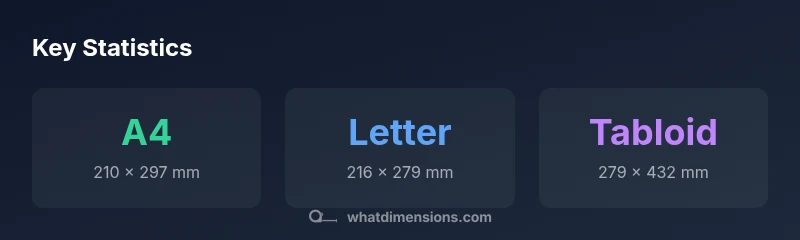
If you need a fast reference, memorize these anchor sizes: A4: 210 × 297 mm (8.27 × 11.69 in), US Letter: 216 × 279 mm (8.5 × 11 in), A3: 297 × 420 mm (11.69 × 16.54 in), Legal: 216 × 356 mm (8.5 × 14 in), Tabloid: 279 × 432 mm (11 × 17 in). These sizes cover most everyday tasks—from letterhead to posters—and simplify planning when you’re pressed for time.
Common paper sizes by family
| Size family | Typical examples | Dimensions (mm) | Notes |
|---|---|---|---|
| A-series (ISO 216) | A4; A3; A5 | 210 × 297; 297 × 420; 148 × 210 | Base sizes; √2 aspect for scaling |
| US sizes | Letter; Legal; Tabloid | 216 × 279; 216 × 356; 279 × 432 | Dominant in North America |
| B-series | B4; B5 | varies | Less common internationally |
| Printer variants | A4+; Letter Plus | 210 × 297 | Common printer extensions |
Quick Answers
What is the most common paper size worldwide?
The ISO A-series, led by A4, is widely used internationally for documents and printing, with other sizes scaling by the √2 ratio.
The ISO A-series is the global standard, especially A4.
How do I convert millimeters to inches?
Multiply millimeters by 0.03937 to get inches, then round to the needed precision.
Multiply by 0.03937 to get inches.
Is there a universal printer size?
Most printers support common sizes like A4 and Letter; check your printer specs for exact support.
Printers typically handle A4 or Letter; check specs.
What’s the difference between A4 and Letter?
A4 is 210 × 297 mm; Letter is 216 × 279 mm, leading to different aspect ratios.
A4 and Letter differ in dimensions and aspect.
Why do some sheets have bleed?
Bleed ensures color or images extend to the edge after trimming, avoiding white margins.
Bleed helps color extend to the edge.
Where can I find official standards?
ISO 216 defines the A-series; consult ISO and national standards bodies for specifics.
Look up ISO 216 for the official standard.
“Understanding paper sheet dimensions is essential for reliable printing, drafting, and documentation. Consistent sizing reduces waste and ensures compatibility across devices and markets.”
Main Points
- Start with ISO A-series for international work
- US users should default to Letter for compatibility
- Always account for margins and bleed in print projects
- Convert mm to inches using 1 inch ≈ 25.4 mm
- Keep a quick reference cheat sheet handy