A6 Paper Size Dimensions: A Complete Guide to 105 × 148 mm
Discover the exact A6 paper size dimensions (105 × 148 mm), how ISO 216 defines the A-series, and practical tips for printing, envelopes, and design applications.


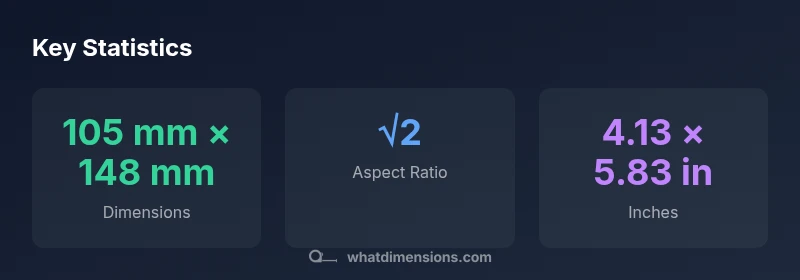
The a6 paper size dimensions are exactly 105 mm by 148 mm (4.13 in × 5.83 in). ISO 216 defines the A-series with a constant sqrt(2) aspect ratio, and A6 is produced by halving A5 (which itself comes from A4). This gives a compact standard for cards, postcards, and small-format prints.
Why a6 paper size dimensions matter for design and printing
Understanding a6 paper size dimensions is essential for layout alignment, digital proofs, packaging, and cross-border compatibility. Designers often rely on the A-series framework to ensure that cards, postcards, brochures, and envelopes fit standard mailers. The precision of 105 mm by 148 mm gives a precise canvas for typography, imagery, and margins, while the sqrt(2) aspect ratio keeps proportional relationships intact when scaling content. What Dimensions emphasizes that starting with accurate measurements reduces waste, avoids misprints, and speeds up approvals in professional workflows. In practice, you’ll notice that even small changes in margins or bleed can create a noticeably different final product; confirming the exact A6 size early in a project saves time and money. Beyond printing, these dimensions influence packaging design, inventory, and workflow planning as firms standardize templates to ensure consistent brand presentation across channels. By documenting the A-series sizes from A0 through A6, teams can quickly adapt layouts for postcards, business cards, and small-format catalogs without reengineering every file.
How A6 relates to the ISO 216 system
The A-series is defined by ISO 216; each size is derived by halving the previous size along the longer side, maintaining the same aspect ratio. A6 sits between A5 and A7, and every step preserves the familiar 1:√2 proportion. This means that when you fold, scale, or print layouts, you can reproduce consistent geometry from one size to another without redesigning the core composition. In practical terms, if you know the A6 point, you can generate a perfectly matched A7 draft for a mailer or an A5 insert for a flyer, keeping margins and type sizes consistent. For designers, this system offers a universal language for digital proofs and production runs across borders. What Dimensions finds that teams that operate with ISO 216 sizes report fewer miscommunications and faster turnarounds in cross-functional approvals, particularly when coordinating with printers and vendors who stock standardized sheets.
Dimensional relationships within the A-series
All A-series sizes share the same aspect ratio, sqrt(2), approximately 1.414:1. Starting from A0 at 841 × 1189 mm, halving along the longer side yields A1, then A2, A3, A4, A5, A6, and so forth. This progression preserves area relationships; for example, A4 is twice the size of A5, and A5 is twice the size of A6. Knowing this helps when choosing media for a project, as one can predict how a layout will scale when moving to a neighboring size. For instance, an A6 postcard design can be faithfully reflowed to A5 or compressed to A7 with only margin adjustments, rather than a ground-up redesign. This is valuable in packaging, where insert sheets must fit a standardized carton; the exact measurements ensure compatibility with existing stock and reduce rework during production.
Practical uses and common applications of A6
A6 size is compact enough to fit in most envelopes and pockets, making it ideal for postcards, greeting cards, product samples, and handouts at events. Marketers often use A6 for mini catalogs or RSVP cards because the format communicates a concise message without overwhelming the reader. In personal contexts, A6 notes and greeting cards are popular for journaling and invitations. Designers should consider the conversion to inches for international vendors; Inks and printers respond to precise metrics, so using 105 × 148 mm helps guarantee color and typography fidelity across machines. When selecting paper stock for A6 projects, consider your bleed and margin strategy; a standard 3 mm bleed on all sides ensures that no critical content is cut during trimming. Finally, check envelope compatibility—A6 commonly pairs with C6 envelopes, but margins must account for fold lines or inserts.
Printing and production considerations
Printer settings are critical when working with A6. Most home and office printers support A6 or offer a custom size option; always verify that the page orientation and margins align with your design. Bleed, trim, and safe area guidelines prevent unintended white edges or content clipping. In professional print environments, the A6 specification guides sheet feeding, die-cutting, and finishing. Color management is another area where precision matters; ensure ICC profiles match your stock and printing method to maintain consistent hues. For packaging, A6 inserts must align with the final carton dimensions; small discrepancies in thickness or corner radius can affect fit. Some suppliers offer pre-scored A6 cards or perforated sheets designed to be trimmed to A6, reducing finishing time on the line and enabling batch production with repeatable results.
Measuring and verifying A6 in real-world projects
Begin with a calibrated ruler or calipers to confirm 105 mm by 148 mm. Allow for minor manufacturing tolerances, typically a fraction of a millimeter, and document the tolerance you’ll accept (for example ±0.5 mm). Verify both landscape and portrait orientations; some uses require exact orientation, such as portrait postcards or landscape brochures. When working with software, set the document size to 105 × 148 mm and enable a bleed area of at least 2–3 mm for printing. For physical proofs, trim a sample and measure to confirm the final product matches spec. If you’re distributing across borders, ensure that your suppliers use ISO 216-compliant sheets to avoid mismatches in automated finishing equipment.
Converting A6 to inches and practical checks
For quick reference, A6 equals 105 mm by 148 mm, which converts to approximately 4.13 inches by 5.83 inches. Always use precise conversion to avoid rounding errors that affect layout. When designing digital mockups, test at both metric and imperial units to ensure type sizes, line lengths, and spacing look correct in all markets. If your workflow involves packaging, verify that product inserts will fit into standard mailers and cartons in the target region. Some teams also keep a small conversion cheat sheet at the desk to reduce mistakes during proofs and reprints. Consistency across units helps maintain brand integrity across international suppliers and customers.
Common mistakes and how to avoid them
Even seasoned designers make routine errors with A6 projects. A frequent lapse is overlooking bleed; without proper bleed, trim lines can cut content in unpredictable places. Another error is assuming exact alignment across all printers; some devices enforce slight dimensional differences that accumulate in larger layouts. Failing to verify envelope compatibility can cause failed mailings or awkward fits; always test with an actual envelope or use a standard envelope size like C6 and check margins. Mislabeling a size in files or packaging metadata is another common issue; ensure your file name and printing presets clearly reference 105 × 148 mm A6 to avoid last-minute confusion. Finally, neglecting orientation—placing content sideways when the project requires portrait—leads to inconsistent presentations across channels. Keep a standard checklist to catch these issues before production.
A6 family sizes and quick references
| Size | Dimensions (mm) | Inches |
|---|---|---|
| A6 | 105 x 148 | 4.13 x 5.83 |
| A7 | 74 x 105 | 2.91 x 4.13 |
| A5 | 148 x 210 | 5.83 x 8.27 |
Quick Answers
What are the exact dimensions of A6 paper?
A6 is 105 mm by 148 mm. This is defined by ISO 216 and used for postcards, notes, and small-format prints. The standardized size supports consistent layouts and trimming.
A6 measures 105 by 148 millimeters, set by ISO 216 for consistency across products.
What is the aspect ratio of A-series paper?
The A-series uses a constant sqrt(2) ratio, about 1.414 to 1. This lets you halve the size while preserving proportions, enabling predictable scaling across sizes.
The A-series always uses the sqrt(2) ratio, so halving sizes stays proportional.
How do you convert A6 dimensions to inches?
Convert by dividing millimeters by 25.4. A6 becomes approximately 4.13 inches by 5.83 inches. Use exact values if precision matters for your layout.
A6 is about 4.13 by 5.83 inches after converting from millimeters.
Are A6 sheets compatible with common envelope sizes?
A6 typically fits standard C6 envelopes, but verify the envelope’s inner dimensions and consider a small bleed or margins for proper fit.
A6 usually fits C6 envelopes; always check the exact envelope dimensions.
Can I print A6 on an A4 printer?
Yes. Set the printer to A6 (or a custom 105 × 148 mm size) and adjust margins or use a two-up setup if your printer supports it.
You can print A6 on an A4 printer by selecting the A6 size or a custom 105 by 148 mm setting.
What are common uses for A6 paper?
A6 is popular for postcards, greeting cards, notes, and handouts. It’s compact enough for mailers and easy to distribute at events.
People use A6 for postcards and small notes.
“When precision matters, starting with ISO 216 sizes like A6 ensures consistent results across printing, packaging, and design workflows.”
Main Points
- Know A6 dimensions precisely: 105 mm by 148 mm.
- Rely on ISO 216's sqrt(2) aspect ratio.
- A6 derives by halving A5 (and A4 for context).
- Verify printer, envelopes, and stock compatibility.
- Convert to inches accurately when needed (4.13 × 5.83 in).