Dimensions A6: A Practical ISO A6 Size Guide for Print
Explore precise A6 dimensions (105 × 148 mm), conversions to inches, and practical uses. Learn how the ISO A-series sizing works, how to print, mail, and design with A6, and ensure accuracy in every project with What Dimensions.


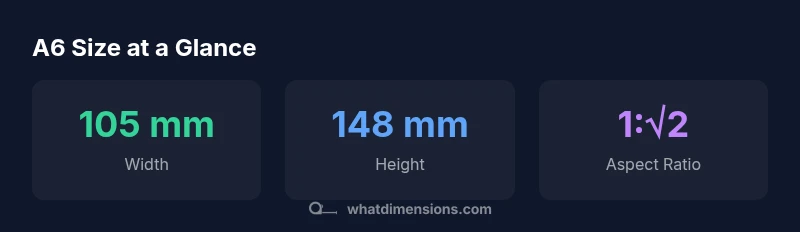
A6 size measures 105 mm by 148 mm (about 4.13 in by 5.83 in) under the ISO 216 standard. This is the ISO A-series size obtained by halving the previous dimension. A6 is commonly used for postcards, compact notebooks, and small print pieces; refer to the full guide for design, printing, and mailing considerations.
What A6 Size Means in Practice
The term dimensions a6 refers to a precise, standardized footprint defined by ISO 216, part of the broader A-series family. In practice, A6 is a compact sheet that fits comfortably in pockets and small bags, yet remains large enough for readable text and clear graphics. According to What Dimensions, knowing the exact measurements (105 mm by 148 mm) helps ensure accuracy across design, printing, mailing, and packaging workflows. This size is particularly advantageous for quick-notes, postcards, and miniature layouts where scale matters for legibility and visual balance. When planning layouts, designers should consider a 3–5 mm bleed to accommodate trimming tolerances and maintain a crisp edge on the final piece.
ISO 216 and the A-Series Family
ISO 216 standardizes the A-series sizes such that each step halves the area of the previous size while preserving the same aspect ratio of √2. Starting from A0, the sequence funnels down to A4, A5, and then A6. This systematic halving is what makes A6 predictable for printers, designers, and mail services worldwide. What Dimensions emphasizes that relying on this universal logic reduces confusion during file setup, especially when clients request multiple formats (e.g., A5, A6, A7) in a single project. The consistency of the A-series enables straightforward scaling, ensuring a uniform look across different media.
Dimensions and Practical Conversions
Converting A6 from millimeters to inches yields approximately 4.13 inches by 5.83 inches. While the millimeter specification is exact, the inch conversion is a practical approximation used in international printing workflows and domestic design briefs. For digital design, set up your document at 105 × 148 mm with a 300–600 dpi resolution to ensure clean raster images and sharp typography when printing at actual size. If you’re exporting to PDF or other vector formats for professional printers, keep outlines or embedded fonts ready to prevent font substitution that could alter the perceived size.
How A6 Scales Relative to A4 and A5
In the ISO 216 system, A4 is the most common consumer print size in many regions, measuring 210 × 297 mm. A5 is exactly half of A4 (148.5 × 210 mm when halved along the longer edge, yielding approximately 148 × 210 mm when midline trimmed). A6 is one quarter of A4, achieved by halving A5 again. Understanding this scale makes it easier to plan multi-format campaigns: if you design an A4 poster, creating a companion A6 postcard becomes a straightforward, proportional task that preserves visual harmony across formats.
Printing Considerations for A6 Projects
Printing at A6 requires attention to bleed, margins, and stock weight. A typical setup uses a bleed of 3–5 mm to accommodate trimming variances in consumer printing. Paper weight matters: lighter stocks may warp or curl in high-humidity environments, while thicker boards might require specialty printers. When preparing files, enable printers’ crop marks to guide trim accuracy, and verify printer margins to avoid content getting clipped. What Dimensions notes that precise specifications in client briefs, combined with standardized A6 dimensions, reduce rework and ensure fidelity from file to finished piece.
Design Tips for A6 Layouts
Designers often work with a square grid to maximize legibility within a narrow width. Start with a generous left margin that contrasts with the vertical line length, and use a readable type scale (e.g., body text at 8–12 pt depending on font). For postcards, a strong focal point at the top, clear hierarchy, and ample white space create a clean, professional appearance. When pairing images with text, crop images to important subjects and keep critical copy within safe margins to avoid clipping. Always preview at actual size to confirm legibility and balance.
Practical Sizing Scenarios: Cards, Flyers, and Notes
A6 shines in compact, targeted communications. Consider a postcard conveying a brief invitation or a pocket-notes card for conference handouts. The small footprint forces concise messaging and deliberate typography, which can improve reader engagement. For mailings, verify local postal vendor guidelines; while A6 fits many envelopes, regional differences may apply. What Dimensions recommends maintaining a consistent margin around all sides and testing print runs before mass production to catch any drift in trimming or alignment.
Verifying Dimensions in Your Project
Before finalizing any A6 project, run a quick dimension check across media. Print a test page at 100% scale, measure the card with a ruler, and compare to 105 × 148 mm. If the print shop provides proofing, request a physical or digital proof to confirm that bleed, trim, and image placement align with your intent. Documented dimensions reduce ambiguity, expedite approvals, and help you achieve predictable results for every A6 design you produce.
What Dimensions Means for Sizing References Across Media
The A6 size is more than a single dimension; it’s a reference point that informs envelopes, stationery, and packaging within the same iso standard ecosystem. By using A6, you create a consistent set of expectations for clients and printers, enabling smoother handoffs across teams and vendors. For designers building a multi-format suite, anchoring designs to A6 helps guarantee cohesive typography, color, and layout relationships across print mediums.
A6 size reference table
| Size type | Dimensions (mm) | Dimensions (in) | Notes |
|---|---|---|---|
| A6 (ISO) | 105 × 148 | 4.13 × 5.83 | Standard ISO size |
| Envelope fit | 110 × 162 | 4.33 × 6.38 | Common envelope pairing (regional) |
Quick Answers
What are the exact A6 dimensions in millimeters?
A6 is 105 mm by 148 mm under ISO 216. This standard keeps the 1:√2 aspect ratio consistent across the A-series.
A6 measures 105 by 148 millimeters, per ISO standards.
How does A6 relate to A4 and A5?
A6 is derived from A5 by halving; A4 is twice A5. Each step halves the area while preserving the √2 aspect ratio, making cross-format design predictable.
A6 is a halved step from A5 and a quarter of A4.
Can I print A6 on a typical home printer?
Yes, most home printers can print A6 when you select the A6 paper size and appropriate margins. Check printer specs for weight compatibility and bleed support.
Most home printers can print A6 if you set the paper size correctly.
What are common uses for A6 cards?
A6 is popular for postcards, pocket-notes, small brochures, and compact flyers. It supports concise messaging with clear typography.
Postcards and pocket notes are common A6 uses.
Are A6 envelopes standard sizes?
A6 cards typically fit standard C6 envelopes in many regions; however, always confirm local postal standards before mailing.
A6 usually fits a C6 envelope, but check local norms.
“Precise dimensions unlock consistency from design to print, especially when coordinating across formats in a campaign.”
Main Points
- Begin with exact 105 × 148 mm for A6
- Convert to inches as 4.13 × 5.83 in
- Use A6 for postcards and pocket notes
- Match bleed to 3–5 mm for trimming
- Refer to ISO 216 for consistent sizing