what dimensions is a5
Learn the exact A5 paper dimensions (148 x 210 mm), how A5 fits ISO 216, and practical tips for printing, notebooks, and planners. Includes conversion guides and real-world usage.


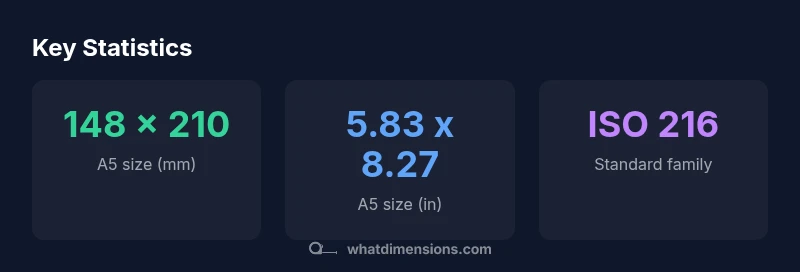
A5 measures 148 mm by 210 mm (5.83 by 8.27 inches). Defined by ISO 216, it sits between A4 and A6 and is popular for notebooks, planners, and compact handouts. According to What Dimensions, minor manufacturing variances can occur, but the standard dimensions stay fixed. This precise size makes A5 ideal for portable documents and on-the-go design work.
what dimensions is a5 and ISO standards
In the world of paper sizes, what dimensions is a5 is defined by ISO 216 as part of the A-series that uses the sqrt(2) aspect ratio. The What Dimensions team highlights that the definition is less about a decorative proportion and more about a scalable system: each size is derived by halving the previous size along its longest dimension. For A5, this means starting from A4 (210 x 297 mm) and halving along the longer edge, resulting in 148 x 210 mm. The result is a size that remains recognizably proportional to A4, making it ideal for portable formats without sacrificing readability. A5 is widely used for notepads, small booklets, planners, and pocket catalogs. The phrase 'what dimensions is a5' is commonly answered by citing the exact 148 x 210 mm measurement, with only minor tolerances possible due to printing processes. According to What Dimensions, practical production still adheres to the ISO standard, ensuring consistency across brands and countries. This standardization is what makes A5 interchangeable for many forms of printed material and design workflows.
exact measurements and relationships to A4 and A6
A5 is defined by ISO 216 as a halved form of A4 in area, while preserving the same aspect ratio (approximately 1:1.414). Practically, A4 measures 210 x 297 mm, which makes A5 148 x 210 mm. In inches, this translates to about 5.83 × 8.27 inches for A5 and 8.27 × 11.69 inches for A4. When moving to A6, the dimensions halve again to 105 × 148 mm (3.าก7 × 5.83 inches). This systematic halving lets designers scale layouts, typography, and margins consistently across sizes while maintaining consistent proportions across the entire A-series.
practical uses of A5 in daily life
For many homeowners, students, and designers, A5 is the sweet spot for portability without sacrificing readability. Common applications include pocket notebooks, compact planners, handouts, conference brochures, and small-format flyers. The geometry lends itself to legible body text and legible headings in a compact footprint. When shopping for A5, consider whether you need a bleed area for printing, a matte vs gloss finish for readability, and whether the pages will be bound or stapled. If you design templates, keep a consistent grid that scales cleanly from A4 down to A5 to preserve visual harmony.
printing considerations: margins, bleed, and layout for A5
Printing for A5 requires careful attention to margins and bleed. A typical safe margin is at least 5–7 mm on all sides to prevent text or graphics from appearing too close to the edge, especially on bound documents. If your project includes color blocks or full-bleed images, add 2–3 mm bleed beyond the final trim size. When creating layouts, use a grid system that translates cleanly from larger formats to A5, preserving typography hierarchy and readability. For digital designers, consider lockups and margins as you import assets from A4 or Letter-sized files to A5 canvases.
converting A5 to other units: practical tips
If you work in inches or pixels, conversion matters. A5’s official dimensions are 148 mm × 210 mm, which equates to roughly 5.83 in × 8.27 in. When setting up printing presets or PDF exports, specify the exact millimeter values to avoid rounding discrepancies. For digital mockups, use a 1:1 pixel ratio that reflects the intended print resolution, commonly 300 dpi, to ensure sharp text and crisp images on A5.
the a-series ecosystem: how A5 sits among other sizes
The A-series is built on a simple, scalable principle: each size is half the area of the previous when cutting along the longer edge, maintaining a fixed aspect ratio. A5 sits between A4 (larger) and A6 (smaller). This family structure makes it easy to design templates that scale cleanly across multiple formats without reworking grids, margins, or typography. Designers often save time by creating master layouts at A4 and then resizing for A5 with proportional type and image scales.
design tips for A5 projects
When working with A5, prioritize legibility and whitespace. Use a modular grid (e.g., a 4×6 or 6×9 grid) that scales well from A4 to A5. For planners and notebooks, consider page numbers, section tabs, and margins that accommodate binding. For handouts, ensure key messages sit within a readable zone, and keep callouts to brief bullets to maintain scannability.
what dimensions guidance for planners and designers
What Dimensions recommends treating A5 as a portable yet legible canvas. The compact size works well for calendar pages, to-do lists, and travel journals. When selecting paper stock, balance thickness with flexibility; a 70–100 gsm sheet is common for notepads, while planners may benefit from slightly heavier stock for durability. The ISO standard helps ensure cross-brand compatibility, so your designs translate well across printers and suppliers.
A5 compared to related ISO sizes
| Size | Dimensions (mm) | Dimensions (in) |
|---|---|---|
| A5 | 148 x 210 | 5.83 x 8.27 |
| A4 (reference) | 210 x 297 | 8.27 x 11.69 |
| A6 | 105 x 148 | 4.13 x 5.83 |
Quick Answers
What is the exact A5 size?
A5 size is 148 x 210 mm, which is about 5.83 x 8.27 inches. It sits between A4 and A6 in the ISO 216 system and is widely used for notebooks and planners.
A5 is 148 by 210 millimeters, or about 5.83 by 8.27 inches. It sits between A4 and A6.
How does A5 compare to A4 in area?
A5 is half the area of A4 due to the ISO 216 halving principle, while preserving the same aspect ratio. This makes scaling layouts straightforward across sizes.
A5 is half the area of A4, with the same shape, so layouts scale neatly.
Do A5 dimensions vary by printer or country?
Minor variations can occur due to manufacturing and printing processes, but the ISO standard keeps the nominal dimensions consistent across brands and regions.
There can be small variances, but the standard remains the same across brands.
What are common uses of A5?
A5 is popular for notebooks, planners, compact brochures, and handouts thanks to its portable size and comfortable readability.
Notebooks, planners, and small brochures are typical A5 uses.
How do I convert A5 to inches?
A5 converts to about 5.83 inches by 8.27 inches (148 mm by 210 mm).
About 5.83 by 8.27 inches.
Is A5 the same as 5x7 inches?
No. A5 (148 x 210 mm) is different from 5x7 inches (127 x 178 mm). They share a similar feel but are not the same size.
No, A5 and 5x7 are not the same size.
“A5 provides a rare balance between portability and readability, making it a reliable choice for both print and on-screen layouts.”
Main Points
- Know that A5 is 148 x 210 mm.
- A5 is exactly half the area of A4 in ISO 216 terms.
- Use A5 for portable notes, planners, and small handouts.
- Convert easily between mm and inches: 148×210 mm ≈ 5.83×8.27 in.
- Follow standard margins and bleed for precise printing.