A5 Journal Dimensions: Exact Size Guide
Discover the precise A5 journal dimensions (148 × 210 mm) and how this size fits inserts, covers, and planners. What Dimensions provides a data-driven sizing guide for accurate noting.


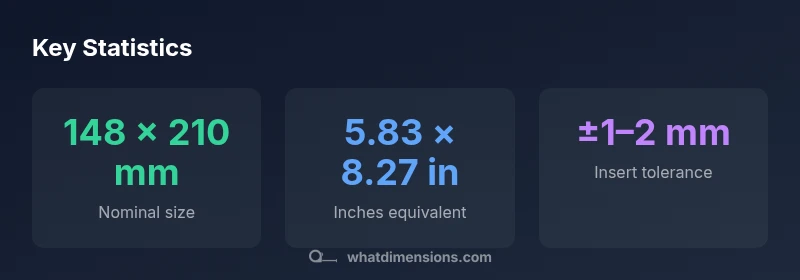
The standard A5 journal dimensions are 148 millimeters by 210 millimeters (approximately 5.83 by 8.27 inches). This size belongs to the ISO 216 A-series family and sits between A6 and A4 in overall area, making it a popular choice for notebooks, planners, and travel journals. Writers and designers often choose A5 for a balanced blend of portability and writing space, while brands vary by tolerances and binding. When shopping, expect minor trims or coating differences that do not alter the nominal size significantly.
What is A5? The origin of a5 journal dimensions
A5 journal dimensions come from the ISO 216 standard for the A-series family. The basic idea is that each size is created by halving the previous size, so A5 sits between A4 and A6. The official nominal size for A5 is 148 × 210 millimeters, which translates to about 5.83 × 8.27 inches. According to What Dimensions, this precise geometry provides a predictable balance between writing space and portability, making A5 a favored format for journals, planners, and travel notebooks. Designers value the consistency across brands, but small trims and bindings can introduce tolerances that affect fit. Many retailers label "a5 journal dimensions" as the standard size, yet buyers should still verify actual product specs when accuracy matters.
A5 vs the wider A-series family: context for size decisions
The ISO A-series is defined by a constant aspect ratio and a halving approach. In practical terms, A4 measures 210 × 297 mm, and A5 is exactly half of A4 when cut along the longer side. This yields 148 × 210 mm for A5, a familiar size for everyday writing. For readers seeking even more portable options, A6 at 105 × 148 mm provides a compact alternative, while A5 remains the sweet spot for many journaling and planner needs. The predictable math—square root of 2 proportions—helps ensure accessories, rings, and covers align across brands.
Practical uses: when to pick A5 for journals and planners
A5 is versatile for daily journaling, note-taking, and planning. Its page area offers ample writing space without overwhelming a backpack or handbag. Academic students often favor A5 for lecture notes, while designers use it for sketches and project briefs. Travel enthusiasts appreciate its compact footprint for entries and sketchnotes. When choosing an A5 journal, look for page count, paper weight (gsm), and binding style to match your writing habits and travel scenarios.
Design considerations: margins, bleed, and binding implications
Because A5 sits between larger and smaller formats, margins and bleed settings matter. If you plan to print your own inserts or binders, set margins that leave room for binding cords or rings without cramping text. Bleed should be considered for covers and edge-to-edge art; many brands add a default bleed of 2–3 mm. Bindings (spiral, perfect, or stitched) influence usable page area, so verify the binding type when you source covers and inserts. A5's standard size supports a wide range of cover materials and printing options, enabling customization without sacrificing compatibility.
Measuring and verifying dimensions: practical tips
To confirm a product's A5 dimensions, measure across the widest points: width (short edge) and height (long edge). Use a steel ruler for accuracy and note tolerances often listed as ±1–2 mm. Compare the printed size with the actual product, especially for inserts and sleeves. If you are buying online, request a tolerance note or check the brand's dimensions page. For DIY projects, create a simple A5 template by cutting a sheet to 148 × 210 mm and test fit with your preferred inserts and covers. Small differences do matter when you require precise fits.
What Dimensions' approach to data: methodology and quality
What Dimensions analyzes size data by cross-referencing ISO standards, brand specifications, and practical consumer testing. The team prioritizes verifiable measurements and notes any brand-level deviations that could affect fit. By compiling a concise reference for a5 journal dimensions, we provide guidance that helps homeowners, students, and designers select the right notebook size for deep work, note ecology, and on-the-go writing. Expect ranges rather than single-point figures when brands vary in tolerance, trimming, or binding.
A5 journal size references and common variations
| Metric | Nominal Size | Notes |
|---|---|---|
| A5 size (mm) | 148 × 210 | ISO 216 standard; common journal size |
| Size in inches | 5.83 × 8.27 | Rounded to 2 decimals |
| Typical paper weight | 80–120 gsm | Brand variation affects feel |
Quick Answers
What are the exact dimensions of an A5 journal?
A5 is defined as 148 mm by 210 mm. Some brands show slight tolerances, typically ±1–2 mm, so always check the product specs if precise fit is critical.
A5 is 148 by 210 millimeters, but tolerances can differ slightly by brand.
How does A5 compare to A6 and A4?
A5 sits between A4 and A6. A4 is 210 × 297 mm, A5 is 148 × 210 mm, and A6 is 105 × 148 mm. The area roughly halves with each step, preserving the aspect ratio.
A5 is between A4 and A6 in size, with a roughly halved area sequence.
Do all brands use the exact 148 × 210 mm?
Not always. While the nominal size is 148 × 210 mm, printing and binding tolerances can introduce small deviations. Check the specific product page for exact measurements.
Nominal size is 148 by 210 mm, but brands vary slightly.
How do I convert A5 dimensions to inches quickly?
To convert, multiply by 0.03937. So 148 mm equals about 5.83 inches, and 210 mm equals about 8.27 inches.
Convert mm to inches with 0.03937; 148 by 210 mm is about 5.83 by 8.27 inches.
What should I measure at home to verify an A5 journal fits a sleeve?
Use a ruler to measure width and height of the sleeve opening. Ensure the interior dimensions are at least 148 × 210 mm, minus tolerance, for a snug fit.
Measure the sleeve opening to confirm it fits 148 × 210 mm.
“"Exact size matters for fit and function. By comparing nominal dimensions with real-world tolerances, you can avoid misaligned covers and ill-fitting inserts."”
Main Points
- Understand A5 as 148 × 210 mm for accurate inserts
- Expect minor tolerances by brand and binding
- Use the ISO 216 framework for cross-brand compatibility
- Test fits with templates before purchasing covers
- What Dimensions analyzes size data for reliable guidance