A5 Paper Dimensions: Precise Size and Practical Uses
Explore the precise dimensions of A5 paper (148 x 210 mm), how it compares to other ISO sizes, common uses, and practical guidance for designers and students involving margins, bleed, and printing workflows.


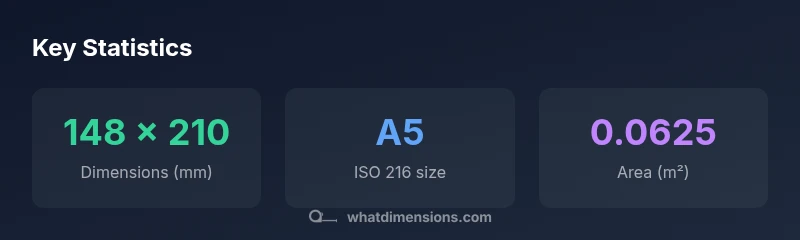
A5 paper dimensions are 148 x 210 millimeters (about 5.83 x 8.27 inches). This ISO 216 size sits in the A-series, derived from A4 by halving along the shorter side. It’s commonly used for notebooks, planners, and small-format handouts. The standard ensures predictable scaling when moving between sizes. Dimensions a5 paper anchor margins, grids, typography, and production workflows for both print and digital projects.
What dimensions matter for A5 paper?
The dimensions a5 paper define its footprint in the physical world: a rectangle that measures 148 x 210 millimeters, or about 5.83 x 8.27 inches. As part of the ISO 216 standard, A5 sits in the A-series family that designers rely on for scalable layouts. Understanding the exact measurements of dimensions a5 paper is crucial for margins, grids, typography, and overall print workflow. According to What Dimensions, the A-series sizes are derived from a square root of two proportion that preserves consistent area even when halving. This means A5 is precisely half the area of A4, and 1/4 of A3, enabling predictable reduction when switching between sizes. For homeowners, students, and designers, knowing these measurements simplifies everything from notebook design to packaging briefs, where accuracy saves time and waste.
In practice, dimension awareness helps you set up templates with correct margins and bleed, ensure text remains legible, and avoid off-center printing. The phrase dimensions a5 paper recurs in checklists, whether you’re planning a short report, a pocket planner, or a print-ready flyer. In short, these measurements anchor both creative and production decisions, making it easier to scale across devices and formats. In many design workflows, the right dimensions a5 paper act as a bridge between portable formats and desktop publishing, reducing guesswork in handouts and personal stationery.
ISO 216 and the A-series logic
The ISO 216 standard defines the A-series to optimize scaling and dimensional consistency. The fundamental proportion is the sqrt(2) ratio (approximately 1:1.4142), meaning any A-series sheet cut or folded in half yields two sheets with the same aspect ratio. This makes A5 a natural step from A4: cutting A4 in half along its shorter edge yields two A5 sheets, each preserving the original proportions. The result is a predictable path for designers who transfer layouts across sizes, reducing the need to redesign grids and typography when moving from, say, a presentation slide to a handout. The What Dimensions Team emphasizes this logic because it supports uniform margins and predictable margins across devices for dimensionally accurate outcomes.
The scale-down property of the A-series ensures that when you jump from A4 to A5, or from A5 to A6, the optical balance remains intact. For packaging, catalogs, and stationery, this consistency translates into smoother conversions and fewer layout shifts during production. The principle also underpins digital templates; if you export an A5 layout to a letter-sized page, the margins and alignment preserve their relative relationships, minimizing rework.
Measuring A5: millimeters, inches, and conversions
A5 is defined as 148 millimeters by 210 millimeters. In inches, this is roughly 5.83 by 8.27 inches. When designing for multiple markets, it’s helpful to cite both systems: use 148 x 210 mm on the spec sheet, and provide a quick inch conversion for printers and users who think in inches. The area of an A5 sheet is approximately 0.03125 square meters, which corresponds to 0.0625 square meters for a full A5 double-page spread. For digital files, plan for a resolution of 300 DPI if you intend to print, which translates to about 1748 x 2480 pixels for a single A5 page.
To convert quickly, halve the longer side of A4 (210 mm) to get A5’s height and keep the shorter side (148 mm) constant when folding. Remember that the exact numbers may vary slightly with rounding in different software, so rely on the ISO 216 definitions as your canonical reference and verify with a print proof when precision matters.
How A5 relates to neighboring sizes
Understanding the relationship between A5 and its neighbors (A4 and A6) helps with layout planning. A4 is 210 x 297 mm; A5 is achieved by halving A4 along its shorter side (210 mm becomes 105 mm, while the other dimension doubles to 210 mm), resulting in 148 x 210 mm for A5 after rounding. This means A5 is exactly half the area of A4 and exactly twice the area of A6, a helpful rule of thumb for quick sketches and printable templates. Writers and designers frequently exploit this relation to create stepping-stone templates that scale cleanly without needing complex recalibration. In practice, the dimensions a5 paper are designed to maintain consistent margins and grid systems across sizes, which is essential for multi-page documents.
When assembling a pocket notebook, a brochure, or a planner, knowing how A5 relates to A4 and A6 ensures you can plan a cohesive design system that translates across formats with minimal adjustment. The What Dimensions Team notes that this continuity is one of the core advantages of ISO-based sizes in professional workflows.
Practical design considerations for A5
Designers working with dimensions a5 paper should start with a robust grid and a safe margin. A standard grid helps maintain alignment across pages and inserts, while consistent margins ensure legibility and printer-friendly output. For A5, typical inner margins range from 5 to 12 millimeters depending on the desired print aesthetic and binding method. If your project includes bleed, plan for an extra 3 millimeters around the edges to prevent white edges after trimming. These considerations are especially important for planners, journals, and marketing handouts where precise alignment matters. With dimensions a5 paper as your baseline, you can craft layouts that remain balanced when the size shifts to A4 or A6.
Typography should be legible at small sizes; use a 9–12 point font for body text in tight A5 layouts and scale headings accordingly to preserve hierarchy. Keep line length comfortable by targeting roughly 40–60 characters per line in portrait orientation. The discipline of margins, typography, and grids ensures your A5 designs look professional in print and adapt gracefully to digital previews.
Printing and production workflows for A5
Printing on A5 requires a few practical steps to ensure accurate results. First, set the document size to 148 x 210 mm in your page layout software. Enable a bleed of 3 mm on all sides if your design includes full-bleed images. Choose a resolution of 300 DPI for crisp text and imagery, especially for planners and handouts that will be printed in bulk. If the project contains color, test color profiles on the specific printer to avoid unexpected shifts. Finally, request a physical proof to verify margins, alignment, and trim accuracy before mass production. Following these steps helps you translate the precise measurements of dimensions a5 paper into a flawless printed piece.
What Dimensions emphasizes that standardized margins and bleed practices save time and reduce waste in production workflows, particularly when producing multiple formats across a single campaign. By planning around the ISO-based size, you simplify file handoffs to printers and maintain consistency across all deliverables.
Digital design and resolution for A5
For digital design, you’ll often work in pixels at a standard print resolution of 300 DPI. A5 at 300 DPI translates to approximately 1748 x 2480 pixels (since 148 mm ≈ 5.83 inches and 210 mm ≈ 8.27 inches). When exporting for screens, you may opt for a 1:1 pixel representation or scale down to typical screen densities, but retain the aspect ratio so that designs scale cleanly to other sizes in the ISO family. If you’re preparing social media assets or web previews that reference an A5 page, include a visible scale indicator and label that aligns with dimensions a5 paper to prevent misinterpretation during reviews.
designers should remember that the relationship between print and digital is easier to manage when you anchor assets to the ISO 216 proportions. The What Dimensions Team recommends maintaining the same aspect across all assets to minimize rework and ensure consistent visual rhythm.
Common uses for A5 in notebooks and handouts
A5 is a versatile format for everyday writing and lightweight distribution. Pocket notebooks, compact planners, travel journals, and small brochures frequently leverage A5 for portability without sacrificing readability. The small footprint makes it convenient for on-the-go note-taking, meeting handouts, and event programs. Students often choose A5 for class notebooks and study guides because it fits easily into bags and organizers, while designers use A5 sheets for product cards, mini catalogs, and sample booklets. The dimensions a5 paper are particularly popular in educational and lifestyle contexts where clarity and compactness matter. In all these applications, ISO standardization ensures that templates, fliers, and inserts align across sizes with minimal adjustments.
What Dimensions’s research confirms that A5 continues to be a practical compromise between space for content and ease of handling, which helps teams deliver consistent, portable print materials across applications.
Quick reference sizing tips and a cheat sheet
- Remember: A5 is 148 x 210 mm (5.83 x 8.27 in).
- It sits between A4 and A6 in the ISO 216 family, maintaining the sqrt(2) proportion.
- Plan margins around 5–12 mm, with a 3 mm bleed if printing full-bleed images.
- For digital mockups, target 1748 x 2480 px at 300 DPI for a true A5 page.
- Use A5 as a scalable template base when designing multi-size documents to minimize rework.
These tips help you apply dimensions a5 paper consistently across print and digital projects. The What Dimensions team recommends keeping a single reference sheet for margins, bleed, and typography to streamline production and design handoffs.
A5 and related ISO sizes comparison
| Size | Dimensions (mm) | Typical Uses |
|---|---|---|
| A5 | 148 x 210 | Notebooks, planners, small handouts |
| A4 | 210 x 297 | Documents, letters |
| A6 | 105 x 148 | Business cards, small prints |
Quick Answers
What is the exact size of A5 paper?
A5 paper measures 148 x 210 millimeters. It is part of ISO 216 and shares the same aspect ratio as the rest of the A-series, enabling consistent scaling across sizes.
A5 is 148 by 210 millimeters. It’s part of the ISO 216 family, so it scales predictably when moving to other sizes.
How does A5 relate to A4?
A5 is exactly half the area of A4. You obtain A5 by halving A4 along its shorter edge, keeping the same proportions for easy layout transitions.
A5 is half the area of A4; you get it by halving A4 along the short side, keeping the same shape.
What are common uses for A5 paper?
Common uses include notebooks, planners, pocket flyers, and small handouts. It provides portability with enough area for readable content.
People typically use A5 for notebooks, planners, and small handouts.
Can A5 be used for business cards?
Yes, but most business cards are smaller (around 85 x 55 mm). A5 can be used when two cards fit on one A5 sheet, or you can trim to A5 size and then cut into cards.
A5 is larger than standard business cards, but you can print two per A5 and cut them.
How do you convert sizes in design software?
Set the document size to 148 x 210 mm (A5) in your software, enable a bleed if needed, and preserve the aspect ratio when scaling between sizes.
Set the document to 148 by 210 mm, add bleed, and keep the aspect ratio when scaling.
“Mastering A5 dimensions unlocks scalable layouts across print and digital projects. Consistent sizing reduces wasted margins and simplifies production.”
Main Points
- Know A5 dimensions: 148 x 210 mm to anchor design work
- Use ISO 216 proportions to ensure scalable layouts
- Plan margins and bleed early for print-ready files
- Export digital assets at true A5 pixel dimensions (1748 x 2480 at 300 DPI)
- Apply a consistent grid across A4, A5, and A6 to minimize rework