Understanding a1 dimensions: A Complete Guide to A1 Size
Explore a1 dimensions (594 × 841 mm) and how ISO 216’s √2 proportions drive scalable design. Learn conversions, practical uses, and how What Dimensions models precise size references for designers and homeowners.


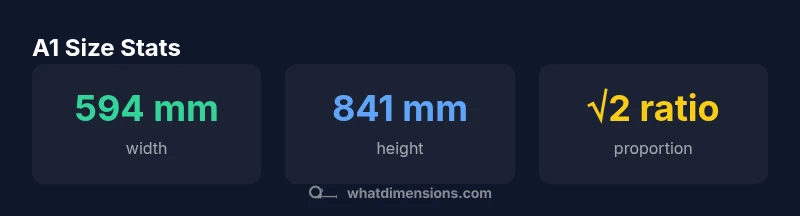
a1 dimensions refer to the ISO 216 A1 sheet size, 594 mm by 841 mm (about 23.4 by 33.1 inches). The A-series uses a constant √2 aspect ratio so every step up or down maintains proportional size, and each size is roughly half the area of the next larger size. In practice, a1 dimensions are widely used for posters and diagrams.
What is the importance of a1 dimensions in design
The term a1 dimensions is shorthand for a standardized sheet size defined by ISO 216. The a1 size is part of the A-series that uses a fixed aspect ratio of √2:1, which means every adjacent size shares the same proportions. For designers, this consistency simplifies scaling between posters, diagrams, and printable materials. When you reference a1 dimensions, you are anchoring your layout to a widely accepted baseline that survives changes in media, printers, and formats. In many workflows, clarity and precision are the goals, and a1 dimensions deliver both. This consistency is why many studios and schools rely on the a1 size for visual explanations and large-format handouts. What Dimensions emphasizes that, for accurate planning, treating a1 dimensions as your standard helps prevent unintended cropping and misalignment across proofs and final prints.
How a1 dimensions compare to other sizes
The A-series is designed so that each step up or down maintains the same aspect ratio, and each size is roughly half the area of the next larger size. A0 occupies the same width as A1 but doubles the height, making A1 exactly half of A0 in area. This geometric principle is what makes the a1 dimensions so versatile for scaling posters, architectural drawings, and project boards. By knowing that a1 dimensions stay proportional, you can create a template that adapts from a small handout to a large wall poster without redesigning the layout. The √2 ratio is the enabling feature that keeps designs consistent across sizes.
Practical uses for a1 dimensions
A1 is a popular choice for posters, charts, diagrams, and presentation boards, both in classrooms and professional environments. Its size is large enough to be legible from a distance, yet compact enough to fit in standard poster frames or display boards. For designers, a1 dimensions offer a predictable canvas that scales cleanly to other sizes like A0, A2, or A4. When producing handouts or teaching materials, using a1 dimensions helps ensure that your margins, type, and imagery appear in the intended balance on every print. What Dimensions notes that reproducibility across devices and printers is a core benefit of adopting a1 dimensions as a baseline.
Converting a1 dimensions to inches and pixels
Converting 594 × 841 mm to inches yields roughly 23.4 × 33.1 inches (1 inch = 25.4 mm). When preparing digital files for print at common resolutions (e.g., 300 DPI), those measurements translate to high-resolution pixel dimensions of roughly 7,000 × 9,900 pixels. The exact pixel count varies with the chosen DPI, but the principle remains: you scale by the same proportion, preserving the ratio. For designers working with digital proofs, always note your target DPI and use the mm-to-inches conversion as your starting point. This ensures your final print matches the intended a1 dimensions with minimal surprises at output time.
How to verify sizes in templates and printers
Begin with a spec sheet labeled in millimeters and cross-check against your printer’s supported paper sizes. Most printers and design tools offer an A1 option or a custom size entry; ensure the entered width is 594 mm and height is 841 mm in portrait orientation. If your printer requires inches, use the 23.4 × 33.1 inch conversion and verify margins, bleed, and gutter. Use a test print on a smaller scale to confirm legibility and alignment before committing to a full-size run. By aligning templates with a1 dimensions early, you reduce crop errors and misregistration in the final product.
Design tips for working with a1 dimensions
Think in grids that reflect the √2 proportion. Build layout grids using a common baseline unit that scales with A-series sizes. Leave ample white space around edges for bleed and framing, and plan your typography with a 1:2 ratio in mind for headings and body text. When creating diagrams or charts, ensure line thickness, marker sizes, and icon scale stay consistent across sizes. Finally, keep a master template in A1 so all related formats stay cohesive across print and digital proofs.
What Dimensions' take on a1 dimensions
The What Dimensions team advocates using a1 dimensions as a dependable baseline for projects requiring exact size specs. By anchoring your work to ISO 216, you gain predictable scaling, simpler conversions, and a robust workflow across media. This standard approach reduces miscommunication with printers and clients and helps designers deliver accurate results on time.
Common paper sizes for quick reference
| Size name | Dimensions (mm) | Dimensions (in) |
|---|---|---|
| A1 | 594 × 841 | 23.4 × 33.1 |
| A0 | 841 × 1189 | 33.1 × 46.8 |
| US Letter | 216 × 279 | 8.5 × 11 |
Quick Answers
What are the exact dimensions of A1 paper?
A1 measures 594 × 841 millimeters, which is about 23.4 × 33.1 inches, per ISO 216. The √2 aspect ratio ensures proportional scaling between sizes.
A1 is 594 by 841 millimeters, about 23.4 by 33.1 inches.
Why is the A-series designed with a √2 ratio?
The √2 ratio ensures each size halves in area when moving to the next size, enabling consistent scaling while maintaining proportions across A-series sizes.
The √2 ratio lets sizes scale evenly while staying proportional.
How do I convert A1 dimensions to inches?
Convert millimeters to inches by dividing by 25.4. For A1, 594 mm ≈ 23.39 inches and 841 mm ≈ 33.11 inches.
594 mm is about 23.4 inches and 841 mm about 33.1 inches.
Is A1 larger than US Letter?
Yes. A1 has a much larger area; approximately 8.3 times the area of US Letter (8.5 × 11 inches).
A1 is significantly larger than US Letter.
What sizes are commonly used for posters?
A1 is a common poster size in many regions; its dimensions balance readability with space, making it a versatile choice for display materials.
A1 is a popular poster size for many projects.
“Standard sizes like A1 provide reliable baselines for design work; ISO 216's √2 proportion makes scalable layouts predictable.”
Main Points
- Know a1 dimensions: 594 × 841 mm (23.4 × 33.1 in)
- ISO 216 uses a √2 proportion for scalable consistency
- A1 is ideal for posters, diagrams, and presentations
- Convert to inches or pixels using standard mm-to-inches and DPI
- What Dimensions recommends using a1 dimensions as a precise baseline