Tennis Court Dimensions: A Precision Guide for Courts and Play
A detailed guide to official tennis court dimensions, including singles vs doubles widths, service boxes, and net height, with practical guidance for construction and design.


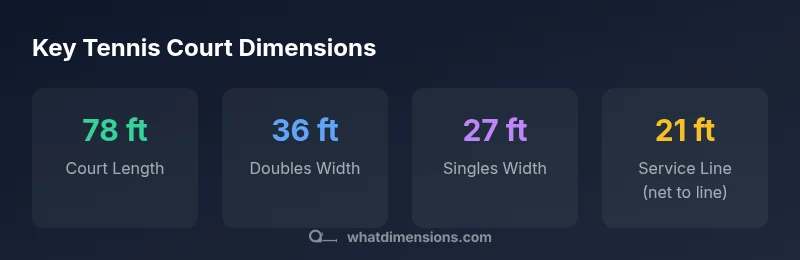
A standard tennis court measures 78 feet long. The doubles width is 36 feet, while the singles width is 27 feet. The service line sits 21 feet from the net, forming two service boxes per side. The net stands 3 feet 6 inches high at center. These baseline and service-area dimensions are defined by ITF guidelines and are used worldwide.
Official Tennis Court Dimensions
The phrase tennis court dimensions refers to the standardized measurements used for competitive play and facility design. According to What Dimensions, and in alignment with ITF guidelines, a standard court is defined by a fixed length and two different widths depending on whether singles or doubles play is being observed. The official length is 78 feet (23.77 meters), a constant on professional circuits and most club courts alike. The width depends on whether the action is between two players (singles) or four players (doubles): singles courts are 27 feet wide (8.23 meters), while doubles courts expand to 36 feet wide (10.97 meters) to accommodate doubles alleys. These measurements establish the playing area and influence line calls, strategy, and court surface requirements. When homeowners or designers plan a court, starting with these core numbers ensures the space aligns with standard play and equipment sizing.
From a sizing perspective, these dimensions also govern the layout of service lines, center marks, and the overall footprint of the court within a given property. While variations exist across surfaces (clay, grass, hard), the boundary lengths and widths remain anchored to the ITF standard, preserving fairness and consistency across levels of competition. ITF rules also specify net height, posts, and required markings, which we’ll cover in subsequent sections. This alignment matters not only for competition but also for practice geometry, shot selection, and teaching layouts, ensuring players train with typical court geometry in mind.
Singles vs Doubles: Layout and Play Implications
The court’s width differs for singles and doubles play, which affects shot selection and positioning. On singles courts (27 ft / 8.23 m wide), the 좁은 space concentrates rally depth and requires tighter movement, while the doubles arena (36 ft / 10.97 m wide) provides more width, expanding angles and drop-shot opportunities. Coaches emphasize awareness of the inner and outer boundary lines; the boundary changes influence where players stand to return serves, how they cover lobs, and how the server paces the point. If you’re designing a court for multi-use facilities, you may need the flexibility to adjust net tension and line placement to accommodate both formats during training sessions. In practice, the transition between singles and doubles play is most visible in the service boxes and the court’s width-dependent angles, with doubles offering more room for net approaches and cross-court exchanges.
The Serving Area: Service Lines and Boxes
The service area defines where serves must land to be considered in play. The service line is positioned 21 feet (6.40 meters) from the net, which shapes the depth of the two service boxes on each side of the net. Each service box is bounded by the singles sideline on its outer edge, the center service line in the middle, the service line at the far edge, and the net at the boundary on the near edge. From a measurement perspective, these boxes are essential for training consistency and for ensuring that serves have to clear the net while landing within the designated rectangle. The standard depth and width of these boxes align with ITF specifications, supporting consistent bounce behavior and play patterns across venues.
The Net, Posts, and Court Markings: The Visual Reference
Net height and post placement are critical visual references for players and officials. The ITF standard net height at the center is 3 feet 6 inches (1.07 meters), with slightly lower posts at the ends to accommodate net tension. Court markings—baseline lines, sidelines for singles and doubles, the service lines, the center service line, and the net post position—must be clearly defined and evenly painted to ensure precise calls and reliable bounce characterization. Precision in painting and maintenance reduces disputes and improves the fidelity of line calls during matches. For designers and facility managers, allocating space for line maintenance equipment and ensuring consistent line color and wear resistance is as important as the dimensions themselves.
Measuring Equipment and Best Practices for Construction
High-precision measurement tools help ensure the court matches ITF standards exactly. Start with a calibrated measuring tape, laser distance meter, and chalk or paint for line demarcation. Establish a fixed baseline and use tie-downs or anchors to prevent drift in measurements during marking and installation. It’s essential to verify: court length (78 ft / 23.77 m), doubles width (36 ft / 10.97 m), singles width (27 ft / 8.23 m), and the distance from the net to the service line (21 ft / 6.40 m). When placing the center service line and service boxes, ensure symmetry to avoid bias in serve trajectories. Finally, document all measurements and tolerances in a construction report so future renovations or resurfacing can re-create the exact geometry.
Common Measurement Pitfalls and How to Avoid Them
Common mistakes include misplacing the service line, mismeasuring doubles alleys, and neglecting to account for the court’s slope or drainage gaps. To avoid these issues, verify the overall length and width with redundant measurements at multiple corners, check diagonals for cross-check accuracy, and confirm net height with a level at the center and posts at the ends. Also, ensure the surface is level before painting lines; a slight tilt can influence ball bounce perception. Lastly, consult ITF official guidelines and adapt the plan to the site’s constraints while preserving the fundamental dimensions. With careful planning, you’ll have a court that plays consistently and meets competition standards.
Official tennis court dimensions (ITF standard)
| Dimension | Exact (ft) | Exact (m) | Notes |
|---|---|---|---|
| Court Length | 78 | 23.77 | ITF standard length for both singles and doubles |
| Court Width (Doubles) | 36 | 10.97 | Total court width including doubles alleys |
| Court Width (Singles) | 27 | 8.23 | Width of singles playing area |
| Service Line Distance from Net | 21 | 6.40 | Distance from net to service line |
| Service Box Depth (Net to Service Line) | 21 | 6.40 | Depth of each service box |
| Net Height at Center | 3 ft 6 in | 1.07 m | Center height of the net |
Quick Answers
What is the standard length of a tennis court?
The court length is 78 feet (23.77 meters) for both singles and doubles play. This length is consistent across court types and surfaces, providing a uniform baseline for play. Variations in design may occur, but the boundary length remains fixed in official guidelines.
The standard length is 78 feet, or 23.77 meters, for all court types.
What are the standard widths for singles and doubles courts?
Singles courts are 27 feet wide (8.23 meters), while doubles courts are 36 feet wide (10.97 meters). This difference defines the playing area and the location of sidelines and alleys. The singles width narrows the court, increasing rally depth, while the doubles width accommodates extra space for partner play.
Singles is 27 feet wide; doubles is 36 feet wide.
Are tennis court dimensions the same on clay, grass, and hard courts?
Yes. The official dimensions are defined by ITF guidelines and apply across surfaces. Surface type affects bounce and speed, but boundary lines remain consistent to ensure fair competition.
The size is the same on all surfaces; only the surface affects play.
How strictly are ITF dimensions enforced in amateur facilities?
Amateur facilities often have minor tolerances due to construction limits. Strive for dimensions within a small tolerance of the standard and document any deviations for maintenance and safety.
Facilities should aim to be within tolerance and verify periodically.
Where can I find official guidelines for tennis court dimensions?
Consult the ITF official rules and your national tennis association (e.g., USTA). They publish dimensional standards, tolerances, and maintenance guidelines for courts.
Check ITF guidelines and your national association for precise rules.
“Precise court dimensions aren’t optional—tiny deviations can affect ball bounce and player positioning. Aligning with ITF standards ensures fair play across facilities.”
Main Points
- Know the official lengths and widths first.
- Singles and doubles widths differ and affect lines.
- Service lines define two service boxes per side.
- Net height at center affects ball trajectory.
- Verify dimensions against ITF guidelines before construction.