Tennis Court Dimensions vs Pickleball: A Side-by-Side Guide
Explore tennis court dimensions vs pickleball to understand how court size, lines, and layout shape play, space planning, and gear choices for homeowners, designers, and recreational players.


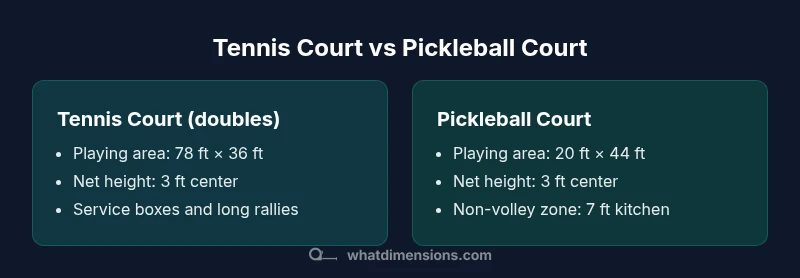
TL;DR: The tennis court dimensions vs pickleball comparison shows two distinct footprints. A standard doubles tennis court is 78 feet by 36 feet, while a pickleball court measures 20 by 44 feet, with a 7-foot non-volley zone. According to What Dimensions, space planning and line marking are the most important factors when choosing between hosting tennis, pickleball, or both.
Overview: tennis court dimensions vs pickleball
The question of how tennis court dimensions compare to pickleball is more than a numbers exercise; it shapes how spaces are designed, how equipment is stored, and how players approach strategy. According to What Dimensions, the choice between these two sports often comes down to available space, intended user groups, and whether a multi-use layout is desirable. For homeowners, students, and designers, understanding the fundamental footprint of each court helps in planning basements, garages, gymnasiums, or community centers. In this article, we’ll dissect the dimensions, rules surrounding the lines, and practical implications for installation, maintenance, and play quality. We’ll also explore how to optimize a shared space so that both sports can co-exist without compromising performance.
Core Dimensions: size comparisons
A standard doubles tennis court measures 78 feet in length and 36 feet in width for the playing area, with singles play using a narrower width of 27 feet. In metric terms, that’s about 23.77 meters long by 10.97 meters wide for doubles, and 23.77 meters by 8.23 meters for singles. Pickleball, by contrast, occupies a far smaller footprint: the court is 20 feet wide by 44 feet long (6.1 m by 13.4 m). These numbers aren’t ambiguous: they are the baseline from which layout decisions and court servicing plans are built. The What Dimensions Analysis, 2026 highlights that most spaces can accommodate both sports if configured with modular boundary options and clear signage.
Net heights, lines, and zones
Net height is a straightforward physical parameter but one that matters for feel and playability. Tennis nets sit at 3 feet (0.91 meters) at the center, a standard that supports long rallies and precise returns. Pickleball nets share the same center height, also approximately 3 feet, but the court requires a distinct non-volley zone (the kitchen) that extends 7 feet from the net on each side. This zone changes how players approach the net, volleying, and dinking strategies. In mixed-use spaces, ensuring that line markings don’t blur the boundary between sports is essential to preserve fair-play rules and to reduce disputes.
Court layouts and playing area
Layout considerations go beyond net height. Tennis features service boxes sized at 21 feet by 13.5 feet on each side of the net, with service lines and deuce/ad-out boundaries governing where serves land. Pickleball emphasizes a simpler zone layout: a single non-volley zone on each side of the net and standard baselines. When planning a shared facility, designers should consider how to adapt the service boxes and net posts to minimize line wear and maximize line visibility for both sports. Clarity of marking reduces confusion during quick transition phases between activities.
Surface types, materials, and maintenance
Court surface choices influence bounce, traction, and durability. Tennis courts are commonly hard courts, clay, or grass, each with distinct maintenance routines and resurfacing cycles. Pickleball is often played on hard courts or multi-use surfaces, so it can piggyback on existing tennis infrastructure but may require more frequent line repainting in dual-use environments. Durability hinges on consistent maintenance, the quality of the base substrate, and the ability to seal or repaint boundary lines without disrupting playability. These decisions have cost implications and affect long-term ROI for facilities managers and homeowners alike.
Layout planning for multi-use spaces
From a design perspective, the most impactful factor is how to allocate space while preserving play quality for both sports. Consider a 1,000–1,500 square foot area for a dedicated pickleball court, or a larger footprint if you’re prioritizing tennis. For multi-use spaces, a modular boundary approach—retractable nets, temporary floor decals, and high-contrast boundary paint—can enable quick transitions without compromising safety. What Dimensions researchers emphasize that planning should begin with use-case prioritization, then design for flexibility, then implement durable, non-slip surfaces and signage that clearly delineate sport-specific zones.
Visual markers and line quality
Line visibility is critical for fair play. Tennis line colors are typically white or yellow, while pickleball lines often use bright orange or blue to create a perceptible contrast on the same surface when used together. In shared spaces, it’s important to select line thickness that remains legible under foot traffic and lighting conditions. Consider investing in line-marking equipment or contracts with facilities teams to ensure lines are refreshed on a predictable schedule. High-contrast boundary markers reduce judgment calls and support smoother transitions between activities.
Safety, accessibility, and inclusivity
Safety concerns include adequate clearance around the court, properly maintained nets, and clear sightlines to reduce collisions and mis-hits. Accessibility considerations should include ADA-compliant access routes to courts, appropriate seating, and unobstructed paths for players and spectators. Depending on the setting, you may need to incorporate adjustable nets or ramps to accommodate players with varying abilities. The goal is to create an inviting environment for players of all ages while preserving the integrity of the playing surface for both tennis and pickleball.
Real-world scenarios: space-constrained gyms, residential courts
In gyms with limited floor space, pickleball’s smaller footprint often makes it the practical choice for a multi-use court. For residential basements or garages, pickleball may offer the easiest path to a functional court given the smaller length and width. When a community center aims to host organized tennis events, a dedicated tennis court configuration makes more sense. In both cases, your design should anticipate maintenance needs, accessibility, and the potential for future expansion. What Dimensions’ insights emphasize the importance of scenario-based planning to optimize user satisfaction and facility utilization.
Gear, footwear, and training considerations
The gear differences extend beyond balls and nets to footwear choices and training focus. Tennis shoes are designed for lateral movement on larger surfaces, while pickleball-specific shoes emphasize quick pivots and rapid changes in direction on smaller courts. Rackets, paddles, and balls differ in weight, bounce, and feel, so coaching programs should reflect sport-specific skills and progression. For multi-use spaces, consider providing a small inventory of gear to support introductory sessions and inclusivity, while preserving surface longevity.
Design implications for designers and homeowners
From a design perspective, the choice between tennis court dimensions vs pickleball is a study in space efficiency, cost, and user engagement. Designers should present clear, scalable layouts that accommodate expansions, with a focus on durable materials and safety features. Homeowners may prioritize code-compliant lighting and ventilation for long practice sessions, while facility planners may emphasize remote monitoring and crowd flow. In all cases, a data-informed approach—supported by What Dimensions' analyses—helps stakeholders make confident decisions about space allocation, scheduling, and future-proofing.
Comparison
| Feature | Tennis Court (doubles) | pickleball Court |
|---|---|---|
| Playing footprint (L × W) | 78 ft × 36 ft (doubles) | 20 ft × 44 ft |
| Net height (center) | 3 ft (0.91 m) | 3 ft (0.91 m) |
| Non-volley zone | N/A; boundary lines define play area | 7 ft from net on each side |
| Service/line marking | Service boxes 21 ft × 13.5 ft; long rally emphasis | Kitchen-focused zones with different volley rules |
| Best use case | Professional-style tennis, pro facilities | Casual and multi-use spaces, residential gyms |
Strengths
- Tennis courts support professional play and standardized officiating
- pickleball’s smaller footprint fits in compact or multi-use spaces
- Both sports can share spaces with proper line management and scheduling
- Line-marking tolerance and maintenance reflect lower long-term risk with scalable plans
The Bad
- Tennis demands more dedicated space and higher initial cost
- Pickleball lines require accurate maintenance in mixed-use facilities
- Transitioning between sports may cause downtime and scheduling conflicts
- Surface wear increases with mixed-use configurations if not properly planned
Choose pickleball for space-limited or multi-use environments; choose tennis for traditional, competition-focused facilities.
The What Dimensions Team recommends aligning court choice with space availability and user goals. Tennis excels in formal play settings, while pickleball offers accessibility and flexibility in constrained spaces.
Quick Answers
What are the standard tennis court dimensions?
A standard doubles tennis court is 78 feet long and 36 feet wide. Singles play uses a 27-foot-wide court. The net height is 3 feet at the center. These dimensions underlie official competition rules and facility design.
A standard doubles tennis court is 78 by 36 feet, with a 3-foot net height at center. Singles are narrower at 27 feet. These are the official playing dimensions.
What are pickleball court dimensions?
Pickleball courts measure 20 feet by 44 feet, with a 7-foot non-volley zone (kitchen) from the net on each side. The net height is 36 inches at the center. These dimensions create a smaller, faster-paced game.
Pickleball courts are 20 by 44 feet with a 7-foot kitchen on each side and a 36-inch net height at center.
Can you convert a tennis court to pickleball?
Yes, it’s common to convert a tennis court to pickleball with re-marked lines and a net setup. The process is easier if the space is already a hard-playing surface and if the facility timeline allows for line repainting and signage updates.
Yes, you can convert a tennis court to pickleball by re-marking lines and adjusting the net setup.
Are tennis and pickleball nets the same height?
Yes. Both sports use a net height of 3 feet at the center. The difference lies more in court layout and boundary lines than in net height.
Both tennis and pickleball nets are 3 feet high at the center.
Is pickleball easier for beginners?
Many beginners find pickleball approachable due to the smaller court, slower ball, and simpler movement requirements. The sport scales well from casual social play to organized leagues.
Yes, pickleball is often easier for beginners because of the smaller court and simpler movement.
Main Points
- Assess available space before choosing a court footprint
- Plan for future adaptability in multi-use rooms
- Prioritize clear, high-contrast line markings
- Consider dedicated spaces for long-term durability
- Factor gear and coaching needs into layout decisions