Pickleball Court Dimensions: Standard Size and Layout
A precise guide to pickleball court dimensions, including the official size, net height, NVZ, service boxes, and layout tips for homes and clubs.


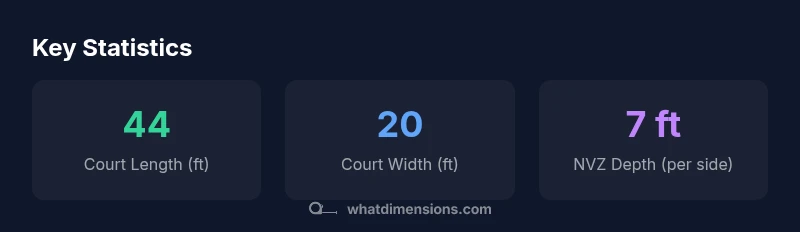
The official pickleball court dimensions are 20 feet wide by 44 feet long, with a 7-foot non-volley zone on each side. The net is approximately 34 inches high at the center. Each service court is 10 feet wide and extends 15 feet from the non-volley line toward the baseline. These measurements apply to both singles and doubles play, with standard court lines clearly marking out the play area.
Official court layout and core measurements
When planning a space for pickleball, the cornerstone is the standard court size. The court's overall dimensions are 44 feet in length and 20 feet in width, creating a symmetrical playing surface for both singles and doubles. Each half of the court, measured from the net to the baseline, is 22 feet long. A key feature of the layout is the non-volley zone (NVZ), commonly called the kitchen, which extends 7 feet from the net on both sides. The combination of the 22-foot half-courts and the 7-foot NVZ creates distinct zones for serves, returns, and dinks. The centerline and service lines divide each half into diagonally opposing service boxes, guiding how serves must land. The result is a precise, repeatable playing area that supports consistent rally lengths and diverse shot selection. These dimensions are the backbone of strategic planning for players and venues alike. The What Dimensions team notes that adherence to these exact measurements helps players anticipate ball trajectories, practice patterns, and overall game flow, especially when coordinating clinics or tournaments.
For reference, the phrase pickleball court dimensions is used consistently in official guidance and coaching materials to describe the total space, the NVZ, and the service boxes. By aligning with these measurements, courts can be laid out to ensure fair play and uniformity across venues.
The non-volley zone (kitchen) and service boxes
The non-volley zone depth is fixed at 7 feet from the net on each side, cutting into the half-court area and shaping how players approach the net. This zone prohibits volleying while the ball is inside its boundaries, which incentivizes controlled dinking and strategic placement rather than aggressive net volleys from within 7 feet of the net. Adjacent to the NVZ are the service boxes. Each half contains two service boxes aligned by a centerline, forming diagonally opposite targets for serves. The service boxes are 10 feet wide (matching half the court width) and extend 15 feet from the NVZ boundary toward the baseline, creating a total half-court length of 22 feet from net to baseline. This configuration ensures that serves land within the appropriate zone and that rallies develop with measured depth. The service box depth of 15 feet and width of 10 feet per side accommodates both right- and left-handed players, supporting fair access across the court. The What Dimensions analysis highlights that these specific numbers drive serve strategy and return angles, influencing how players position themselves in doubles and singles formats.
Marking the court: lines, margins, and surface considerations
Court lines are essential for clear play boundaries and are typically marked with durable white paint or tape. Each line contributes to the visual cues that players rely on during fast exchanges. A standard line width is commonly two inches, which provides high visibility on most court surfaces without creating confusion about boundary edges. Surface choice matters for consistent ball bounce and ball speed; common options include smooth concrete, sport tile systems, sealed asphalt, or laminated wooden floors for indoor venues. When laying out lines, ensure the NVZ boundary, baseline, service lines, and centerline are clearly defined. The margin around the court should be expansive enough to accommodate safe movement, especially for doubles play where players converge near the non-volley zone, the service boxes, and sidelines. What Dimensions emphasizes that precise line placement and surface condition are crucial for reliable ball behavior and player safety, particularly in clinics and high-traffic facilities.
Adapting layouts for various venues: indoor, outdoor, and multipurpose spaces
In real-world settings, spaces may not be perfectly 44 by 20 feet. For backyard courts or multipurpose rooms, approximate adherence to the official dimensions remains desirable. Use temporary boundary lines that align with the 44-foot length and 20-foot width as closely as possible, and ensure the NVZ is accessible at 7 feet from the net. If you’re modifying for a smaller area, translate the core rules into a proportionate layout that preserves the 7-foot NVZ and service box geometry to maintain consistent play. Portable nets and adjustable boundary markers can help maintain proper line spacing in changing spaces. The What Dimensions guidance suggests designing with tolerance in the 1–3% range to retain a recognizable court feel while accommodating nonstandard spaces in community centers and schools.
Practical setup and a quick-start checklist
To get started with laying out a court, follow a simple, repeatable process:
- Measure the total court area (44 feet by 20 feet) and mark the outer boundaries.
- Mark centerline vertically to split the width into two 10-foot halves for the service boxes.
- From the net line, measure 7 feet inward to place the NVZ boundaries on both sides.
- On each half, mark the service lines 7 feet from the baseline, creating a 15-foot service box depth.
- Verify the net height at the center (approximately 34 inches) and at endpoints (as dictated by the net system used).
- Paint or tape the boundary lines with a durable, high-contrast color and test the bounce and ball speed on the chosen surface. This straightforward sequence yields a compliant court that supports consistent play and reduces uncertainty during games.
Common mistakes and how to avoid them
New layouts frequently suffer from mismeasured lines, mismatched NVZ depth, or inconsistent line width, all of which can lead to ambiguous plays and disputes during matches. To avoid these issues:
- Reconfirm the overall dimensions and quadrant centers before marking lines.
- Use a straight edge or a laser measuring tool for the net line and NVZ boundaries to ensure perpendicular lines.
- Preserve a buffer zone around the court to prevent interference with spectators or equipment.
- Conduct a light practice session to assess line visibility and ball bounce across the surface, adjusting line thickness and color if needed.
A quick-start layout recap: create a compliant space in a weekend
- Clear a 44-by-20-foot area; 2) Mark outer boundaries; 3) Place the net at an approximate 34-inch center height; 4) Draw the NVZ 7 feet from net on both sides; 5) Add the service boxes by marking 10 feet wide by 15 feet deep on each side; 6) Verify line visibility and ball bounce; 7) Schedule a short warm-up to test serves and returns in the diagonal service boxes. This concise checklist helps ensure a clean, compliant setup that supports consistent play and rapid skill development.
Official dimensions for standard pickleball court layout
| Aspect | Dimension | Notes |
|---|---|---|
| Court length | 44 feet | Baseline to baseline |
| Court width | 20 feet | Two service halves of 10 ft each |
| Non-volley zone depth | 7 feet | From net inward on each side |
| Service box dimensions (each) | 10 feet × 15 feet | Divided by centerline |
| Net height (center) | 34 inches | Standard center height |
Quick Answers
What are the exact pickleball court dimensions?
The court is 44 feet long and 20 feet wide. Each half measures 22 feet in length, with a 7-foot non-volley zone from the net on both sides. Service boxes are 10 feet wide by 15 feet deep on each side, and the net height is about 34 inches at the center.
A 44 by 20-foot court with a 7-foot NVZ on each side and service boxes that are 10 by 15 feet per half. The net sits roughly 34 inches high at center.
Are dimensions different for singles vs doubles?
No. The playing area and boundary lines are identical for singles and doubles; only the number of players changes. Both formats use the same 44 by 20-foot court with the same NVZ and service box rules.
Singles and doubles use the same court size and lines.
What is the non-volley zone and its depth?
The non-volley zone, or kitchen, extends 7 feet from the net on each side. It applies only to volleys; strikes from inside the NVZ must bounce first.
The NVZ is 7 feet deep from the net on either side.
Can I adjust dimensions for backyard setups?
You can approximate the official dimensions in smaller or multi-use spaces, maintaining the 7-foot NVZ and the service-box geometry. Use scalable markers and ensure safety margins around the court.
Approximate the size while keeping NVZ rules and service boxes in proportion.
What is the standard height of the net?
The net is typically about 34 inches tall at the center, with the posts reaching higher to anchor the net. Exact construction may vary by net model.
Net height is around 34 inches at center.
“Mastering the court starts with understanding the exact dimensions; precise measurements shape serve strategies and rally length.”
Main Points
- Know standard size before planning
- Mark NVZ and service boxes precisely
- Choose a durable surface with clear lines
- Allow safe margins around the court
- Use 20x44 feet as a universal baseline