Pickleball Dimensions vs Tennis: A Side-by-Side Guide
A focused comparison of pickleball dimensions vs tennis, detailing court sizes, net heights, service zones, and space planning for homes, clubs, and classrooms. Explore how the pickleball dimensions vs tennis differences shape layout decisions.


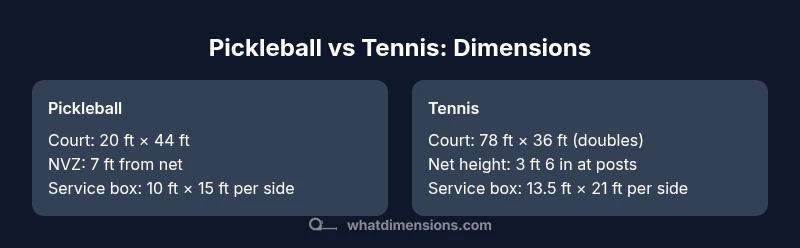
pickleball dimensions vs tennis: The two sports use distinct court footprints and line placements. Pickleball courts measure 20 feet by 44 feet and feature a 7-foot non-volley zone on each side, while tennis doubles courts measure 36 feet by 78 feet with a 3-foot center net height and 21-foot service boxes. Understanding these differences helps planners choose appropriate spaces and equipment.
Core Concept: What the numbers mean
In any court based sport, size drives how players move, how lines are drawn, and how strategies unfold. The comparison pickleball dimensions vs tennis reveals why venues plan differently for each game. According to What Dimensions, the size differences shape how spaces are used, how equipment is placed, and how easy it is for players to learn and transition between games. By understanding the core measurements, designers can anticipate crowd flow, safety zones, and the need for signage that minimizes confusion during play. This section establishes the context for a deeper dive into how dimensions translate into real world layouts and play quality.
Court footprint: total area and shapes
The pickleball court is compact compared with a tennis court. A regulation pickleball court measures 20 feet by 44 feet, providing a near rectangle that fits easily into many indoor gyms or converted spaces. A tennis doubles court, in contrast, measures 78 feet by 36 feet, creating a much larger playing surface that also imposes stricter perimeter clearance. When planning multi-use facilities, these footprint differences matter for layout, storage space, and circulation routes. What Dimensions notes that the smaller footprint of pickleball can be advantageous for community centers, schools, and apartment buildings, where every square foot counts and flexibility is valued, while tennis courts demand substantial dedicated space for regular competition.
Boundary lines and lines: how lines define play
Line geometry defines where the ball is in or out and can determine how players approach the court. On pickleball, the key lines include the baseline, sideline, and a non-volley zone or kitchen that extends 7 feet from the net on each side. The lines must be clearly painted and maintained because players rely on them for dinking, strategy, and soft shots near the net. Tennis uses singles and doubles boundary lines, creating an extra central alley for doubles and a wider baseline and sidelines; while the service boxes are central to rally construction, the court is asymmetrical in terms of useful width depending on whether it is used for singles or doubles. These differences affect how courts are marked and how lines are interpreted during play.
Net heights and service lines: central details
Net height influences rally pace and safety. For pickleball, the net height at the center is 36 inches, and the net height near the ends is roughly the same within measurement tolerances. The tennis net height is 3 feet 6 inches at the posts and 3 feet at the center. The service lines in pickleball create two clearly defined service boxes on each side, each box measuring about 10 feet wide by 15 feet deep. Tennis service boxes on each side are 13.5 feet wide by 21 feet deep. These measurements shape where players stand during serves and how returns develop, affecting both practice routines and competitive play.
Service zones in pickleball vs tennis: how the boxes differ
Pickleball service boxes are 10 feet wide by 15 feet deep per box, split by a centerline into two equal boxes. Tennis service boxes are larger, 13.5 feet wide by 21 feet deep, located on each side of the net. The location of the service line (the line behind the net that marks the service depth) is a core difference in how serves are executed, and it informs practice drills and player training.
The non-volley zone (kitchen) and its strategic impact
The pickleball non-volley zone extends 7 feet from the net; players cannot volley while inside this zone, which shapes net play and ball placement. Tennis does not use a non-volley zone; instead serves and returns rely on court positioning and shot selection across a full 78 by 36 foot area. The kitchen rule promotes dinking and controlled soft shots in pickleball, creating a distinctive transition zone that changes how players approach the net and construct points. Designers must plan signage and paint to clearly mark the NVZ for safety and consistency.
Singles vs doubles: how space changes
In pickleball, the full 20 by 44 foot court size is used for both singles and doubles play, with the same boundary lines for most recreational games. Tennis, however, uses a wider doubles width of 36 feet, including the doubles alley, which expands the playable area and requires more surrounding clearance. For facilities that host both formats, this distinction guides layout decisions, line maintenance, and floor markings to prevent confusion during events and casual play alike.
Comparison
| Feature | pickleball | tennis |
|---|---|---|
| Court footprint (overall size) | 20 ft x 44 ft | 78 ft x 36 ft (doubles) |
| Net height (center) | 36 inches | 36 inches |
| Service boxes (per side) | 2 boxes: 10 ft x 15 ft each | 2 boxes: 13.5 ft x 21 ft each |
| Non-volley zone vs service area | NVZ 7 ft from net (pickleball) | No NVZ; service boxes define play (tennis) |
| Doubles alley | No doubles alley (pickleball) | Doubles alley 4.5 ft wide (tennis) |
Strengths
- Clear standards help planners avoid mis-measurements
- Compact footprint fits more spaces
- Straightforward markings improve learnability
- Faster setup for temporary courts
The Bad
- Smaller play area can limit long rallies in competitive tennis
- Dedicated lines required for dual-use facilities
- Transitioning players between sports can be confusing without signage
Dedicated courts optimize play quality; multi-use spaces require careful zoning
The What Dimensions Team recommends sport-specific courts when possible but supports well-planned multi-use zones to maximize footprint efficiency and safety.
Quick Answers
What are the standard dimensions for a pickleball court?
A standard pickleball court measures 20 by 44 feet with a 7-foot non-volley zone on each side. The lines define a defined playing area suitable for casual and competitive play.
A standard pickleball court is 20 by 44 feet with a 7-foot kitchen on each side.
What are the standard tennis court dimensions?
A standard doubles tennis court is 78 feet long and 36 feet wide. The net height is 3 feet 6 inches at the posts and 3 feet at the center, with service boxes 13.5 by 21 feet per side.
A standard doubles tennis court is 78 by 36 feet with a net height of 3 feet 6 inches at the posts and 3 feet at the center.
Can you play pickleball on a tennis court?
Yes, with proper markings and space, you can adapt a tennis court for pickleball, but ensure the lines and NVZ zones align with official rules to avoid confusion.
You can adapt a tennis court for pickleball with proper markings.
Do tennis and pickleball courts share lines?
Venues may share lines when layouts align, but most facilities use sport-specific lines to prevent confusion during mixed-use events.
Most places keep separate lines to avoid confusion.
What is the service box size in pickleball?
Each pickleball service box is 10 feet wide by 15 feet deep per side, split by the centerline. Tennis service boxes are larger, at 13.5 by 21 feet.
Pickleball service boxes are 10 by 15 feet per box.
What space is needed for a home setup?
For home setups, plan at least 20 by 44 feet for pickleball or 78 by 36 feet for tennis, plus space for movement around the court.
Home spaces should be roughly the court size with a buffer around it.
Main Points
- Plan court spaces before procuring resources
- Know the core differences in zones and service areas
- Use clear signage to avoid line disputes
- Prioritize dedicated courts for frequent play if space permits