Dimensions of a Pickleball Court: Official Size and Guidelines
Learn the official pickleball court dimensions, including the 20x44 ft footprint, 7 ft NVZ on each side, and center net height of 34 inches. A practical guide for builders, players, and facility managers.


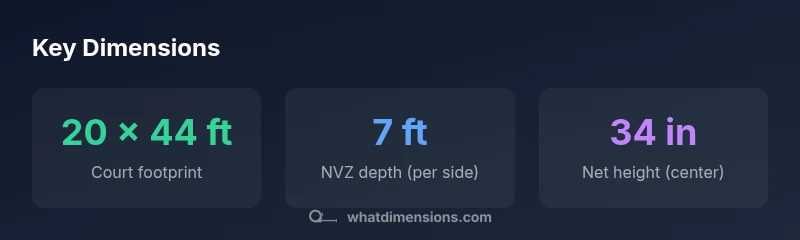
The official pickleball court size is 20 feet wide by 44 feet long for both singles and doubles play, with a non-volley zone (the kitchen) extending 7 feet from the net on each side. The net height is 34 inches at the center and 36 inches at the sidelines. These dimensions ensure consistent play and safe spacing on courts of all sizes.
Official Court Size and Shape
The standard pickleball court footprint is fixed at 20 feet wide by 44 feet long, a size that applies to both singles and doubles play. This uniform footprint ensures consistent spacing for players, officials, and equipment such as portable nets and boundary markers. Converting to metric units, the court measures approximately 6.10 meters by 13.41 meters, a dimension frequently used in international facilities planning. What Dimensions analysis indicates that this consistent footprint supports safe circulation, predictable ball trajectories, and scalable layouts for multi-court venues. Facility designers should verify wall and post clearances around each court to maintain the official play area without encroachment.
The Non-Volley Zone (NVZ) Explained
The NVZ, commonly referred to as the kitchen, extends 7 feet from the net on both sides. Within this zone, players are prohibited from volleying the ball (hitting before it bounces). The NVZ defines critical strategic space near the net and governs how players position their feet and paddle during fast exchanges. Proper NVZ marking helps prevent dangerous footwork and ensures fair rallies. In practice, most rapid exchanges occur just behind the NVZ line, where players leverage a mix of dinks, drives, and drop shots to win points.
Net, Lines, and Markings: Where Everything Belongs
The net in pickleball spans the width of the court and should be tensioned so that it sits at a center height of 34 inches, with sidelines reading 36 inches. Boundary lines include the baseline at each end, the sidelines along each side, and the NVZ line running parallel to the net 7 feet from it. The centerline divides the service courts into left and right halves. Accurate line placement is essential for clear ball in/out calls and consistent serve placement. Regular inspection for faded lines, cracking concrete, or warped posts helps maintain standard play conditions.
Service Areas and Centerlines: How the Court Is Divided
On each side of the net, the service courts are split by a centerline into left and right service locations. The service boundary lines define where serves must land, and the NVZ line marks the front boundary of the non-volley zone. Maintaining the correct alignment of the centerline and service boundaries ensures fair opportunities for both server and receiver. In established facilities, a standardized layout reduces confusion for players and officials alike, especially during competitive events.
Net Height, Tolerances, and Measurements
Official sources specify a net height of 34 inches at the center and 36 inches at the sidelines. This subtle difference helps accommodate court geometry and paddle height during serves. When setting up a court, ensure the posts are square to the sidelines and that the net is taut across the entire width. Periodic checks with a level and tape measure help catch sagging or uneven nets, which can affect ball bounce and bounce consistency near the NVZ.
Measuring Your Court: A Practical Guide
Accurate measurement starts with locating the net at the exact court center and measuring outward to define the 44-foot length. Next, confirm the 20-foot width by measuring between the outer boundary lines. For NVZ verification, measure 7 feet from the net along both sides to locate the NVZ boundary. Use a straightedge or chalk line to mark the lines and a durable tape measure for repeatable accuracy. Record measurements and compare against official dimensions to identify any deviations before play resumes.
Indoor vs Outdoor Variations: Surfaces and Tolerances
Indoor courts commonly use hard, flat flooring with consistent lighting, while outdoor courts face weather-related wear and surface irregularities. Regardless of setting, the 20x44 ft footprint should be preserved, and all lines must be clearly marked and resistant to fading. Outdoor nets may require weatherproofing and more frequent re-marking due to wind and UV exposure. Additionally, surface slope and drainage influence ball roll and reaction times, so facility managers should account for these factors when leasing or constructing multiple courts.
Accessibility, Safety, and Compliance: What to Watch For
Beyond strict dimensions, accessible design requires clear paths, safe boundary walls or fencing, and signage indicating NVZ rules. Facilities should provide adequate space for players to enter and exit without crossing lines during rallies. Regular audits, including line re-marking and net checks, help sustain compliance with official dimensions over time. Incorporating these practices reduces disputes and improves user satisfaction for players of all skill levels.
Practical Takeaways for Builders and Facilities Managers
When planning a new court or upgrading an existing facility, prioritize the official 20x44 ft footprint, 7 ft NVZ depth per side, and center-net height of 34 inches. Invest in durable line materials and frequent inspection cycles to maintain accuracy. Use metric conversions for international events, and document every measurement to support future renovations or expansions. What Dimensions emphasizes consistency to maximize fairness and versatility across venues.
Key court dimensions
| Aspect | Specification | Notes |
|---|---|---|
| Court size | 20 ft x 44 ft | Doubles and singles share footprint |
| Non-volley zone (NVZ) | 7 ft from net on each side | Total NVZ depth along court 14 ft |
| Net height | Center 34 inches; sidelines 36 inches | Measured from floor to top edge of net |
Quick Answers
What are the official pickleball court dimensions?
The official court measures 20 ft by 44 ft for both singles and doubles. The NVZ extends 7 ft from the net on each side, and the net height is 34 inches at the center (36 inches at the sidelines).
The official court is twenty by forty-four feet with a seven-foot non-volley zone on each side and a center net height of thirty-four inches.
What is the NVZ or kitchen size?
The non-volley zone is 7 feet deep on each side of the net, totaling 14 feet of NVZ along the court.
The kitchen is seven feet from the net on each side.
Are singles and doubles courts different in size?
No. The court footprint is the same for singles and doubles: 20 by 44 feet.
Singles and doubles share the same court size.
What is the net height?
Net height is 34 inches at the center and 36 inches at the sidelines.
The net is 34 inches high at the center and 36 inches at the edges.
Do outdoor courts differ in dimensions?
Dimensions are the same; outdoor surfaces should be level and clearly marked, with weather considerations.
The size stays the same; outdoor surfaces should be level and properly marked.
Where can I find official dimensions for compliance?
Official dimensions come from governing bodies and recognized standards; check USAPA rules and official guidelines for pickleball.
Look up the USAPA rules and official standards for court dimensions.
“Accurate dimensions are the foundation of fair play and scalable facilities. The precise 20x44-foot footprint, 7-foot NVZ, and center-net height of 34 inches ensure consistent play across venues.”
Main Points
- Know the official footprint: 20 ft by 44 ft.
- Remember the NVZ depth: 7 ft per side.
- Account for net heights: 34 in center, 36 in at edges.
- Mark lines accurately to avoid violations.
- Consult governing standards for facility planning.