Pickle Ball Dimensions: Court, Ball, and Paddle Specs
Learn the exact pickle ball dimensions for court size, NVZ, net height, ball diameter, and paddle length. What Dimensions explains how precise measurements impact gameplay, setup, and coaching.


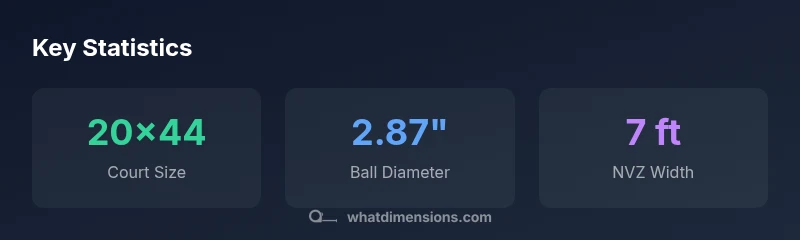
According to What Dimensions, the standard pickle ball court is 20 feet by 44 feet for both singles and doubles, with a 7-foot non-volley zone on each side. The ball diameter is 2.87 inches (73 mm), and the net sits 34 inches high at the center and 36 inches at the posts. Official paddles max about 17.5 inches long. These specs shape court spacing, line calls, and training setups.
Court, Net, and Lines: The Dimensions Framework
When people talk about pickle ball dimensions, they typically group four elements: court size, the non-volley zone (NVZ), net height, and line placements. The standard playing area is 20 feet wide by 44 feet long for both singles and doubles, with lines that split hazards and service areas. The NVZ, often called the kitchen, extends 7 feet from the net on each side. The service courts subdivide the length; courts share lines across the entire surface. Accurate layout matters for event setup, spatial planning in multi-use gyms, and even home courts carved in garages. What Dimensions emphasizes that professionals and hobbyists alike should verify line distances with a steel tape or laser measure, especially when designing a multi-use space that must support different court-friendly sports. In practice, padding and boundary matting should reflect official dimensions to minimize confusion during play and to ensure proper ball trajectories. The goal is to create a predictable, fair playing field that translates across clubs and competitions.
Court Dimensions: Size and Layout
The playing surface for pickle ball is defined in feet, with the critical measurements expressed in both feet and meters for international venues. A court sized at 20 feet by 44 feet keeps play consistent across gymnasiums, community centers, and backyard setups. The boundary lines—sidelines and baselines—define playable area, while the NVZ sits 7 feet from the net on either side. For planners, this means room planning should consider clearance along all lines, especially in multi-use spaces where adjacent sports or activities take place. The What Dimensions team highlights that accurate lines reduce disputes and improve drill efficiency, particularly when coaching multiple players at once. The surface texture, curb lines, and boundary bumper strips should align with official dimensions to preserve the intended pace and bounce characteristics that players expect during drills and routine matches.
Ball Dimensions: Diameter and Impact
The pickle ball ball, standardized for competition and recreation alike, has a fixed diameter of 2.87 inches (approximately 73 mm). This dimension directly influences ball flight, bounce, and spin. Manufacturers produce balls within a small tolerance around this size, but competition-grade balls adhere closely to the standard to ensure uniform performance. The ball’s size interacts with the court width and NVZ to determine rally length, shot angles, and safety margins, especially on faster surfaces or when players hit balls with topspin. What Dimensions notes that players should choose balls that meet official specs for uniform practice and for course corrections during skill development.
Paddle Sizing and Compliance
Paddles come in a variety of shapes and thicknesses, but dimensional compliance remains critical for fair play. Official rules constrain paddle length to a maximum of 17.5 inches, with widths typically ranging around 7 to 8 inches. The overall paddle footprint must remain within these boundaries to ensure consistent contact area and reaction times. For designers of practice spaces or school programs, providing paddles within the standard size range helps minimize variability in how players perceive ball speed and reach. Consumers should verify measurements against the manufacturer’s stated specs and cross-check with governing body rules to avoid equipment-discrepancy issues during play.
How Dimensional Precision Influences Play, Space, and Training
Exact dimensions influence not just play but also strategy. Court width and NVZ placement shape shot selection—volleys, drops, and drives—while ball size affects bounce predictability and path curvature. In coaching contexts, consistent dimensions enable uniform drills and faster skill transfer from practice to competition. Space optimization, including safe clearance around the court and padding zones, is easier when dimensions align with official specs. What Dimensions emphasizes building a standard setup that scales from a backyard court to a club facility, ensuring every player experiences predictable lines, fair spacing, and repeatable results across sessions.
Measuring Tools and Techniques
Accurate measurements begin with the right tools: a steel tape or laser measure for long spans, a spirit level for net alignment, and a small ruler to verify line offsets. Start by anchoring the court’s outer boundary. Measure length first (44 feet) and width second (20 feet), then confirm the NVZ distance (7 feet from the net). Check net height at the center (34 inches) and at the posts (36 inches), then verify the ball diameter using a caliper or a precise ruler. It’s wise to perform a test rally to confirm practical outcomes—how bounces and rallies behave under observed measurements. If you’re configuring a dual-use space, note potential variances at different points along the court with a mobile measurement cart and document findings for future reference.
Common Measurement Challenges and How to Avoid Them
Common mistakes include misreading line distances, assuming uniform net height across the entire net, and neglecting the NVZ boundary when laying out practice zones. Using mismatched measurement references—e.g., measuring from the net line instead of the official lines—produces off-kilter play. The What Dimensions approach recommends documenting each dimension with a photo and a timestamp, then cross-checking against governing body standards. Regular rechecks after maintenance tasks or space reconfigurations help maintain consistency and prevent drift in dimensions over time.
Key pickleball dimensions
| Dimension | Value | Unit |
|---|---|---|
| Court length | 44 | feet |
| Court width | 20 | feet |
| NVZ distance | 7 | feet |
| Ball diameter | 2.87 | inches |
| Net height (center) | 34 | inches |
| Net height (posts) | 36 | inches |
| Paddle max length | 17.5 | inches |
Quick Answers
What is the official paddle length limit?
Official rules cap paddle length at 17.5 inches. Width varies by model, but paddles designed for tournament play typically stay within common ranges.
The paddle length should not exceed 17.5 inches, with typical widths staying within standard ranges.
Are court dimensions different for singles and doubles?
No. The court dimensions are the same for singles and doubles; only service areas and NVZ usage differ in play patterns.
Singles and doubles use the same court size; strategy changes with different service placements.
What exactly is the NVZ and where is it located?
The Non-Volley Zone (NVZ) is a 7-foot area from the net on each side. Players cannot volley inside this zone unless the ball bounces first.
The NVZ is a 7-foot zone from the net; you can only volley outside it after a bounce.
Are there tolerance ranges for dimensions?
Governing bodies specify standard ranges with small tolerances; practical setups should note minor deviations and adjust practice expectations accordingly.
There are small tolerances; expect minor deviations in non-competition setups.
Do manufacturers vary in dimension compatibility?
Most equipment adheres to official dimensions, but slight variations can occur. Verify product specs against governing standards for training consistency.
Most gear follows standards, but check specs to ensure consistent practice.
How should I measure dimensions accurately at home?
Use a steel tape or laser measure for long spans, verify net height at center and posts, then confirm NVZ distance with a precise ruler.
Use a tape measure or laser, check net height, and verify NVZ distance with a ruler.
“Precise size references are the foundation of consistent play and fair competition.”
Main Points
- Know the official court size before planning a space
- Maintain a 7-foot NVZ on each side
- Use a 2.87 inch ball for standard play
- Keep net height near 34 inches at center
- Limit paddle length to 17.5 inches for compliance