Dimensions for a Pickleball Court: Official Size Guide
Discover the official dimensions for a pickleball court: 20 by 44 feet with a 7-foot non-volley zone on each side. Learn how to measure accurately, plan layout, and ensure proper play space.


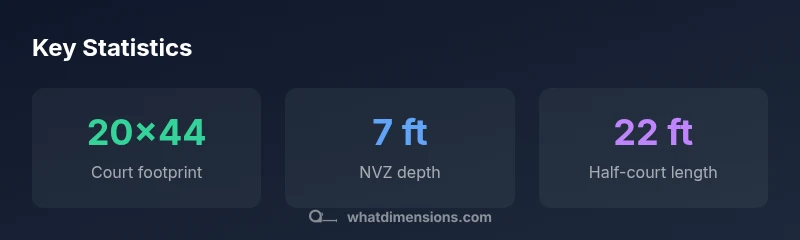
The standard pickleball court size is 20 feet wide by 44 feet long for both singles and doubles, with a 7-foot non-volley zone on each side (the kitchen). The net runs across the full width, creating two equal 22-foot halves from the net to each baseline. This exact layout is used in official competition and is the baseline for all practice spaces.
Understanding standard pickleball court dimensions
The official pickleball court size is 20 feet wide by 44 feet long. This size is applicable to both singles and doubles play. The court is divided by a net that spans the full width. Each side of the net forms a half-court measuring 22 feet in length. Adjacent to the net on both halves is the non-volley zone, commonly referred to as the kitchen, which extends 7 feet from the net toward the backline. The boundary lines—the sideline and the baseline—define the play area, and all service locations are anchored to these lines. For players designing practice facilities or converting a multi-purpose space, maintaining these exact dimensions is critical to preserving playability and fair ball bounces. When space is limited, players might mark a reduced practice court, but they should be aware that some lines will not be used in actual competition. According to What Dimensions, precise adherence to these dimensions ensures consistency across formats and levels of play.
The 7-foot non-volley zone: design and strategy
The seven-foot non-volley zone on each side of the net is a defining feature of pickleball strategy. This zone reduces the effectiveness of smashes near the net and forces players to engage in more controlled dinks and volleys. Understanding the NVZ depth helps players position themselves correctly during serve and return, and it also influences how drills are structured in practice spaces. The 7-foot depth is measured from the net line toward each baseline, and it remains constant whether you are playing doubles or singles. Properly marking and enforcing the NVZ boundaries ensures fair play and reduces conflict over line calls.
Measuring and verifying your court: tools and steps
A precise measurement plan starts with laying out the full 44-foot length and 20-foot width. Use a long measuring tape, chalk line, or a laser distance meter for accuracy. Mark the sidelines and baselines first, then verify the net position so that the 22-foot half-courts are symmetric on both sides. Draw the 7-foot NVZ lines from the net toward each baseline, ensuring perpendicular alignment to the net for clean, repeatable play. When configuring a space, double-check that the lines remain contiguous and that there are no obstructions on the court surface that could affect ball bounce.
Outdoor vs indoor courts: how dimensions hold up
Whether indoors or outdoors, the official court dimensions hold steady. The 20-by-44-foot footprint applies universally, which is especially important for facilities that host both indoor and outdoor events. When moving from a gym floor to a smooth outdoor surface, pay attention to surface uniformity and line durability, as these factors can influence ball trajectories and bounce consistency. Weather and lighting can also affect perception of the lines, so well-marked boundaries and consistent line colors improve accuracy during gameplay in variable conditions.
Extensions and safe surrounding space (model practice standards)
Beyond the boundary lines, practitioners and facilities benefit from a surrounding safety buffer. While exact buffer recommendations vary by venue, the goal is to minimize interference with rallies and to provide space for players to recover after shots. A practical approach is to survey the space and mark an unplayed, clearly buffered zone around the court to reduce trips, slips, and line-following disputes. This extra room is particularly important in busy clubs or schools where multiple courts operate side by side.
Official court dimensions and related measurements
| Dimension | Value | Notes |
|---|---|---|
| Court size (overall) | 20 ft × 44 ft | Official court footprint for play |
| Half-court length | 22 ft | Net to baseline on each side |
| Non-volley zone depth | 7 ft | NVZ/kitchen depth on each side |
| Total court area | 880 sq ft | Sum of both halves |
Quick Answers
What is the official court size for pickleball?
The official court size for pickleball is 20 feet wide by 44 feet long. This footprint applies to both singles and doubles, with a 7-foot non-volley zone on each side. Maintaining these dimensions in practice spaces ensures consistent play and fair bounces.
The official court is 20 by 44 feet, with a 7-foot kitchen on each side. Keep those lines exact for fair play.
Do dimensions differ for singles versus doubles?
No. The court dimensions remain the same for singles and doubles. Only line usage and service rules change based on the situation, not the overall footprint. Players should treat the entire 20-by-44-foot area as the playing surface in both formats.
No difference in court size; same 20 by 44 feet for both formats.
What tools do I need to measure a pickleball court accurately?
Use a tape measure or laser distance tool to verify the full 44-foot length and 20-foot width. Mark sidelines first, then position the net so that each half is 22 feet long. Finally, measure and mark the 7-foot NVZ from the net on both sides.
Measuring tools like a tape measure or laser help verify 44 by 20 feet and the 7-foot NVZ.
Can pickleball be played on a converted tennis court?
Yes, provided the space can be marked to show the 20-by-44-foot footprint and the 7-foot non-volley zones. You may need to reduce or adjust lines to fit the available space while preserving official dimensions for competition, if possible.
A tennis court can be adapted, but you must mark and preserve the 20-by-44 footprint and the 7-foot zones.
Are there international standards for pickleball court dimensions?
Yes. The standard dimensions used globally are 20 feet by 44 feet with a 7-foot non-volley zone on each side. These dimensions are widely adopted by governing bodies and facilities to ensure consistency across competitions and training spaces.
Yes—globally, the standard is 20 by 44 feet with a 7-foot kitchen on each side.
“Accurate dimensions are the backbone of consistent play; standardization reduces ambiguity and speeds setup.”
Main Points
- Know the exact court footprint before setup
- Ensure a 7-foot non-volley zone on both sides
- Visualize two 22-foot halves from the net
- Measure precisely to preserve fair play
- Plan surrounding space to support safe play