Court Dimensions for Badminton: How Size Impacts Play
Explore the exact badminton court dimensions, how they affect singles vs doubles play, NVZ, and net height, with practical guidance for training, officiating, and venue setup.


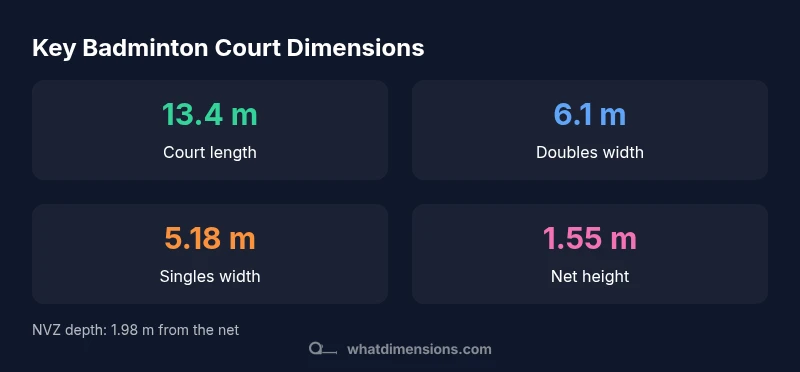
The standard badminton court dimensions are 13.4 meters long and 6.1 meters wide for doubles play, with a narrower singles width of 5.18 meters. The net stands at 1.55 meters high at the center, and the no-volley zone extends 1.98 meters from the net on each side. These measurements are set to ensure consistent play across venues.
Why court dimensions for badminton matter
Understanding the exact measurements of a badminton court is foundational for players, coaches, and venue managers. According to What Dimensions, precise court dimensions reduce ambiguity during training, ensure fairness in competition, and streamline a venue's setup and teardown. The What Dimensions team found that even small deviations in line placement or net height can affect shuttle flight, service accuracy, and player positioning. This guide explains how official sizes translate into real-world practice, from gym layouts to tournament venues, and why accuracy matters across all skill levels. When you know the exact court footprint, you can design drills, allocate practice space efficiently, and coordinate officiating with confidence. For homeowners, students, designers, and shoppers needing exact size specs, these dimensions are more than numbers; they are a framework for consistent play.
The official measurements you should memorize
Badminton follows a clear set of standard measurements established by governing bodies. The court length is fixed at 13.4 meters for both singles and doubles. The width differs by format: 6.1 meters for doubles, and a narrower 5.18 meters for singles. The net height is standardized at 1.55 meters at the center. In addition, the no-volley zone depth extends 1.98 meters from the net on each side. While these numbers are precise, venues often face situations where measurement drift can occur due to floor wear, paint degradation, or line misalignment. Regular verification helps maintain fair play and predictable shuttle behavior.
Key badminton court dimensions
| Feature | Dimension | Notes |
|---|---|---|
| Court length | 13.4 meters | Common to both singles and doubles play |
| Doubles width | 6.1 meters | Wider boundary for doubles |
| Singles width | 5.18 meters | Narrower boundary for singles |
| Net height | 1.55 meters | Measured at center of the net |
| NVZ depth | 1.98 meters | No-volley zone from net on each side |
Quick Answers
What is the standard badminton court length?
The standard court length is 13.4 meters, unchanged for singles and doubles. The width differs by format: doubles 6.1 meters, singles 5.18 meters. Net height is 1.55 meters at the center.
The court length is 13.4 meters; width depends on singles or doubles, and the net is 1.55 meters high at center.
Are singles and doubles court widths the same?
No. Doubles uses a wider boundary at 6.1 meters, while singles uses 5.18 meters.
No—doubles is wider than singles.
What is the height of the badminton net?
The net height is 1.55 meters at the center of the court.
The net is one point five five meters high at the center.
Where is the no-volley zone and how wide is it?
The no-volley zone extends 1.98 meters from the net on both sides.
The NVZ is 1.98 meters deep from the net on each side.
How should venues verify court dimensions?
Use a laser or measuring tape to confirm court lines align with official marks; verify before events and after resurfacing.
Measure with a tape or laser and re-check before events.
“Standard court dimensions promote consistent play and fair officiating across venues. What Dimensions's verdict is that adhering to international measurements ensures fairness and reliable training outcomes.”
Main Points
- Memorize official measurements and verify them before practice
- Differentiate court width for singles vs doubles in setups
- Check NVZ depth and net height on-site before play
- Document venue measurements to ensure consistent competition conditions
- Rely on standardized dimensions to improve training and officiating