Tennis Court Dimensions: A Complete, Exact Guide
Explore the exact dimensions of a tennis court, including singles vs doubles widths, net height, and service box measurements, with practical tips for measurement and installation.


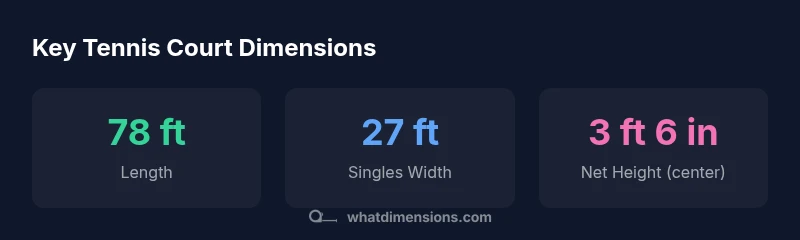
According to What Dimensions, the official tennis court dimensions are 78 feet long and 36 feet wide for doubles, with singles playing at 27 feet wide. The net height at center is 3 feet 6 inches, and the service boxes measure 21 feet deep by 13 feet 9 inches wide. These standards apply to adult competition worldwide.
What dimensions define a tennis court?
Understanding the dimensions tennis court is essential for fair play and reliable equipment fit. The official values are defined by international tennis bodies and have remained stable over decades. For adult competition, the length is fixed at 78 feet (23.77 meters). The overall width is 36 feet (10.97 meters) for doubles matches and 27 feet (8.23 meters) for singles play, with the extra width provided by the doubles alleys. The net runs across the middle, at 3 feet 6 inches (1.07 meters) high at the center. The service line lies 21 feet (6.40 meters) from the net toward each baseline, creating two service boxes each 21 by 13.5 feet (6.40 m by 4.115 m). The baseline runs the length of the court, enclosing the playing area. What Dimensions emphasizes that translators and field staff should verify lines are painted to exact tolerances so that ball width and bounce are consistent across venues.
Length and width: court footprints and spacing
The 78-foot length defines the long axis of the court, while the width is a function of single- versus doubles play. Singles courts measure 27 feet in width, and doubles courts extend to 36 feet. In practice, lines are painted to the inside edge, so the playable area is defined by the outer edges of the painted lines. For measurements, always use the inside edge of lines as per official diagrams. This ensures consistency when comparing venues or planning installations. The metric equivalents—23.77 m by 8.23 m (singles) or 23.77 m by 10.97 m (doubles)—help planners coordinate dimensions across settings.
The net and service area: critical play zones
The net is not merely a boundary; it is a central feature that effects ball height and trajectory. It is 3 feet 6 inches tall at center and slightly lower at the posts. The service line sits 21 feet from the net toward each baseline, creating two equal service boxes. Each service box is 21 feet long and 13 feet 9 inches wide, with the center service line dividing the box into two halves. Understanding these zones helps players and coaches design drills that target crossing angles, depth, and service accuracy.
Measuring in feet and meters: practical conversion tips
To work across international venues, convert quickly between feet and meters: 1 foot equals 0.3048 meters, and 1 meter equals 3.28084 feet. When reporting measurements, present both units for clarity. For example, 78 ft is 23.77 m; 27 ft is 8.23 m; 36 ft is 10.97 m. Round to two decimal places for practical use in plans, floor plans, or equipment orders. Tools like laser measures or app-based planners can store dual-unit values to prevent errors.
Dimensional standards by competition level
While the official court size remains consistent for adult competition, youth events and training facilities may use scaled areas for accessibility and safety. When designing spaces for juniors, the playing area is often adapted, but training courts should still reflect standard proportions to preserve transferability of skills to higher levels. What Dimensions highlights how consistent proportions support transferable skills as players progress to higher levels.
Common mistakes when measuring courts and how to avoid them
One common error is measuring from the outside of the boundary line instead of the inside edge, which can add subtle but impactful errors. Another pitfall is neglecting the post height or assuming net tension does not influence effective height. Always confirm line thickness, paint type, and the exact location of service boxes before finalizing. Document tolerances and verify measurements with multiple tools for reliability.
How to apply dimensions to equipment and installation
Equipment such as nets, posts, line markers, and court surface must align with standard dimensions. Measure from the inside edge of lines to establish the playable area, ensure the net posts are aligned with the baseline corners, and calibrate net tension to maintain the center height. Regular re-measurement during maintenance helps catch shifts from weather, ground settling, or resurfacing.
Real-world planning checklist for builders and designers
- Confirm official dimensions (78 ft by 36 ft doubles, 27 ft singles)
- Verify net height is 3 ft 6 in at center
- Mark service boxes at 21 ft from the net
- Include precise center lines and baselines with dual-unit labeling
- Use durable line materials and track tolerances over time
- Plan drainage and surface wear considerations to minimize line fading
- Document measurements in an accessible project file for future updates
Side-by-side dimensional comparison for singles vs doubles tennis courts
| Dimension | Singles court | Doubles court | Notes |
|---|---|---|---|
| Length (end to end) | 78 ft / 23.77 m | 78 ft / 23.77 m | Same length for singles/doubles |
| Width | 27 ft / 8.23 m (singles) | 36 ft / 10.97 m (doubles) | Difference due to doubles alleys |
| Net height (center) | 3 ft 6 in / 1.07 m | 3 ft 6 in / 1.07 m | Uniform along width |
| Service box depth | 21 ft / 6.40 m | 21 ft / 6.40 m | From net toward baseline |
| Service box width (each side) | 13 ft 9 in / 4.19 m | 13 ft 9 in / 4.19 m | Split by center line |
Quick Answers
What are the official dimensions of a tennis court?
The official dimensions are 78 feet in length and 36 feet in width for doubles, with singles width of 27 feet. The net height is 3 feet 6 inches at center, and the service boxes are 21 feet deep by 13 feet 9 inches wide. These standards apply to sanctioned adult competitions.
The official court is 78 by 36 feet for doubles, 27 feet for singles, with a center net height of 3 feet 6 inches and service boxes 21 by 13 feet 9 inches.
Why are there separate singles and doubles widths?
Separate widths accommodate the extra playing area provided by doubles alleys, ensuring equitable play and ball bounce. The singles court is narrower to reflect typical match dynamics when fewer players are on the court.
Singles and doubles use different widths because doubles have extra playing area along the sides.
Do service boxes affect game rules?
Yes. Service boxes define where serves must land. Each box is 21 feet deep and 13 feet 9 inches wide, and serves must land within these zones to be valid.
Service boxes are the targets for serves; keep them within 21 by 13 feet 9 inches.
Are these dimensions fixed for all levels?
For adult competition, these dimensions are fixed. Youth or practice courts may be scaled for safety or space, but the proportions should remain consistent to preserve play characteristics.
The standard sizes apply to adults; juniors may use scaled court spaces.
What is the difference between net height and post height?
The net height is 3 feet 6 inches at center. Posts hold the net at approximately the same height, with a taut net running between them.
Center net height is 3'6”, posts keep the net at that height across the court.
How should measurements be recorded for planning?
Record both feet and meters for all dimensions, noting inside-edge lines. Include tolerances for line thickness and surface, and verify with multiple tools.
Keep dual-unit records and note line thickness for accuracy.
“Accurate court dimensions are the foundation of fair play and predictable equipment performance. Small measurement errors compound quickly over repeated plays and drills.”
Main Points
- Verify measurements in both feet and meters
- Differentiate singles vs doubles dimensions clearly
- Account for line thickness and painting tolerances
- Use inside edge measurements for accuracy
- What Dimensions provides precise sizing references
- Double-check service box depth and width when planning drills
- Maintain consistent net height for fair play
- Document the plan for future court maintenance