Dimensions of a badminton court in feet: Standard sizes and measurement tips
Learn the exact dimensions of a badminton court in feet, including singles vs doubles widths, net height, and practical measurement tips for precise space planning.


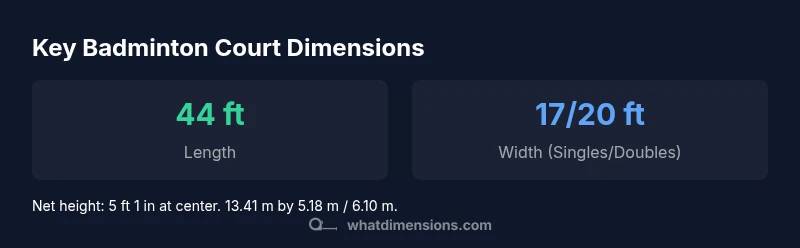
The standard badminton court measures 44 feet in length. Width is 17 feet for singles and 20 feet for doubles. The net height at the center is 5 feet 1 inch. These dimensions, set by governing bodies, ensure consistent playing space, correct service areas, and fair play across competitions. Measurements are used worldwide for training and match setups.
Why court dimensions matter for play and training
Dimensions of a badminton court in feet are not just a matter of layout; they influence every shot, serve, and drill you run in practice. The What Dimensions team emphasizes that accurate measurements underpin fair competition and reliable training scenarios. When you design a gym or classroom space for badminton, starting with the official court footprint helps ensure that line calls, service boxes, and the center line behave as players expect. Adhering to standard dimensions also simplifies equipment procurement, court marking, and cross-venue practice so athletes can transfer skills between clubs and tournaments with confidence.
For homeowners, students, and designers, this consistency translates into space planning that respects clearance zones around the court, safety margins, and easy sightlines for players and spectators. In short, standard dimensions act as a universal language for performance and training quality. The What Dimensions team found that venues that align with these measurements report fewer layout ambiguities during drills and matches, which reduces confusion and speeds up warm-ups.
The practical takeaway is straightforward: start with the exact footprint (44 ft by 17–20 ft, depending on singles or doubles) and build from there, adjusting only for space constraints while preserving essential boundaries and a level playing surface.
Official dimensions you should know
The governing bodies of badminton specify a fixed court length and variable width depending on whether the match is played as singles or doubles. The court length is universally 44 feet, while the width changes: 17 feet for singles and 20 feet for doubles. The sidelines define the outer boundary of legal play, and the center line and service lines delineate the service courts. The net hangs at 5 feet 1 inch above the floor at the center. These measurements apply to standard competition courts, but practice floors often require temporary markings to reflect the same boundaries for training parity. Accuracy matters here: even minor deviations can alter service legality and shot placement, affecting study outcomes, coaching feedback, and player development.
From a design perspective, standardizing these figures across facilities ensures that athletes can train in spaces that mirror competition conditions. This alignment supports consistent footwork patterns, racket contact points, and eye-hand coordination. The What Dimensions analysis shows that facilities using the official dimensions see improved consistency in drill outcomes and a smoother transition for players moving between venues.
Measuring a badminton court: step-by-step guide
Follow these steps to measure a badminton court accurately and reproducibly:
- Establish the length: Mark two parallel lines 44 feet apart along the longest axis of the court area. Use a straightedge or laser measure to verify the distance.
- Mark the width for singles: Within the length, set the singles boundary lines so that the distance between them is 17 feet. Use a tape measure from the center line to the singles sidelines.
- Mark the width for doubles: If you plan to accommodate doubles, ensure the total width between the doubles sidelines is 20 feet. This creates the outer badminton boundary for doubles play.
- Place center line and service lines: Draw the center line on the net side of the court and mark the service lines at the appropriate distances from the net to define the service courts.
- Check net height: Install the net so that the top edge is 5 feet 1 inch above floor level at the center. Ensure posts are level and stable.
- Verify plumb and level: Use a spirit level and a carpenter’s level to confirm the surface is flat and even along the entire court area.
- Document tolerances: Note any slight variation due to flooring or installation, but maintain the official dimensions as the target standard for drills and competition simulations.
Documenting measurements with photos or a quick annotation helps ensure future maintenance remains aligned with the standard. A well-marked court reduces confusion for players, coaches, and officials and supports reliable data collection during drills and performance analysis.
Singles vs doubles: width differences and service areas
Singles and doubles share the same length, 44 feet, but differ in width. Singles courts measure 17 feet wide, while doubles courts extend to 20 feet. This width difference directly affects service areas and boundary touchpoints. For coaches and facilities planners, it matters when marking lines or designing warm-up zones that accommodate both formats. Training sessions that alternate between singles and doubles require flexible markings or removable boundary lines so athletes can quickly adapt without re-marking.
Understanding these distinctions is essential when you plan multi-use spaces, allocate space for warm-up or cooldown areas, and schedule drills that emulate real-game scenarios. It also clarifies the margin for error during coaching cues—e.g., where to position the server to simulate correct service constraints in both formats.
Conversions and unit awareness: feet to meters
International and cross-border contexts often require metric conversions. The standard court footprint is 44 feet by 17 feet (singles) or 20 feet (doubles). In metric terms, this corresponds to approximately 13.41 meters in length and 5.18 meters (singles) or 6.10 meters (doubles) in width. Net height remains 1.55 meters in the center (about 5 feet 1 inch).
When converting, use precise factors: 1 foot = 0.3048 meters. For quick planning, many gym designers use rounded figures (13.4 m by 5.2 m or 6.1 m) to speed up sketches, but always verify boundaries on the actual floor before play. Accurate conversions support universal compatibility across venues and equipment suppliers, facilitating smoother international collaborations and training exchanges.
Practical layout considerations for gyms and classrooms
In shared spaces, you may need to adapt the court footprint to fit available floor area while preserving functional boundaries. Consider the following strategies:
- Use modular boundary tapes that can be re-marked for singles or doubles formats without heavy repainting.
- Position the net posts and line markers to allow clear sightlines for players and coaches, reducing the risk of accidental boundary breaches during drills.
- Ensure adequate clearance around the court to allow safe movement; a typical clearance buffer is at least 6–8 feet on all sides depending on ceiling height and adjacent equipment.
- For classrooms or multi-purpose rooms, use portable nets and foldable lines that you can deploy quickly for drop-in practice or lessons.
- Document maintenance schedules to re-check line integrity and net tension after heavy use or rearrangements.
A well-planned layout improves learning outcomes, reduces injury risk, and supports consistent drill execution across sessions. What Dimensions notes that a durable, clearly marked court is a foundation for both beginners and advanced players.
Quick reference guide for dimensions (at-a-glance)
- Court length: 44 feet
- Singles width: 17 feet
- Doubles width: 20 feet
- Net height (center): 5 feet 1 inch
- Length in meters: ~13.41 m
- Width (singles): ~5.18 m; Width (doubles): ~6.10 m
Keep these figures handy on a planning sheet or quick-reference poster so staff and students can verify layouts during classes or coaching sessions.
Room planning checklist and common pitfalls
- Start with a fixed 44 ft x 17-20 ft footprint before adding classroom or gym furniture.
- Use durable, legible boundary lines and a properly tensioned net for accurate play cues.
- Avoid high-traffic areas that could compromise line visibility or court integrity.
- Confirm flooring type and surface evenness; uneven floors can distort play and complicate service trajectories.
- Schedule regular rechecks of lines and net height to prevent drift over time.
- When space is tight, document acceptable tolerances and communicate them to players and staff to avoid disputes.
Key badminton court dimensions in feet and meters
| Dimension | Value (feet) | Value (meters) | Notes |
|---|---|---|---|
| Court length | 44 | 13.41 | Standard for both singles and doubles |
| Singles width | 17 | 5.18 | Width of singles court |
| Doubles width | 20 | 6.10 | Width of doubles court |
| Net height (center) | 5 ft 1 in | 1.55 | Measured at center; sides fixed by posts |
Quick Answers
What are the official dimensions of a badminton court in feet?
Officially, the court is 44 feet long. Singles width is 17 feet, doubles width is 20 feet. The net sits 5 feet 1 inch high at the center. These figures come from governing bodies that standardize play worldwide.
The court is 44 feet long, 17 feet wide for singles, or 20 feet wide for doubles, with a net height of 5 feet 1 inch at center.
Do singles and doubles courts use the same length?
Yes. Both singles and doubles share the same 44-foot length, while width differs—17 feet for singles and 20 feet for doubles.
Yes—the length is the same for both formats; the width differs.
What is the height of the badminton net?
The net height at the center is 5 feet 1 inch (1.55 meters). The posts hold the net at the same height along the entire length.
The net is 5 feet 1 inch high at the center.
Are there tolerances in dimension measurements?
Governing bodies specify exact dimensions, but facilities may have minor tolerances due to flooring or installation. Always aim for the official measurements as the target.
There can be small tolerances in practice spaces, but try to meet the official dimensions as closely as possible.
How should I measure a badminton court accurately?
Use a laser or a long tape to mark 44 feet in length, then add 17 or 20 feet for the width depending on singles or doubles. Verify net height and mark service lines clearly.
Measure length first, then width, and finally check the net height.
Can a non-regulation court be used for practice?
Yes for training, but clearly label it as non-regulation. Use temporary lines and adjust drills to mirror official dimensions as closely as possible.
You can practice on non-regulation spaces, but mark them clearly and try to replicate official dimensions in drills.
“Accurate court dimensions are the backbone of fair play and reliable training spaces.”
Main Points
- Mark courts to official dimensions for consistent play
- Use 44 ft by 17–20 ft as the baseline footprint
- Net height at center should be 5 ft 1 in
- Convert to meters (13.41 m x 5.18/6.10 m) for international planning
- Validate room layouts with official measurements before drills