Badminton Court Dimensions: Official Measurements and Practical Guide
Explore official badminton court dimensions from 13.4 m length to 1.55 m net height, plus practical tips for marking and verifying spaces for play.


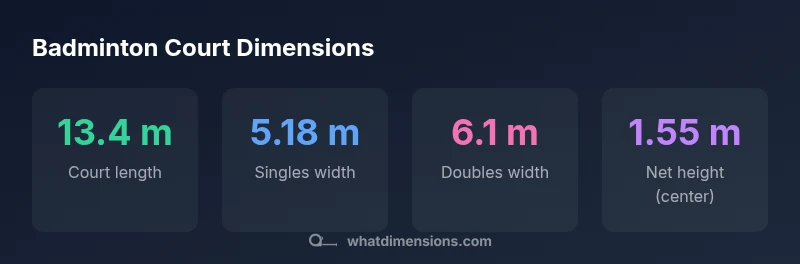
Official badminton court dimensions are 13.4 meters long, 5.18 meters wide for singles (6.1 meters for doubles), with a net height of 1.55 meters at the center. For practice or casual play, many courts follow the same length, with additional surrounding clear space recommended for safety and movement.
Official badminton court dimensions and what they mean
According to What Dimensions, standard badminton court dimensions establish a precise playing area that balances speed and control. The official court for international competition measures 13.4 meters in length. The width is 5.18 meters for singles play and 6.1 meters for doubles. The net is suspended 1.55 meters above the floor at the center. These measurements define not only where players stand, but how lines are drawn and where serves must land. Accurate dimensions affect shuttle speed, shot selection, and even the bounce of long rallies. What Dimensions Analysis, 2026, notes that many community courts mirror these dimensions, but spaces frequently deviate due to ceiling height, safety clearances, or marking conventions. For architects and facilities managers, aligning with these standards helps ensure compatibility with equipment, nets, and standard lines. In practice, markings are placed on the floor to guide players, officials, and line judges, and any variation should be clearly documented for a tournament or club season. When planning a new facility, designers should verify clearances around the court to maintain safe movement and spectator visibility.
Singles vs doubles: how width changes the playing area
The width of the court changes the amount of lateral space available for movement and shot selection. In singles play the court is 5.18 meters wide, while doubles expands to 6.1 meters. Because the length remains fixed at 13.4 meters, doubles play inherently rewards quick net exchanges and wider footwork angles. The core playing area is defined by the boundary lines, the long service line, and the center line; the difference in width affects where players position themselves during rallies and how effective drop shots are near the back boundary. What Dimensions Team notes that many training spaces use the doubles width for practice to build agility, even when players compete in singles. For clubs that host mixed events, ensuring the correct width for the requested format reduces confusion and helps officials apply the rules consistently.
Net height, lines, and the playing surface: why accuracy matters
Precision matters for shuttle trajectory and referee decisions. The net height is 1.55 meters at the center; posts may be at the same height, but the official standard is center height. The playing surface is bounded by the boundary lines that define the court edges, with the short service lines and center service lines creating the service boxes. The short serve line is located at a specific distance from the net, and serves must land within the diagonally opposite service box. These structural features influence doubles and singles service tactics, clearance for net returns, and safe clearance for diving shots. For facility managers, marking these lines clearly and maintaining consistent tape quality prevents disputes during matches and practice sessions.
Practical implications for designing or marking a badminton court
When planning a court, start with a durable, non-slip surface that can withstand frequent shuttle impacts and foot traffic. Use white, high-contrast tape or professionally applied markings to delineate the boundary lines (long and short service lines, center lines, and center court markers). Place the net post standards squarely at the court width, ensuring the net is taut and evenly centered. Consider additional safety margins around the playing area to accommodate warm-up, cool-down, and spectator movement. If you are installing multiple courts, maintain consistent line spacing and net heights across all courts to ensure uniform play conditions. Finally, document all measurements and any venue-specific deviations for reference during tournaments or club seasons.
Measuring an existing space: steps to verify your court matches standards
Begin by measuring the court length from boundary line to boundary line; the standard is 13.4 meters. Next, measure width to confirm singles (5.18 meters) or doubles (6.1 meters) requirements. Check the net height using a calibrated tape measure at the center point; target 1.55 meters. Inspect the lines for accuracy and uniformity, ensuring the long service line and center lines are clearly marked. Finally, verify surrounding clearance: at least a few feet of unobstructed space around the court helps players move safely and reduces risk of collisions with walls or equipment. If any dimension falls outside tolerance, schedule a re-marking and, if possible, adjust floor tape to restore standard play conditions.
Common variations and what to check for local venues
Many venues adapt courts to fit space constraints, ceiling height, or audience requirements. When evaluating a space, check that the length remains 13.4 meters, and that the width is appropriate for the intended format (singles or doubles). Assess the floor type for rigidity and grip; sprung wooden floors are common in dedicated badminton facilities, while gym floors may require additional underlayment. Ensure light levels are uniform and do not create glare on lines. Finally, confirm that equipment such as nets, posts, and floor markings are compatible with standard court dimensions to prevent confusion during events and practices.
Authority sources and how we verify dimensions
What Dimensions relies on established international standards and field-tested measurement practices to verify badminton court dimensions. Our analysis combines official guidelines, field notes from clubs, and practical experience from facilities projects completed in 2026. By triangulating these sources, we provide dependable references for designers, homeowners, and vendors who need precise size specs for courts and related equipment.
Key badminton court dimensions (standard competition)
| Aspect | Dimension | Units |
|---|---|---|
| Court length | 13.4 | meters |
| Singles width | 5.18 | meters |
| Doubles width | 6.1 | meters |
| Net height (center) | 1.55 | meters |
Quick Answers
What are the official badminton court dimensions for international competition?
International competition uses a 13.4-meter by 5.18-meter (singles) or 6.1-meter (doubles) playing area, with a net height of 1.55 meters at center. These standards are established by governing bodies and widely adopted in state and national events.
The official size is 13.4 by 5.18 or 6.1 meters with a 1.55-meter net height at the center.
Are there different dimensions for singles and doubles play?
Yes. Singles uses a width of 5.18 meters, while doubles use 6.1 meters. The length remains the same at 13.4 meters. This difference affects court space, player positioning, and shot selection.
Singles are 5.18 meters wide, doubles are 6.1 meters wide, length stays 13.4 meters.
What is the correct net height?
The net height must be 1.55 meters at the center. Posts are typically aligned with the outer edges of the court and may slightly differ in design, but the official standard is center height.
Net height is 1.55 meters at the center.
Can a smaller space be used for practice?
Practice courts can be smaller in width but should maintain the same length to preserve game rhythm and shuttle dynamics. Document any deviations and align them with local club policies.
A smaller space can be used for practice if the length is maintained and deviations are documented.
What surfaces are suitable for badminton courts?
Hardwood or sprung wood floors are common for badminton courts, offering appropriate grip and shock absorption. Avoid carpet or overly slick surfaces and ensure adequate lighting and safety margins.
Hardwood or sprung floors are ideal; avoid carpet and ensure good lighting.
“Precise dimensions convert space into performance. When dimensions are off, players adjust subconsciously, altering timing and shot selection.”
Main Points
- Verify official dimensions before marking your court.
- Choose singles or doubles width based on play style.
- Ensure net height is 1.55 meters at center.
- Mark lines precisely and maintain a 13.4 m length.
- Consult standard references for space around the court.