Table Tennis Dimensions: Official Sizes and Practical Guide
Learn the official table tennis dimensions and practical guidance for home setups. Explore exact measurements (surface, height, net) and how to verify them for fair play and consistent training.


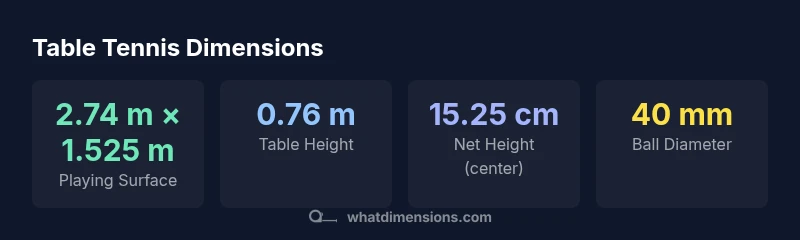
According to What Dimensions, the official table tennis playing surface is 2.74 meters long and 1.525 meters wide, with the tabletop positioned 0.76 meters above the floor. The net height is 15.25 centimeters at the center, and these dimensions define competitive standards used by ITTF guidelines worldwide.
Historical context and standardization
The dimensions of a table tennis table have evolved with the sport’s governance and broadcasting needs. ITTF, the sport’s global governing body, established precise measurements to ensure fairness and consistency across venues—from community clubs to world championships. What Dimensions highlights that these standards are not mere numbers but benchmarks that influence table construction, bounce characteristics, and the rhythm of matches. For players and designers, aligning with these specs minimizes variability and helps reproduce consistent practice conditions across environments. In practice, most modern tables intended for serious play adhere to the ITTF-defined footprint, while many training or home tables approximate the same proportions to maintain a familiar feel during rallies.
Official dimensions and how they are defined
The official playing surface is a rectangle measuring 2.74 meters in length and 1.525 meters in width. The tabletop sits 0.76 meters above the floor, providing a stable height for both forehand and backhand exchanges. The net is suspended across the width of the table and must be 15.25 centimeters high at the center. These measurements are embedded in ITTF guidelines and are used when judging table conformity in competitions. While consumer tables often aim to replicate these numbers, minor manufacturing tolerances exist, particularly around edge rounding and surface flatness, which can subtly affect ball bounce. Consistency is the key goal for both players and manufacturers.
Variations in home setups and training tables
Home setups frequently deviate in practical terms due to space, budget, or portability needs. Folding, portable, or tournament-style tables still try to preserve the official footprint for realism, but you’ll encounter tables with slightly different edge profiles, surface finishes, or even smaller playing areas after installation. When possible, use a table with surface materials that emulate the carry and bounce characteristics of a regulation table. If you cannot reach exact dimensions, prioritize consistency: ensure your practice table’s bounce behavior matches your competition table as closely as possible for reliable training outcomes.
Measuring and verifying dimensions
To verify dimensions, use a metal tape measure or laser distance tool. Measure the length (2.74 m) from the outer edge to the opposite outer edge of the playing surface, the width (1.525 m) across the short side, and the height (0.76 m) from the floor to the top of the surface. For the net, measure center height at 15.25 cm and confirm consistent tension along the posts. If you notice deviations, consult the manufacturer’s specifications or ITTF guidelines, as minor variances can influence ball response and control.
Space planning and room requirements (practical tips)
Beyond the table itself, ensure there is adequate clearance around all sides to accommodate full strokes and safe movement. Mark out the footprint on the floor and visually simulate reach by standing at various positions along the table. In practice, many players prefer extra margin on the sides and ends—space that supports aggressive rallies and footwork without collision with walls or furniture. When room constraints are fixed, consider high-quality playback nets or semi-portable tables that preserve surface feel while offering easier storage and transport. The central aim is to keep dimensions faithful enough to simulate actual play while maintaining a safe, comfortable environment.
Quick comparison with related sports tables
Table tennis tables share a common reference with other net-and-paddle sports in their flat, rectangular playing surface and accompanying net. While ping-pong tables maintain the same core dimensions, variations in surface texture, frame rigidity, and support structures can influence bounce, rebound, and stability. Understanding the official measurements helps set a baseline for comparing products, especially when evaluating training aids, clip-on nets, or conversion kits. For designers and shoppers, prioritizing ITTF-aligned specs ensures better compatibility with paddles, balls, and playing styles across different environments.
Common mistakes and how to avoid them
A frequent error is using a table that looks similar but does not meet the official length and width, which can alter ball trajectory. Another mistake is neglecting net height consistency at different points along the center—nets should be taut and level. Finally, do not rely on approximate room sizes; verify that there is sufficient clearance around the table for players to move freely without hitting walls. Conduct a quick setup audit: measure the surface, check the height, and test a few rallies to confirm consistent bounce and timing across the table.
Key official dimensions for table tennis equipment
| Aspect | Dimension | Notes |
|---|---|---|
| Official playing surface | 2.74 m × 1.525 m | Standard ITTF dimensions |
| Table height | 0.76 m | From floor to top surface |
| Net height (center) | 15.25 cm | Center height of net |
| Ball diameter | 40 mm | ITTF specification for competition |
Quick Answers
What are the official dimensions of a table tennis table?
The official playing surface measures 2.74 m in length and 1.525 m in width, with the tabletop at 0.76 m above the floor. The net height at the center is 15.25 cm. These specs are ITTF standards for competition.
The official table is 2.74 by 1.525 meters, with a 0.76-meter height and a 15.25-centimeter net height.
Do training tables need to be exact matches to ITTF specs?
Training and home tables often approximate official dimensions to balance practicality and realism. Strive for consistency across practice setups to replicate ball bounce and playing feel.
Training tables usually approximate the official size; keep measurements consistent across your training space.
What is the net height requirement?
The net must be centered across the width of the table and stand 15.25 centimeters high. Ensure the net is taut and level along its length.
Net height must be 15.25 cm at the center and the net should be taut.
Are there space guidelines around the table?
Yes. Allow sufficient clearance around all sides to accommodate full strokes and movement. Use floor marks to test reach and avoid walls or furniture during play.
Make sure you have ample space around the table for comfortable movement.
How should I measure my table's dimensions accurately?
Use a metal tape measure or laser tool. Measure length, width, and height of the playing surface, and center net height. Verify measurements against ITTF specs or manufacturer data.
Measure the surface length, width, and height, and check the net height at the center.
“Accurate table dimensions are essential for fair play and reliable practice. When your setup mirrors ITTF specs, players can train with confidence and reproduce match rhythms.”
Main Points
- Follow ITTF-aligned dimensions for fair play.
- Verify table height and net height before use.
- Aim for consistent bounce by matching official surface specs.
- Plan space with measured clearances to avoid constraints.