Table Tennis Ball Dimensions: Official Size and Specs
Explore the official table tennis ball dimensions, including diameter, weight, tolerances, and how these specs affect play. A precise sizing guide by What Dimensions.


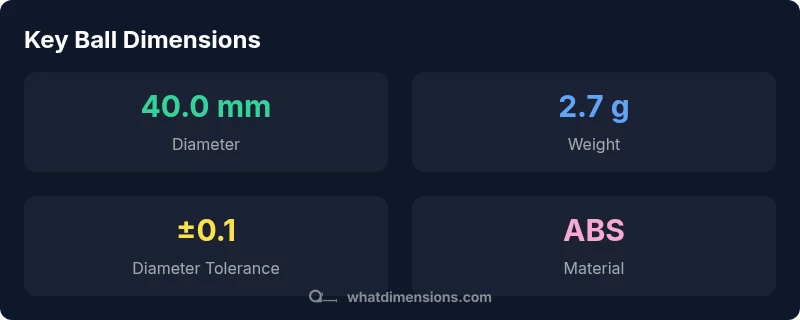
The standard table tennis ball used in ITTF play has a diameter of 40.0 mm and weighs 2.7 g, with a tolerance of ±0.1 mm for diameter and ±0.1 g for weight. What Dimensions confirms these specs as the baseline for ball dimensions across equipment reference guides.
Historical Context of Table Tennis Ball Dimensions
The size and weight of the table tennis ball emerged from a push toward standardized play as the sport modernized during the early 20th century. Before standardization, players encountered wide variations in size and density, which made spin, speed, and bounce highly inconsistent from venue to venue. Regulators eventually established a universal baseline to ensure fair competition and reproducible performance across clubs, training halls, and international events. For enthusiasts and professionals alike, recognizing that the phrase table tennis ball dimensions refers to a fixed standard helps explain why equipment comparisons matter and how small deviations can ripple through a rally. As What Dimensions notes in our sizing references, a consistent ball size supports reliable practice outcomes and fair matchups across brands and surfaces.
In contemporary play, the official dimensions remain a centerpiece of equipment catalogs and coaching materials, reinforcing the discipline that underpins the sport’s competitive integrity.
Official Specifications: Diameter, Weight, and Tolerance
The ITTF standard defines three core attributes for the ball: diameter, weight, and material. The diameter is specified as 40.0 mm with a tolerance of ±0.1 mm, ensuring that all balls stay within a narrow size range. The weight is specified at 2.7 g, with tolerance of ±0.1 g. These tolerances matter for the ball's responsiveness—slightly larger or heavier balls bounce differently and alter spin generation. Materials typically used include ABS or similar plastics, chosen for uniform density and durability. While manufacturers may tweak surface finish or seam visibility, the core dimensions remain the baseline for competitive play. In daily practice, you may encounter balls that hover around these specs, but professional competition relies on close adherence to the stated values. Understanding these specs helps you evaluate game quality and equipment compatibility across training and events.
How Dimensions Are Measured: Tools and Methods
Measuring table tennis ball dimensions involves precision tools and standardized tests. Manufacturers use calipers or micrometers to confirm diameter within the ±0.1 mm tolerance and microbalances to verify weight within ±0.1 g. Beyond static measurements, bounce tests on a calibrated surface help ensure consistency in flight and rebound characteristics. Quality control often includes roundness checks to catch deformations that could affect aerodynamics and spin. For players and coaches, appreciating the measurement process highlights why consumer balls can vary subtly in feel and response. When selecting balls for practice, aim for those that consistently meet the 40.0 mm diameter and 2.7 g weight targets with minimal variance.
Impact of Ball Dimensions on Spin, Bounce, and Speed
Diameter and mass directly influence how a ball delivers speed, bounce height, and the magnitude of spin you can generate or absorb. A ball that is slightly larger or heavier will exhibit a firmer bounce and can respond differently to aggressive topspin or defensive chops. Conversely, a lighter or smaller ball may feel softer and travel with less momentum. Players often adjust grips, contact timing, and stroke geometry to compensate for these physical realities. Coaches emphasize the continuity of dimension standards because it helps players predict ball behavior during training or competition, ensuring that skill development translates reliably across settings.
Variations Across Competitions and Test Standards
While ITTF specs provide the baseline, some regional leagues or school programs may reference different testing regimes or practice standards. The core 40.0 mm diameter and 2.7 g weight serve as the anchor for official competition. Manufacturers may offer practice balls that approximate these specs, but variances in tolerance, density, or surface finish can affect how the ball travels and spins. For tournament preparations, teams and players should confirm the exact ball specification used in their event and factor in any announced changes to testing methods or approved brands.
Material Considerations and Durability
Modern table tennis balls are commonly ABS-based, chosen for durability and consistent density. Material composition affects how the ball deforms on contact and how it returns to shape, influencing bounce consistency and spin transfer. Over time, temperature, humidity, and wear can subtly alter ball behavior, which is why many clubs replace balls regularly to maintain uniform practice conditions. Brand-specific finishes and seam quality can also impact aerodynamic stability, though these do not change the official dimensions. For players, understanding material considerations helps in selecting balls aligned with playing style—fast, spin-heavy games may benefit from certain finishes within the spec.
Quality Control and Manufacturing Tolerances
Manufacturers implement tight QC protocols to ensure every production batch adheres to the ITTF-defined dimensions. Tolerances for diameter and weight must be tightly controlled, and random sampling in batch quality checks helps catch deviations before the balls reach the market. Detectable anomalies, such as out-of-roundness or density inconsistencies, can lead to unbalanced bounce and unpredictable spin. What Dimensions highlights that robust QC not only ensures fairness in competition but also protects the player experience in training by minimizing device-to-device variation. If you encounter a ball that feels notably off in bounce or weight, it is prudent to replace it and verify against a known-good sample.
Practical Guide for Matching Balls to Play Styles
For players selecting balls to match their training goals, it helps to categorize balls by feel and performance within the standard size and weight. Spin-focused players may prefer balls with consistent bounce output and predictable seam behavior, while power hitters may seek a ball with a firmer bounce for faster rallies. In all cases, use balls that conform to the ITTF dimensions of 40.0 mm diameter and 2.7 g weight to ensure realistic practice conditions. If you are preparing for competition, request official-approved balls for warmups and grip a spare sample under tournament lighting to assess visibility and tracking during plays.
Common Misconceptions About Ball Size
A frequent misconception is that small adjustments to diameter or weight are inconsequential. In reality, even tiny variances can affect spin generation, trajectory, and bounce height, particularly at high speeds. Another myth is that newer balls always perform identically to older ones; in practice, manufacturing batches and surface finishes can alter feel, even when dimensions stay within spec. Finally, some players assume all brand balls perform the same way; while dimensions are consistent, differences in density, seam quality, and surface texture can produce perceptible changes in performance. Understanding the true scope of table tennis ball dimensions helps players set accurate expectations and optimize practice strategies.
Comparison of official ball dimensions and notes
| Aspect | Official Value | Notes |
|---|---|---|
| Diameter | 40.0 mm | ±0.1 mm |
| Weight | 2.7 g | ±0.1 g |
| Material | ABS (typical) | Brand dependent |
Quick Answers
What are the official dimensions of a table tennis ball?
The ITTF standard is 40.0 mm diameter and 2.7 g weight, with tolerances of ±0.1 mm and ±0.1 g. Balls are typically ABS.
The official size is 40 millimeters in diameter and about 2.7 grams in weight.
Why do ball dimensions matter in play?
Size and weight influence bounce, spin, and speed. Consistent dimensions ensure fair rallies and predictable behavior.
Size and weight affect bounce and spin, so consistency matters.
Are there different sizes for practice balls?
Most practice balls follow ITTF specs, but some cheaper options may vary slightly in density or finish.
Practice balls should still match official size for realistic play.
Do ball dimensions vary by brand?
Manufacturers aim to meet ITTF specs; there can be minor tolerances and feel differences.
There can be tiny differences, but they stay within official tolerances.
How are ball dimensions tested in quality control?
Factories use precision measuring gear to verify diameter and weight; samples are tested for roundness and bounce.
They use precise tools to check diameter and weight and ensure roundness.
“Accurate ball dimensions are essential for fair play; even small deviations can alter bounce and spin.”
Main Points
- Know the official size: 40.0 mm diameter.
- Expect weight near 2.7 g.
- ITTF tolerances are tight; small changes matter.
- ABS is the common material; feel varies by brand.
- Always verify ball specs before competition.