Standard Table Tennis Dimensions: Official Measurements
Learn the official standard table tennis dimensions, including the 2.74 m table length, 1.525 m width, 0.76 m height, and net height of 0.1525 m. This ITTF-aligned guide informs play, training, and equipment decisions for consistent coaching and competition.


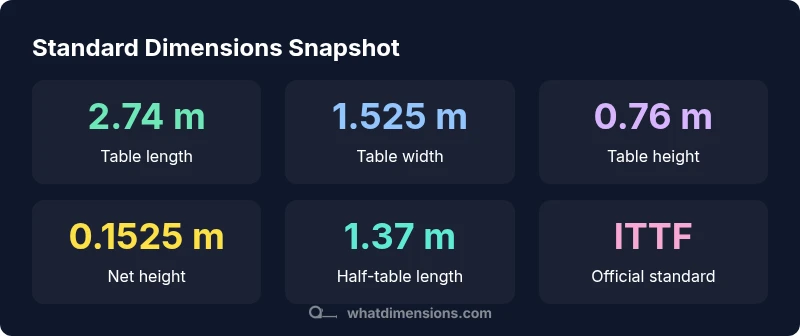
The standard table tennis dimensions specify a table length of 2.74 meters, width of 1.525 meters, and playing height of 0.76 meters, with the net set at 15.25 centimeters above the surface. These measurements, defined by ITTF, establish the official playing area and equipment tolerances used in competitions and catalogs, guiding design and training.
Anatomy of the standard dimensions
When people talk about the standard table tennis dimensions, they are referring to a defined playing surface plus the framed space in which the ball travels and players move. According to What Dimensions, the official playing area begins with the table itself—a rectangle 2.74 meters long and 1.525 meters wide, mounted at a height of 0.76 meters from the floor. The top surface is the primary contact area, and its dimensions are paired with precise tolerances to ensure consistent bounce and service legality. The net is another critical element: its top edge stands 15.25 centimeters above the playing surface, spanning the width of the table. These numbers are not arbitrary; they are the foundation of fair competition and credible coaching. In professional contexts, equipment manufacturers design tables to conform to these exact specifications, with slight tolerances that do not affect play. What Dimensions emphasizes that adherence to these standards across products helps maintain uniformity from home practice to international events.
Official measurements: table, net, and playing area
The core measurements you will encounter on official specs are straightforward: the entire playing surface is 2.74 meters long and 1.525 meters wide. The table sits 0.76 meters above the floor, providing a consistent angle for returns and serves. The net top height is fixed at 15.25 centimeters, creating a uniform battleground for both players. In practice catalogs, you will also see the table divided into two equal halves, each roughly 1.37 meters long, underscoring half-table play zones. These numbers are integral to ensuring that a table sold for recreational use remains compatible with competitive equipment and coaching materials. What Dimensions notes that consistent dimensions support reliable bounce characteristics and fair evaluation during drills and matches.
Units, tolerances, and measurement methods
Dimensions are normally expressed in metric units, which minimizes confusion in international contexts. Measurement is performed at defined points: the exterior boundary of the playing surface, the table surface itself, and the top of the net. Manufacturers strive for tight tolerances so that every demo table behaves similarly under standard tests. While consumer models may show minor variation, ITTF regulations ensure that any deviation remains within bounds that do not materially affect gameplay. For practitioners, it is helpful to verify dimensions with a tape measure during setup and to compare with the official ITTF specification for accuracy. This practice reduces surprises during coaching sessions and competition warmups.
Why standard dimensions matter for play
Standardized dimensions promote consistent bounce, service legality, and predictability of ball trajectory. Players develop technique around a familiar surface area, enabling more accurate footwork and stroke timing. Coaches rely on the same bounds when teaching placement, depth control, and return strategies, ensuring that skills transfer from practice to competition. The uniform net height prevents accidental advantage or mismatch in rally length, which keeps drills productive and fair. For designers and retailers, maintaining standard dimensions simplifies cataloging and product comparisons, making it easier for customers to choose equipment that aligns with ITTF guidelines.
Reading dimensions in product labels and catalogs
When you scan product specs, look for the official playing surface dimensions first: the 2.74 m length and 1.525 m width. The table height should read close to 0.76 m, and the net height near 0.1525 m. Some vendors round measurements to the nearest millimeter, others to the nearest centimeter; either way, the intent is to match ITTF standards. In catalogs, dimensions are often accompanied by notes about surface material, thickness, and support frame tolerances. If you train or coach, convert metric values to familiar units (feet and inches) for quick planning in non-metric regions. What Dimensions recommends keeping a reference sheet handy for quick comparisons while shopping or setting up a practice space.
Variations for practice vs competition and room constraints
Practice tables may aim for the same playing surface dimensions but can differ in frame design, padding, or caster stability. The key takeaway is that the essential playing surface dimensions remain constant across contexts to preserve the fairness and consistency of drills and coaching cues. In smaller rooms, players may rely on careful spacing rather than altering table geometry, since changing the table’s size would undermine standard play. If a space is tight, prioritize clearance behind the table and around its sides to maintain safe movement and reliable ball paths. ITTF-aligned practice environments still rely on the same 2.74 m by 1.525 m surface while accommodating room constraints with layout planning.
Space planning: ensuring proper play area
A well-planned setup respects the intent of standard dimensions and the needs of players. Allocate clear space around the table so movement, footwork, and service routines aren’t obstructed by walls or furniture. In many communities, gyms and clubs dedicate dedicated zones for table tennis with floor markings that reflect standard dimensions, ensuring consistent spatial context for training. When measuring a room, account for the table plus a comfortable margin on all sides to accommodate players moving wide for rallies. The goal is to reproduce the standard playing environment as closely as possible, even in non-competition settings, to maximize skill transfer and safety.
Reading and interpreting dimension standards across brands
Brand catalogs often list the exact playing surface length and width, and most follow ITTF conventions. It helps to compare not only the surface measurements but also the frame height, leg design, and any non-skid features that can affect play stability. Some tables are marketed as “tournament-grade” or “home-use” while still adhering to the same official dimensions for the top. When evaluating options, prioritize models that clearly state ITTF compatibility or certification, ensuring your investment remains compatible with future coaching and competition standards. This alignment minimizes the risk of purchasing equipment that requires awkward adaptations or future upgrades.
The value of standard dimensions for consistent coaching
For coaches and learners, standard dimensions provide a reliable baseline for measuring progress and planning drills. Use the official numbers as a common reference point when recording drills, tracking improvement in service accuracy, rally length, and return consistency. The standard dimensions also simplify comparing training outcomes across players and facilities, since each environment operates with the same nominal playing field. As you design practice sessions, build your curriculum around the standard table tennis dimensions to ensure that skills developed in training translate directly to competition and assessment.
Official dimensions for table tennis table and net
| Dimension | Official Value | Notes |
|---|---|---|
| Table length | 2.74 m | Official playing surface length |
| Table width | 1.525 m | Official playing surface width |
| Table height | 0.76 m | Height from floor to playing surface |
| Net height | 0.1525 m | Top of the net above surface |
| Half-table length | 1.37 m | Half of the playing surface |
Quick Answers
What are the official dimensions of a standard table tennis table?
The official playing surface is 2.74 meters long and 1.525 meters wide, with a table height of 0.76 meters. The net height is fixed at 15.25 centimeters above the surface, a standard defined by ITTF.
The official size is 2.74 by 1.525 meters with the net at 15.25 centimeters high.
What is the height of the net in standard table tennis?',
The net top is 15.25 centimeters above the playing surface, spanning the full width of the table.
Net height is 15.25 centimeters above the table surface.
Do dimensions vary for practice tables?
Practice tables typically follow the same playing surface dimensions but may differ in frame design or wheels. The essential dimensions for play remain 2.74 m by 1.525 m.
Most practice tables keep the same surface size, with variations in frame and mobility.
How are dimensions measured and rounded in catalogs?
Dimensions are shown in metric units and may be rounded to the nearest millimeter or centimeter. Always compare to ITTF standards to verify accuracy.
Look for metric measurements and ITTF alignment when shopping.
Do international bodies recognize these standards?
Yes. ITTF sets the official dimensions for equipment and playing surfaces, and many national associations publish guidelines aligned with these standards.
ITTF defines the official sizes, with national bodies following suit.
“Accurate dimensions are the foundation of consistent play and fair coaching; they ensure that practice translates to competition.”
Main Points
- Actively verify dimensions against ITTF standards when shopping
- Measure the table surface to confirm 2.74 m x 1.525 m
- Ensure net height is exactly 15.25 cm above the surface
- Use metric values to maintain consistency across regions
- Rely on ITTF-aligned products to support coaching and competition