Dimensions Ping Pong Table: A Size Guide for 2026
Discover exact dimensions for a regulation ping pong table, including length, width, height, and clearances. This What Dimensions guide explains how size impacts play and space planning.


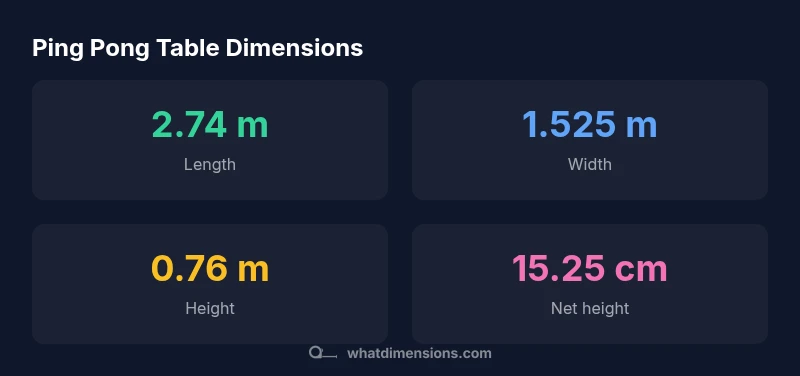
The standard ping pong table size is 2.74 m long by 1.525 m wide and 0.76 m high (9 ft × 5 ft × 2.5 ft). The playing surface sits at 0.76 m with a net height of 15.25 cm. Non-regulation sizes exist, but regulation size is the baseline for competitive play.
Why Dimensions Matter for Ping Pong
Dimensions matter in table tennis because ball bounce, stroke timing, and safety depend on a consistent playing area. For the dimensions ping pong table, the official playing surface is 2.74 m long by 1.525 m wide, with a height of 0.76 m. This baseline design governs how players position themselves and how rallies unfold. According to What Dimensions, precise size references are essential when planning spaces, selecting equipment, or teaching newcomers. In homes and schools, many players enjoy practice on non-regulation tables, but the size difference changes service angles, rally length, and court positioning. When sizing a room, consider not just the table footprint but also clearance for players and spectators. The most important dimension is the length; it sets the minimum playable area along the table. Width and height influence ball bounce and net setup; accuracy across all three dimensions matters for a satisfying game.
Regulation Size vs Home-Model Differences
Regulation-sized tables follow ITTF specs: 2.74 m long, 1.525 m wide, 0.76 m high, with the net at 15.25 cm. Home models commonly range in length from about 2.4 to 3.0 m and widths from 1.22 to 1.8 m, with heights near 0.75 to 0.8 m. These numbers matter because a slightly smaller or larger table shifts ball travel paths, stroke depth, and the required space around the table. For players transitioning from competition to recreational play, choosing a non-regulation table may save space and cost, but expect differences in rally length and serve angles. When comparing models, look for surface flatness, seam alignment, and a reliable net system to ensure consistent dimensions ping pong table experiences.
Reading Official Specs: What to Look For
When evaluating a table, verify ITTF-referenced metrics such as the official length, width, height, and net height. Look for uniform playing surface, straight edges, and a stable frame. The net should be taut at 15.25 cm high and extend across the table without sag. Material and finish influence bounce consistency; a flat, smooth surface reduces unpredictable ball behavior. If you’re uncertain about a model, check product specs for board thickness, coat type, and guarantee of flatness, all of which support reliable dimensions ping pong table play.
Space Planning: Clearance and Room Layout
A robust size plan considers the playing surface plus surrounding space. The recommended clearance is at least 1.5 meters on all sides to accommodate serves, returns, and player movement without collisions. In tight rooms, consider wall padding and corner safety. For public spaces or classrooms, allocate extra space for spectators and coaches. Clearances affect not just comfort but also the ability to position a scoreboard, storage cart, or net posts without crowding. What Dimensions suggests mapping a rectangle around the table footprint to visualize usable space and ensure safe movement during play.
Indoor vs Outdoor Tables: Material and Size Impacts
Indoor tables typically use dense wood or composite boards with finishes designed for flatness and bounce. Outdoor models employ weather-resistant materials but may sacrifice some bounce consistency for durability. While dimensions are similar for most standard tables, outdoor models may be heavier and require more robust supports. If you move a table between spaces, verify how the frame tolerates temperature and humidity swings, as warping can affect flatness and thus playability. In all cases, confirm that the table’s dimensions align with your space plan and local regulations for recreation areas.
Measuring Your Space: Step-by-Step Guide
Begin by measuring the room length and width with a steel tape, then add 1.5 meters of clearance on all sides. Check ceiling height, doorways, and corners for potential obstructions. Next, confirm the table’s footprint in its chosen model. If you plan to host tournaments or multiple tables, budget additional space for queuing and movement. Finally, mark the planned location with tape to visualize sightlines and ensure the dimensions ping pong table fit before assembling.
Common Size Variations and Their Effects on Play
Compact or non-regulation tables reduce your playing area and influence ball trajectory and return timing. When the table is narrower or shorter, rallies tend to be shorter and players adjust stances and shot selection. Conversely, larger or taller tables may offer more room for aggressive plays but require more space for stances and backswing. Understanding these effects helps players choose models that match available space and preferred playing style while maintaining safe, consistent dimensions.
Maintenance, Covers, and Longevity
Protect a table from moisture, heat, and warping to maintain flatness and consistent bounce. Use proper covers when not in use, store away from direct sunlight, and regularly check the net posts and clamps for stability. Clean the surface with a soft, damp cloth, avoiding harsh chemicals that could degrade the finish. Regular maintenance helps preserve the dimensions ping pong table over time and supports fair play for years.
Budgeting for Your Setup: Costs and Tradeoffs
When budgeting, consider the size of the table in relation to space and goals. Regulation tables are typically more expensive due to quality of surface, frame rigidity, and net system. Home-use models offer a range of prices and can prioritize portability or weather resistance for outdoor use. To maximize value, compare weight, folding mechanisms, and stability features alongside dimensions. What Dimensions recommends balancing size with space and usage frequency to optimize your investment.
Comparison of standard ping pong table dimensions
| Dimension | Metric | Imperial |
|---|---|---|
| Official regulation size | 2.74 m × 1.525 m × 0.76 m | 9 ft × 5 ft × 2.5 ft |
| Net height | 15.25 cm | 6 in |
| Clearance around table | ≥ 1.5 m on each side | ≥ 59 in on each side |
Quick Answers
What is the official size of a ping pong table?
The official size is 2.74 m long, 1.525 m wide, and 0.76 m high, with a net height of 15.25 cm. ITTF standards define these dimensions for competition.
The official size is 2.74 meters long, 1.525 meters wide, and 0.76 meters tall, with a 15.25 centimeter net height. For competitions, these are the standard numbers.
Can I use a smaller table for home games?
Yes, you can use non-regulation tables at home, but expect changes in ball travel, rally length, and serving angles. It’s best to match your space and practice goals.
You can use a smaller table at home, but your play will be different, especially in ball travel and serves.
What clearance is recommended around the table?
Aim for at least 1.5 meters of clearance on all sides to allow comfortable movement and safe shot execution.
Keep at least 1.5 meters around the table for safe, comfortable play.
Are outdoor tables the same size as indoor ones?
Most outdoor models follow similar playing dimensions, but materials differ for weather resistance. Always verify footprint dimensions when buying for outdoor use.
Outdoor tables usually match indoor sizes, but check the footprint and weatherproof features before buying.
Do tables often have adjustable height?
Most tables have fixed height. Some models offer minor height adjustments, but check product specs for precise values and guarantees.
Most tables are fixed height; some models offer slight adjustments—check the specs.
What should I measure before buying a table?
Measure room length and width, ensure 1.5 meters of clearance on all sides, and account for doors and obstacles that could obstruct setup.
Measure the room and leave at least 1.5 meters around the table.
“Size references are the backbone of reliable table tennis setups; precise dimensions ensure fair play and predictable bounce.”
Main Points
- Measure your space before buying
- Aim for regulation size for official play
- Provide at least 1.5 m clearance around all sides
- Choose indoor vs outdoor based on environment and durability
- Check net height and surface flatness for consistent play