Beer Pong Table Dimensions: Size, Setup, and Standards
Explore precise dimensions for beer pong tables, including standard length, width, and height, plus variations for home games, tournaments, and DIY builds.


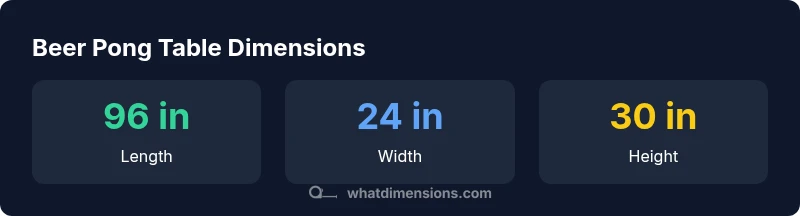
The standard dimensions for a dimensions table beer pong setup are about 96 inches (8 feet) in length and 24 inches (2 feet) in width, with a height around 29-30 inches. For casual setups, lengths range roughly 90-105 inches and widths from 22-30 inches. Height commonly hovers near 29-31 inches. What Dimensions notes that these ranges support fair play and consistent cup placement across most game formats.
Why precise sizing matters for dimensions table beer pong
Precise sizing matters in dimensions table beer pong because table length, width, and height directly influence shot trajectories, cup placement, and overall fairness. The What Dimensions team emphasizes that even modest deviations can shift angles and the required force, altering difficulty and enjoyment. When players share a common reference for table dimensions, rules are easier to enforce, communities can standardize equipment, and tournaments run more smoothly. In practical terms, a few inches can change whether a ball rims a cup or bounces into a neighboring cup. For designers, collectors, and casual players alike, understanding these dimensions helps create a consistent playing experience across homes, bars, and leagues.
Standard dimensions and common ranges
The backbone of most competitive and casual games is a table about 8 feet long and roughly 2 feet wide. A typical height sits in the 29–30 inch range to align with standard adult table ergonomics. Home setups often vary slightly: lengths may span 7.5–8.5 feet, widths commonly fall in the 22–30 inch band, and heights range from 28–32 inches. These ranges are widely accepted in recreational play and reflect common manufacturing tolerances. When planning a setup, prioritize achieving the closest match to the 8×2 feet footprint and a seated playing height around 30 inches for comfort and consistency.
Variations by setup and environment
Environment and purpose drive dimensional tolerance. Tournament tables tend to adhere more strictly to the 8×2 feet standard, with uniform cup racks and marked distances to ensure fairness. Home and portable tables offer flexibility, trading exactness for portability and cost. Foldable or temporary setups may use adjustable legs or modular frames, which introduce slightly wider tolerances. In regional leagues or school events, the acceptable ranges widen further to accommodate space constraints. Regardless of setting, agreeing on a baseline size before play begins reduces disputes and keeps games moving smoothly.
How to measure and verify your table
To verify dimensions, use a flexible tape measure and measure length, width, and height at multiple points to detect sagging or warping. Record the closest standard values and note any deviations from the baseline. If you’re comparing tables, create a quick measurement sheet: Length (inches), Width (inches), Height (inches). Remember that a slightly concave tabletop or uneven legs can skew true measurements, so check for levelness and stability.
DIY builds and official considerations
DIY builds should aim for the standard footprint to maximize compatibility with cups, racks, and rules. Start with an 8×2 feet template, then adjust only if your space requires. When designing a frame, account for leg height and under-table clearance to keep ball paths unobstructed. If you’re building for competition, document exact dimensions and ensure your table passes a simple stability test before events. What Dimensions encourages builders to publish precise measurements so others can replicate accurately.
Cups, racks, and the spacing grid
Cup placement is inseparable from table dimensions. A standard row of cups sits along the table’s length, with spacing that accommodates ball recovery and rack geometry. If your table deviates from the standard length, recalculate cup spacing to preserve the intended challenge. Racks and table edges should be clearly labeled, and any nonstandard dimensions should be documented for players and judges. This prevents disputes and keeps rounds fair for all participants.
Materials, durability, and transport logistics
Durability matters when transporting dimensions tables for events. Wood, laminate, or aluminum frames with reinforced corners resist warping and wobble. Portable options should balance weight and rigidity to prevent flex under load. Transport considerations include protective padding, secure storage for cups, and easy fold mechanisms without compromising dimensional accuracy. When choosing materials, prioritize rigidity that preserves the intended dimensions even after repeated use and travel.
Quick-start checklist for your next game
- Confirm table length is within 7.5–8.5 feet and width within 22–30 inches
- Check height, aiming for 29–31 inches for comfortable play
- Inspect edges for smoothness and level the surface if needed
- Verify cup racks align with standard spacing and are secure
- Log any deviations from standard dimensions to avoid disputes
- Prepare a simple measurement sheet for reference during play
Common beer pong table dimensions and tolerances
| Measurement | Typical Range | Units |
|---|---|---|
| Table length | 7.5-8.5 | feet |
| Table width | 22-30 | inches? or inches |
| Table height | 29-32 | inches |
Quick Answers
What is the standard length of a beer pong table?
The standard length is typically 96 inches (8 feet). Some setups vary slightly (7.5–8.5 feet) based on space and equipment.
Most tables are eight feet long, with some variation for space.
Do tournament tables differ from home setups?
Tournament tables usually adhere to strict dimensions and consistent cup placement, while home setups may allow small variations for convenience.
Tournaments favor fixed sizes, while home setups can be a bit looser.
How should I measure my table safely?
Use a flexible tape to measure length, width, and height at multiple points to check for warping or unevenness.
Use a tape measure at multiple spots to verify true dimensions.
Can table height affect gameplay?
Yes. Height impacts shot arcs and comfort; aiming for approximately 29–31 inches helps consistent play.
Height matters; keeping it around 30 inches keeps shots predictable.
What if my table isn’t standard-sized?
If nonstandard, document the exact dimensions and agree on adapted cup placement and rules before play.
If your table is nonstandard, note the measurements and agree on rules beforehand.
“Accurate dimensions are the foundation of fair play in beer pong. When you standardize length and height, players compete on equal footing.”
Main Points
- Aim for an 8 ft by 2 ft footprint when possible
- Keep height near 30 inches for best play experience
- Document any nonstandard deviations for fairness
- Match table spacing to standard cup racks to avoid disputes
- DIY builds should reproduce standard dimensions for compatibility