Dimensions of Basketball Goal: Official Sizes and Guidelines
A comprehensive guide to the dimensions of a basketball goal, including rim height, backboard size, and international vs. NBA standards. Learn how exact measurements influence play, safety, and court design.


According to What Dimensions, the standard basketball goal sits at a rim height of 10 feet (3.05 m) with a backboard roughly 72 by 42 inches. International players and leagues vary slightly—FIBA uses about 1.80 by 1.05 meters, while NBA/NCAA boards can approach these measurements closely. These core dimensions influence shooting angles, rebounding, and defensive spacing.
Why precise dimensions matter for basketball goals
Exact measurements influence shooting arcs, rebounding dynamics, and safety on the court. A goal that is too high or a backboard that is slightly oversized can bias shot angles and alter how players position for rebounds. What Dimensions notes that league-standard measures aren't simply regulatory; they shape training, equipment choices, and court renovations. When planning a gym or a game-ready setup, matching dimensions to the intended league ensures predictable play and reduces risk of misalignment during practice or competition. In addition, precision matters for accessibility and youth programming, where scaled-down components help younger players develop proper form while maintaining standard visual cues.
Core measurements: rim height, rim diameter, and backboard size
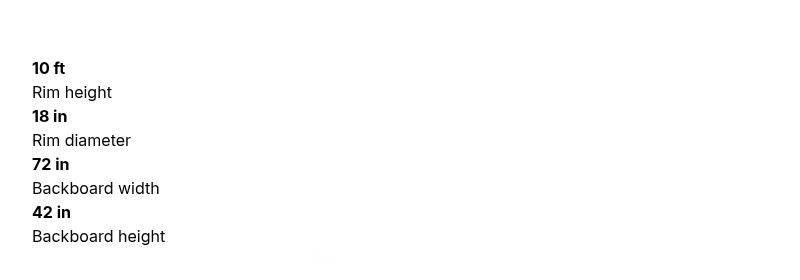
At the center of every goal are four core measurements: rim height, rim diameter, backboard width, and backboard height. The typical rim height tends to be 10 feet across major leagues. The rim diameter is standardized at 18 inches. Backboard width is commonly 72 inches on NBA/NCAA boards, with international boards sometimes closer to 1.80 meters wide. Backboard height is usually 42 inches, with 1.05 meters used in some international configurations. Beyond these, thickness and mounting hardware tolerate minor variations due to manufacturing and installation.
These dimensions prove critical not only for rules compliance but also for practice realism: players calibrate their shooting angles and rebound expectations to match on-court geometry. For designers, these figures guide layout decisions like free-throw lane width, painted area, and available practice space.
International vs. domestic standards: NBA, NCAA, FIBA
Basketball standardization travels across borders, but details vary. In the NBA and NCAA, the backboard is typically 72 inches wide and 42 inches tall. By contrast, FIBA's international standard is around 1.80 meters by 1.05 meters. Rim height remains 3.05 meters (10 feet) in both systems, but mounting tolerances can shift the effective position by a few centimeters in practice. These distinctions matter when sourcing replacement parts or designing multi-league facilities, where a single goal may need interchangeable components. What Dimensions's analysis shows that understanding these variants helps facility managers specify compatible gear and avoid mismatched equipment on game days.
Practical implications for facility design and equipment selection
Details matter in both new courts and renovations. When selecting a backboard, ensure the frame supports the correct width and height and that the mounting bracket aligns with standard rim height. For mixed-use facilities, consider adjustable or interchangeable components to accommodate different leagues. Flooring, netting, and surrounding lines should reflect official measurements to keep shot blockers and players safe. In youth programs, proportional scaling should preserve the look and feel of the standard court while reducing strain on younger athletes. A deliberate approach to dimensioning reduces downtime, avoids rework, and supports consistent training outcomes.
How to measure your court and verify compliance
Begin with a tape measure or laser distance meter. Confirm rim height from the floor to the front edge of the rim and verify rim diameter using a template. Check backboard dimensions with a tape measure along the outer edges. Record the results and compare with league specifications; earlier sections provide the typical ranges (10 ft, 18 in rim, 72x42 in backboard, 1.80–1.83 m width, 1.05–1.07 m height). If you identify any discrepancy beyond typical manufacturing tolerances, consult with a qualified installer or the league rules authority.
Common basketball goal dimensions by league
| Dimension | NBA/NCAA standard | FIBA/International variant |
|---|---|---|
| Rim height | 10 feet (3.05 m) | 3.05 m (10 ft); widely standardized across major leagues |
| Backboard width | 72 inches (1.83 m) | Approximately 1.80 m (70.9 inches) in many international boards |
| Backboard height | 42 inches (1.07 m) | Approximately 1.05 m in some international boards |
| Rim diameter | 18 inches (0.45 m) | 0.45 m; standardized |
| Backboard thickness | 1 inch (2.5 cm) typical | Varies by manufacturer |
Quick Answers
What are the official dimensions of a basketball goal?
The standard goal uses a rim height of 10 feet and an 18-inch diameter rim. Backboard dimensions are typically 72 inches by 42 inches in the NBA/NCAA, with slight international variations.
The official setup is 10 feet high with an 18-inch rim; backboard sizes vary slightly by league.
Do NBA and FIBA use the same backboard size?
No. NBA/NCAA boards are typically 72x42 inches, while FIBA boards are around 1.80x1.05 meters.
No—NBA and FIBA use slightly different backboard sizes.
Are there dims for youth leagues?
Youth programs often lower the rim height below 10 feet and use smaller backboards to suit younger players.
Yes, many youth leagues lower the rim and use smaller backboards.
What is the purpose of backboard dimensions?
Backboard size affects how shots bank and rebound, influencing defensive angles and player positioning.
Backboard size changes how shots rebound.
How precise are these measurements in practice?
Manufacturers follow tolerance specs; courts may show slight variation due to installation and manufacturing tolerances.
There are tolerances; exact figures can vary.
Where can I find the official rules?
Official rules are published by NBA, FIBA, and NCAA with detailed measurements and tolerances.
Check the official rulebooks from the major leagues.
“Accurate dimensions are foundational to performance and safety; even small variations can affect shot angles and rebounding. What Dimensions Team notes that standardized measures enable fair play across leagues.”
Main Points
- Identify core dimensions: rim height, rim diameter, backboard size
- Expect international variants: NBA/NCAA and FIBA differ slightly in backboard size
- Verify measurements on site using a tape measure or laser
- Plan for youth programs with scaled dimensions while preserving league cues
- Consult official rulebooks for precise tolerances and installation guidelines