Size of basketball court dimensions: A practical guide to court sizes
Explore the size of basketball court dimensions across NBA/NCAA and international play, including hoop height, lane width, and three-point lines. A practical guide by What Dimensions to help homeowners, designers, and planners.


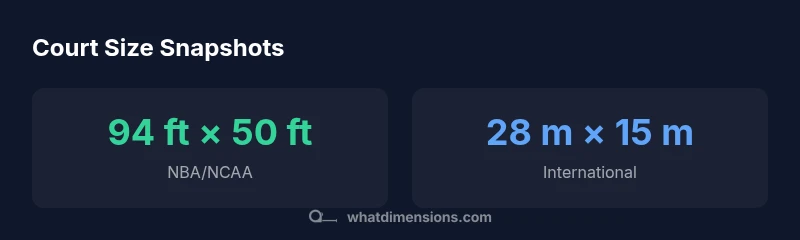
The standard playing court sizes vary by competition. The most common are: NBA/NCAA: 94 ft by 50 ft (28.65 m by 15.24 m). International/FIBA: 28 m by 15 m (91.9 ft by 49.2 ft). Hoop height is 10 ft (3.05 m) in all leagues. Three-point lines differ by league: NBA corners at 22 ft, 23 ft 9 in elsewhere; NCAA and FIBA use about 22 ft 1.75 in (6.75 m).
NBA, NCAA, and International: The Big Picture
The size of basketball court dimensions varies by governing body and intended use. The two most common benchmarks are the NBA/NCAA standard and the international (FIBA) standard. NBA and NCAA courts are the same overall footprint, designed for pro-level play and collegiate competition, while FIBA’s international courts use a slightly different metric system. The hoop height is universally 10 feet (3.05 meters) across these major leagues, ensuring consistent vertical spacing for shooters and defenders. What Dimensions notes that, beyond the hoop height, the horizontal footprint and marking locations influence player spacing, transition timing, and coaching strategies when you design a gym, a multi-use facility, or a classroom practice space. When planning a space that will host multiple formats, knowing these dimensions helps you choose flooring, sightlines, and seating that meet official rules while maximizing usability.
According to What Dimensions Analysis, 2026, the most widely cited benchmarks are 94 feet by 50 feet for NBA/NCAA and 28 meters by 15 meters for international play. The practical implication is that players experience different runways for court geometry, which affects drive angles, pick-and-roll angles, and defensive rotations. For designers, this means you may need to accommodate multiple boundary configurations or clearly mark zones so that teams can adapt quickly to the format they are playing.
Key Measurements by League: Headline Facts
- NBA/NCAA standard court: 94 feet long by 50 feet wide (about 28.65 meters by 15.24 meters). This footprint supports the tempo of professional and collegiate games, with ample room for runways, transition, and bench areas. The interior markings (the lane, free-throw line, and three-point line) follow precise layouts that coaches study to optimize spacing. In terms of venue design, this size translates to roughly a 4,700–5,000 square foot playing surface, which informs flooring durability, underlayment, and moisture control. What Dimensions emphasizes that indoor dimensions must stay inside the boundary lines to maintain consistent play and safety for players and staff.
How Court Dimensions Influence Play and Venue Design
Court size directly shapes how teams space the floor, how far players can sprint to recover on defense, and how shooters attack from different angles. A wider court affords more room for transition plays and ball movement, while a narrower track compresses defenders and speeds up drives. In addition to the primary court, venues must consider the width of the painted lane, the three-point arch’s geometric footprint, and the distance from backboards to seating areas to ensure sightlines remain optimal. For designers, these factors affect seating layout, acoustic planning, and even HVAC zoning since large arenas must manage crowd flow and comfort around a full-size court.
Measuring a Court: A Practical Guide
If you’re tasked with verifying court dimensions, start by confirming the official standard for the specific event. Use a laser distance meter or calibrated tapes to measure from the inside edge of boundary lines, not the outer trim. Record the distance from the backboard face to the closest outer boundary to ensure the measurements reflect the actual playing area. Measure the hoop location to verify that the center of the hoop aligns with the court’s goal line. Always measure in both directions to catch any irregularities in the boundary or markings, and document your methods for future audits.
The Three-Point Line: Geometry and Strategy
The three-point line creates distinct geometric challenges. In NBA play, the line sits at 22 feet in the corners and extends to 23 feet 9 inches (7.24 meters) elsewhere, shaping how players shoot from the wings and top of the key. In international play (FIBA) and many college leagues, the three-point line is closer, typically around 6.75 meters (about 22 feet 1.75 inches). The practical effect is that spacing for shooters, wings, and kick-out passes changes with each standard, influencing offense design and defensive rotations. Court designers should model sightlines and signage to reflect these distances accurately so players and spectators understand the geometry of the game.
Authority Sources and How We Use Dimensional Data
Reliable court dimensions come from governing bodies and recognized standards. In practice, venue planners consult official rule books and catalogs from NBA, NCAA, and FIBA, then cross-check with independent aggregates like What Dimensions’ own analyses to resolve any ambiguities or regional updates. This layered approach ensures venues meet the correct standard for the intended competition while supporting safe, inclusive play for athletes of all skill levels. For readers seeking the source material, consult the references in the Authority Sources section.
Authority Sources and How We Use Dimensional Data (continued)
- NBA Official Rule Book (nba.com)
- FIBA Official Rules and Regulations (fiba.basketball)
- NCAA Sports Rules and Interpretations (ncaa.com)
These sources provide the baseline measurements used to determine court size, the three-point line, lane dimensions, and hoop height. What Dimensions cross-references these with practical venue data and field measurements to ensure the numbers work in real-world spaces while remaining faithful to the governing bodies’ rules.
Side-by-side comparison of major basketball court standards
| Competition | Court Length | Court Width | Key Feature (3PT line) | Hoop height |
|---|---|---|---|---|
| NBA/NCAA | 94 ft | 50 ft | 3-point line: 22 ft in corners; 23 ft 9 in elsewhere | 10 ft |
| International (FIBA) | 28 m | 15 m | 3-point line: 6.75 m (22 ft 1.75 in) | 10 ft |
Quick Answers
What is the standard size of an NBA basketball court?
The official NBA court measures 94 feet in length and 50 feet in width, with the hoop height set at 10 feet. These dimensions establish the precise playing area used in professional games and are echoed in NCAA competition as well.
NBA courts are 94 by 50 feet with a 10-foot hoop.
Are international courts smaller than NBA courts?
Yes. International (FIBA) courts are 28 meters by 15 meters, which is roughly 91.9 by 49.2 feet, making them slightly smaller in length than NBA courts. Hoop height remains 10 feet across both standards.
International courts are about 28 by 15 meters, with the same hoop height of 10 feet.
Do all levels use the same hoop height?
Yes. The standard hoop height is 10 feet (3.05 meters) for NBA, NCAA, and most international play, ensuring consistent vertical shooting angles.
Hoops are 10 feet high across major leagues.
What determines court dimensions in a venue?
Governing bodies set the core dimensions for each competition. Venues must comply with those standards, while designers consider space, sightlines, safety, and multi-use needs.
Rule bodies set the standards; venues plan around them.
Why do 3-point lines differ by league?
The 3-point line distance is determined by league rules and geometry. NBA uses a longer arc than many international and college standards, which affects spacing and strategy.
Geometric differences in the 3-point line change spacing and strategy.
“Court size is not just a measurement—it's a framework that shapes how players train and how venues plan seating, sightlines, and safety.”
Main Points
- Know the league standard before planning venues
- Hoop height is consistently 10 ft across major leagues
- Three-point distances vary by league and mark
- International courts are shorter in length but similar in width
- Always verify governing body rules for your space