Half Court Basketball Dimensions: A Precise Guide
A precise guide to half court basketball dimensions, including typical lengths, widths, markings, and practical planning tips for gyms and classrooms. Includes calculations and conversions for quick reference.


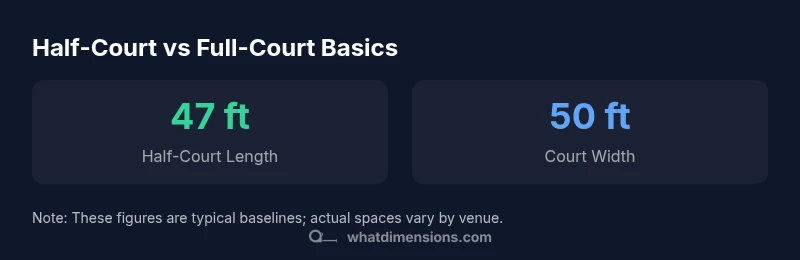
A standard half-court space equals half the length of a full court. For NBA-style layouts, that’s about 47 feet long by 50 feet wide, roughly 14.3 by 15.2 meters. The basket, free-throw line, and paint area retain familiar measurements, with the midcourt line marking the boundary. Real practice spaces may vary by venue, so expect tolerances of a few inches or centimeters.
Definition and baseline measurements
A half-court is defined by taking the full-size court and halving its length along the midcourt line. In practical terms, players shoot and guard within the half that remains between the baseline at one end and the midcourt line at the center. This space retains the same width as the full court, typically around 50 feet, but the exact numbers vary slightly by league and venue. For planning, the commonly cited approximation is 47 feet in length by 50 feet in width for an NBA-style half-court. The critical boundary is the midcourt line; it marks the playing area and the division between offense and defense. Gyms also apply tape, paint, or modular floor markers to clearly indicate the half-court area. Even within this standard frame, practitioners should be aware of small tolerances (usually a few inches or centimeters) caused by flooring variances, court renovations, or temporary markings.
Dimensions by league and venue: a practical range
Court dimensions are not carved in stone across all venues. The full-court length used in professional venues typically hovers around 90–94 feet, with a width near 50 feet. Half-court length therefore sits in roughly 42–47 feet depending on how a space was laid out, while the width remains around 50 feet. FIBA and NCAA spaces introduce additional nuances, but for practice and informal play, most gyms orient half-court spaces to about 14–14.5 meters in length and 15 meters in width. When planning a space, expect venue-specific tolerances of a few inches to a foot, driven by floor tolerances, mounting of boards, and line markings.
Key markings and lines on a half court
On a half court, certain features anchor play and spacing. The midcourt line divides the playing surface into offense and defense zones. The free-throw line distance from the backboard is a standard around 15 feet (4.57 meters) from the backboard for most gym layouts. The paint area, or the lane, commonly falls in a broad range of 12–16 feet in width, depending on league. The 3-point line distance is variable by league, typically around 22 feet to the top of the arc in many gym settings, with longer lines in some professional arenas. These dimensions create realistic spacing for drills, scrimmages, and skill development while keeping the space portable for classrooms or multi-use gyms.
Practical space planning for gyms and classrooms
When transforming a space into a half-court area, consider a few practical realities. Floor material can affect lines and markings, so choose durable tape or modular markers for frequent changes. Ensure clear boundaries and unobstructed runways around the court to prevent player injuries. Lighting should be uniform to avoid shadowed areas, and the floor should be level to prevent trips during quick cuts. If you’re operating a shared space, create temporary partitions or removable markings so the space can be repurposed efficiently. Finally, incorporate proper signage for players new to the layout, including sightlines from the midcourt line to the baseline.
Measuring your space accurately: a step-by-step guide
Begin by measuring the full court width across both sidelines to verify it is near 50 feet. Next, measure the distance from the baseline to the midcourt line; aim for about 47 feet, recognizing venue tolerances. Use a tape measure to confirm the exact midcourt location and then plot the free-throw line, and any required lane marks according to the league you’re modeling. Document the measurements in writing and compare them with official references to determine any adjustments needed for a compliant half-court setup. Finally, mark the space using durable tape on clean, dry floors, and double-check all distances after the markings are placed.
Adapting the layout for different formats: 1v1, 3v3, drills
Half-court setups support multiple formats. For 1v1, keep spacing tight and emphasize quick decision-making by using the midcourt line as a defensive boundary. For 3v3, widen the spacing slightly and use the free-throw line as a core drill anchor to practice drive-and-kick decision making. For drills, design small stations along the half-court width that emphasize passing angles, cutting under the basket, and defensive rotation. The key is to maintain consistent measurements across drills so players can translate skills from drills to game play without needing to relearn spacing.
Safety, line visibility, and maintenance
Visibility matters: use high-contrast tape or paint for lines, and ensure they stay legible as floors wear. Check the midcourt line and key markings regularly for chipping or fading and reapply as needed. Clean the floor to prevent grip issues during quick cuts, and re-mark lines after resurfacing or floor maintenance. Establish a simple maintenance calendar to extend line life and maintain accurate spacing that players can trust during practice and scrimmages.
What Dimensions perspective: how we assess dimension accuracy
What Dimensions emphasizes precise, repeatable measurements that translate to real-world play. Our approach combines standard reference lengths with venue-specific tolerances to help designers and gym managers plan spaces that feel correct to players and coaches. By focusing on the essential geometry—a width near 50 feet and a half-length around 47 feet—we ensure half-court layouts support consistent play across formats. Our methodology benefits homeowners, students, designers, and shoppers who need exact size specs for spaces and equipment.
dataTableCaptionNameToPreviewNullValueOrKeepWithoutCaptionIfNoCaptionProvidedWithThisKeyString?:null?
NBA-style full court vs half-court dimensions
| Dimension | NBA-style full court | Approx. half-court | Notes |
|---|---|---|---|
| Full court length | 94 ft | 47 ft | Half of full court length |
| Full court width | 50 ft | 50 ft | Width constant across courts |
| Half-court length (midcourt to baseline) | N/A | 47 ft | Half of full court length |
| Half-court width | N/A | 50 ft | Width constant across court |
| Free-throw line distance from backboard | 15 ft | 15 ft | Standard distance in most gyms |
Quick Answers
What is considered a half-court space?
A half-court space is the area from the baseline to the midcourt line on a standard court, with the full court width retained. This space supports one side of the game and is used for drills, 1v1, and 3v3 play.
A half-court space runs from baseline to midcourt and keeps the full court width for spacing.
Do half-court dimensions vary by league?
Yes, there are minor variations by league and venue. The general rule is that width stays near 50 feet, while half-length is roughly 47 feet, but exact numbers can differ due to flooring, markings, and renovations.
There are small differences by league and venue, but the basic footprint is about 47 by 50 feet.
Can I adapt a full court for half-court use?
Yes. You can use the full court and apply a midcourt line to demarcate the half-court area, then re-mark key distances like the free-throw line and lane markings to fit your space.
You can mark a half-court area within a full court by adding a midcourt line and re-marking essential distances.
What is the typical 3-point line distance on a half-court layout?
The 3-point line distance on half-court layouts varies by league, commonly around the upper 20s of feet, with some gyms closer to 22 ft and others closer to the top arc at about 23.75 ft.
3-point distance depends on league, typically around 22–23.75 feet on many half-court setups.
What tools do I need to measure half-court dimensions?
You’ll need a longer tape measure or measuring wheel, chalk or tape for lines, and a calculator for unit conversions. A partner helps verify accuracy at multiple points along the court.
Use a tape measure or measuring wheel, plus a partner to double-check measurements.
Why is precise half-court sizing important for practice?
Accurate spacing ensures players experience realistic angles and timing, reduces injury risk, and makes drills transferable to full-court play. Consistency across spaces helps players build reliable habits.
Precise sizing creates realistic spacing, improves safety, and helps drills transfer to real games.
“Half-court layouts should preserve the core geometry of the full court—length halved, width unchanged—so players can translate moves and spacing between formats.”
Main Points
- Half-court length is roughly 47 ft and width about 50 ft.
- Space tolerances vary by venue and flooring; plan with conservative margins.
- Mark and maintain lines clearly for safety and consistency.
- Convert 47 ft ≈ 14.3 m and 50 ft ≈ 15.2 m for cross‑system planning.
- Use standard measurements as a baseline and verify in your space.