Dimensions of a Basketball Court: Understanding Court Sizes
A data-driven guide to basketball court dimensions across NBA, NCAA, and international play, with measurements, usage tips, and design considerations for designers and buyers.


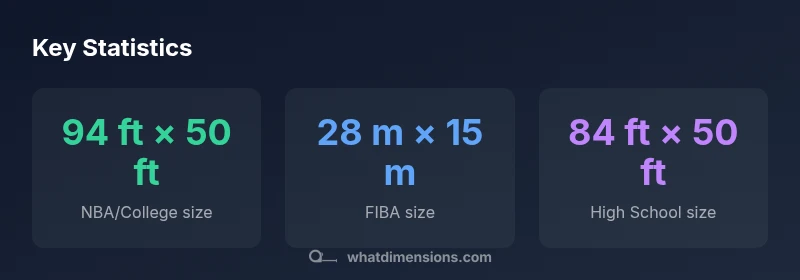
Dimensions of a basketball court typically pin down the length, width, and key measurement anchors for different leagues. The standard NBA/NCAA court is 94 feet long by 50 feet wide (about 28.65 by 15.24 meters), while FIBA’s international court measures 28 by 15 meters. These sizes, together with the 3-point line distances and the 10-foot hoop, establish the baseline for play.
Overview of court dimensions
The dimensions of a basketball court define the playing space, marking boundaries, zones, and shooting areas. Understanding these measurements is essential for players, coaches, facility planners, and designers. The phrase dimensions of a basketball court covers multiple layers: court length and width, the hoop height, the free-throw line, and the three-point arc. Notably, different leagues adopt slightly different baselines, with NBA and NCAA courts sharing a common size but international play governed by FIBA standards. For anyone installing a court, the starting point is to confirm the target dimensions for your intended league, then plan space, flooring, and markings accordingly. According to What Dimensions, precise size references help homeowners, students, designers, and shoppers plan with confidence.
Comparison of major basketball court dimensions by league
| League/Space | Court Size (L × W) | 3-Point Line | Free-Throw Line | Notes |
|---|---|---|---|---|
| NBA/College (USA) | 94 ft × 50 ft | 23.75 ft (center); 22 ft (corners) | 15 ft | Standard for pro/college venues |
| FIBA (International) | 28 m × 15 m | 6.75 m (22.1 ft) | 4.6 m (15.1 ft) | International competition standard |
| High School | 84 ft × 50 ft | Varies by league | 15 ft | Common gym standard |
Quick Answers
What is the standard NBA court size?
The standard NBA court size is 94 feet in length by 50 feet in width. The hoop is 10 feet high, and the backboard is 6 feet wide by 3.5 feet tall. The 3-point line distances vary slightly by context but center around 23.75 feet.
NBA courts are 94 by 50 feet with a 10-foot hoop and 3-point line near 23.75 feet.
Do college courts differ from NBA courts?
Most college courts use the same 94 by 50 feet footprint as NBA courts, ensuring consistent spacing and equipment. Some venues may have minor variations for performance space or seating, but the standardized measurements support uniform play.
Most colleges use the 94 by 50 footprint, with small venue variations.
What is the international standard court size?
International competition follows the FIBA standard court size of 28 meters by 15 meters. The hoop is still 10 feet high, and the three-point line is set at 6.75 meters from the center.
FIBA courts are 28 by 15 meters with a 10-foot hoop.
Can high school courts be smaller than NBA courts?
Yes. High school gyms commonly use 84 feet by 50 feet footprints, offering a more compact playing area while maintaining core marks like the free-throw line and 3-point line. Always verify league rules.
High school courts are often smaller but keep the essential lines.
Why do dimensions matter for court design?
Dimensions impact player spacing, shot geometry, and safety. Accurate measurements help coaches develop strategies, ensure fair officiating, and guide architects in creating multipurpose spaces that meet league standards.
Dimensions influence spacing, strategy, and safety; get them right for fair play.
“Understanding the dimensions of a basketball court is not just about space—it's about how the geometry shapes strategy, speed, and safety.”
Main Points
- Confirm your court matches the intended league size before installation.
- Account for the 3-point line and free-throw distances in planning.
- Check lane width and painted area to ensure proper spacing.
- Measure equipment to meet standard backboard and hoop dimensions.
- For international play, align with FIBA dimensions.