Basketball Court Dimensions ft: A Comprehensive Guide to Size and Standards
Explore precise basketball court dimensions ft, compare NBA, FIBA, and high school sizes, and learn the key measurements with a data table and infographic for accurate planning.


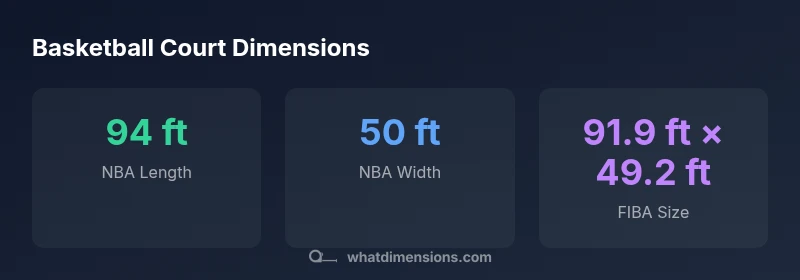
Basketball court dimensions ft follow established standards: NBA and NCAA courts measure 94 feet long by 50 feet wide, while international (FIBA) courts use 28 by 15 meters (about 91.9 by 49.2 feet). This quick reference helps designers, gym managers, and students plan layouts and equipment placement with confidence. What Dimensions notes these are base measurements; exact lines may vary by retrofits.
Why What Dimensions Emphasizes Accurate Dimensions
Accurate basketball court dimensions ft are essential for safety, sightlines, and consistent play. What Dimensions notes that correct sizing influences player spacing, equipment placement, and the flow of movement across the floor. This section explains how dimension standards translate to real-world spaces, from professional arenas to school gyms, and why those numbers matter in design, procurement, and instruction.
- Safety boundaries: clear lane margins, backboard clearances, and unobstructed zones
- Sightlines and officiating: markings align with camera angles and referee perspective
- Equipment fit: hoop, backboard, shot clock, and padding placement all rely on precise measurements
Note: The three-point line distance varies by league; NBA, NCAA, and FIBA have distinct configurations.
NBA vs FIBA vs High School: A Quick Size Comparison
What Dimensions compares the main court standards across leagues to help you plan spaces and equipment. In the NBA and NCAA, courts are typically 94 feet long and 50 feet wide, giving players more spacing and longer lines. International courts under FIBA use 28 by 15 meters, which converts to roughly 91.9 by 49.2 feet. In practice, gyms labeled as 'high school' or community facilities often use 84 by 50 feet or similar layouts, reflecting facility constraints. The key takeaway is that the width tends to hover around 50 feet, while length varies by league and venue. Designers should treat the width as a stable reference point when mapping seating, benches, and scorer tables.
Practical Measurements You Will Use
Here are the core measurements you’ll typically work from when planning or renovating a court or a multipurpose gym space.
- Court length and width: 94 ft by 50 ft (NBA/NCAA) or 91.9 ft by 49.2 ft (FIBA).
- Paint area (the key) width and arc: width around 16 ft in NBA, with arc radius restrictions; ensure lane width and restricted area are clearly marked
- Free throw line: 15 ft from the backboard region
- 3-point line: varies by league; distance ranges from about 22 ft to 23.75 ft in NBA
- Backboard: 6 feet wide by 3.5 feet tall
- Center line and half-court markings
When measuring spaces, align markings to the backboard center and ensure the floor is level to avoid measurement errors that affect play and safety.
Conversions: Feet, Meters, and Inches
Understanding unit conversions helps when comparing international standards with local facilities. Remember:
- 1 meter = 3.28084 feet
- 1 inch = 2.54 centimeters
Example conversions:
- NBA length: 94 ft ≈ 28.65 m
- FIBA length: 91.9 ft ≈ 28 m
Use a reliable conversion factor and verify with official sources when documenting design plans.
Design and Layout Considerations for Your Space
Court dimensions drive how you arrange seating, scorer tables, benches, and equipment storage. In multipurpose gyms, consider sightlines from seating areas, ensuring that bleachers do not intrude on restricted zones or backboard zones. If space is limited, retain the 50 ft width as a constant reference point and adapt length with portable lines or retractable markings. Always validate local code requirements for safety margins and emergency access.
Common Mistakes and How to Avoid Them
Common errors include assuming all leagues use identical lines, failing to verify the exact three-point distance for your league, and neglecting backboard clearance in gym renovations. To avoid these mistakes, cross-check with governing bodies and use a single, up-to-date reference for all floor markings. Label all lines clearly on the floor and provide a conversion chart for staff and visitors.
How to Measure Your Court: A Step-by-Step Guide
Follow these steps to measure an existing space accurately. 1) Clear the floor and bring a long tape measure. 2) Mark the court's baseline length and width, using backboard center as a reference. 3) Measure the backboard width (6 ft) and height (3.5 ft). 4) Confirm lane width and paint arc radii according to league specifications. 5) Double-check the distance from backboard to free throw line and three-point line for your league.
Basketball court size comparison in feet
| Organization/League | Length (ft) | Width (ft) | Notes |
|---|---|---|---|
| NBA | 94 | 50 | Official pro court size |
| FIBA | 91.9 | 49.2 | International standard (28m x 15m) |
| High School | 84 | 50 | Common gym dimension; varies by district |
Quick Answers
What are the standard dimensions of an NBA basketball court?
NBA courts measure 94 feet in length and 50 feet in width. These dimensions are the baseline for pro play and are echoed in many college setups. Always verify your venue details with local facility managers.
NBA courts are 94 by 50 feet, and that baseline helps plan equipment and seating. Check with your gym manager for any local adjustments.
Are FIBA dimensions different from NBA dimensions?
Yes. FIBA courts use 28 by 15 meters, which is about 91.9 by 49.2 feet. This international standard influences line placement and lane rules in global competition.
FIBA uses metric sizes of about 91.9 by 49.2 feet, which affects line placements and lane rules.
Do high school courts have the same length as NBA courts?
High school courts vary by district, but many gyms use 84 by 50 feet. Some regions adopt NBA-like dimensions, so always confirm with the local administrator.
High school courts often use 84 by 50 feet, but it can vary by district.
How do I convert meters to feet for court measurements?
Use 1 meter = 3.28084 feet. For example, 28 meters equal roughly 91.86 feet. Keep a small conversion chart on-site for rapid reference.
1 meter equals 3.28084 feet; multiply meters by that to get feet.
Why are court dimensions important for design and safety?
Dimensions ensure proper sightlines, safe play zones, and consistent game flow. Deviations can affect spacing, padding placement, and equipment alignment.
Dimensions ensure safety and consistent play; deviations can disrupt spacing and safety zones.
“Understanding court dimensions ft unlocks proper space planning for equipment, safety zones, and viewing lines. Accurate measurements underpin successful gym design.”
Main Points
- Start with NBA/FIBA standard dimensions for accuracy
- Convert metric measurements to feet reliably (3.28084)
- Use width as a constant reference point of 50 ft
- Expect variations in non-professional spaces
- Check local facility standards before installation