Football Court Dimensions by Code: Field Sizes and Guidelines
A practical guide to football court dimensions across codes—international soccer pitches, futsal courts, and American football fields—with design, safety, and facility planning insights.


What football court dimensions cover across codes
The phrase football court dimensions covers the size and layout of playing surfaces used across different football codes. In practice, dimensions influence line-of-sight, player spacing, and safety margins just as critical as ball size or goal dimensions. According to What Dimensions, the term encompasses outdoor soccer pitches, indoor futsal courts, and the rectangular grids used for American football. While each code enforces its own ranges, the underlying goal is consistent: clear boundaries, clearly defined goal areas, and adequate run-off space to protect players. Facility designers, league organizers, and coaches should start by identifying the sport code, then confirm the current standard dimensions with the governing body before planning any build or refurbishment. This approach ensures compliance, reduces rework, and helps teams deploy facilities that support fair play and long-term safety.
Association football (soccer): international vs non-international field sizes
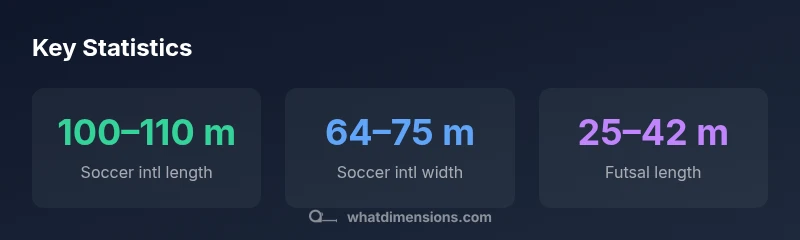
Association football, commonly called soccer in some regions, uses two broad bands of football court dimensions: international matches and domestic/non-international play. For international matches, the Laws of the Game specify a field length of 100–110 meters and a field width of 64–75 meters. Domestic leagues may use the wider national ranges: 90–120 meters long and 45–90 meters wide. Corner arcs, goal areas, and penalty areas are further defined, but the length/width envelope is the key determinant of the playable area. The goal frame is standardized at 7.32 meters wide by 2.44 meters high, with goal markings spaced along the touchlines. Designing a venue around soccer therefore begins with these primary dimensions, then adds the appropriate markings and safety buffers to fit the venue's constraints.
Indoor futsal and 5-a-side: compact, consistent sizes
Futsal courts are designed for fast-paced, small-sided play, typically configured indoors with boards or padded barriers. The official futsal playing area is 25–42 meters long and 16–25 meters wide, with a hard surface and a uniform boundary. The compact size encourages quick ball movement, tight pressing, and rapid transitions. For 5-a-side variants, many leagues adopt spaces around 40 by 20 meters, though the exact dimensions can vary by facility and governing body. Regardless of format, futsal emphasizes consistent boundary lines, proper padding, and surface quality to ensure safety and competitive balance.
American football field: length, width, end zones, and lines
In North American football, the standard field measures 120 yards in total length, including two 10-yard end zones, and is about 53 1/3 yards wide. The 100-yard playing field is marked every 5 yards, with end zones clearly separated from the playing surface. That arrangement creates a playing area that supports strategic planning for offense and defense, from set plays to passing routes. Dimensions also influence equipment placements, spectator sightlines, and safety considerations, such as padding and barrier placement along sidelines.
How dimensions influence play: space, speed, strategy
Field size directly affects how teams space themselves, accelerate, and manage players in space. Longer pitches and wider fields tend to favor wide attacks and long-range combinations, while tighter arenas emphasize close control, quick tempo, and compressed defending. In futsal, limited space magnifies ball control, deception, and decision speed, while in American football, the width of the field and the presence of end zones shape play-calling patterns and special teams planning. Coaches should tailor drills and formations to the exact football court dimensions used in their league to optimize performance and reduce risk.
Facility planning: choosing the right size for your league
When planning a facility, start by identifying the sport code and the typical competition level. International soccer requires larger pitches, while domestic leagues may accept broader ranges. For futsal, prioritize a compact court with durable boards and a high-friction surface. For American football, ensure there is ample sideline space, proper end-zone padding, and clear boundary lines for player safety. Budget and space constraints will drive decisions, but always align the chosen dimensions with the governing body’s published specifications to avoid costly retrofits later.
Measuring and verifying dimensions: practical tips
To verify football court dimensions on a site, use a laser rangefinder or a long measuring tape, and mark the primary boundaries first. Confirm corner arc radii, goal areas, and penalty marks where applicable. Re-check length and width diagonally to catch any misalignment, and document the results with photos and a simple floor plan. For outdoor fields, measure rough ground irregularities and adjust with clear boundary lines or temporary markings as needed. Always record the date, staff, and equipment used for future audits and maintenance.
Global governance and where to check official rules
Governing bodies publish the official rules for each code, and those documents are the authoritative reference for football court dimensions. When planning facilities, consult the current Laws of the Game for soccer, formal futsal guidelines, and American football rulebooks to confirm exact measurements, surface requirements, and safety recommendations. If your plans span multiple codes or venues, create a cross-reference sheet that maps each sport’s required dimensions and safety standards to ensure consistent, compliant facilities.