Urinal Dimensions: A Practical Sizing Guide
Explore precise urinal dimensions, how to measure footprint, space planning tips, and ADA considerations for code-compliant, efficient restroom design, with practical examples and measurements.


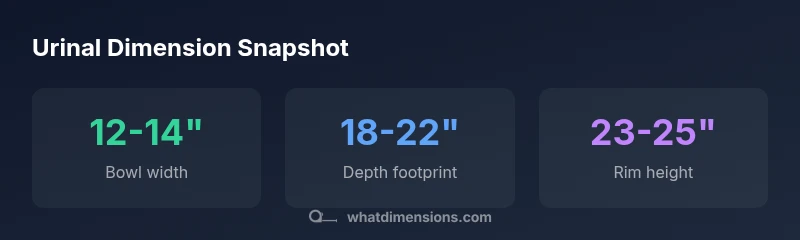
Urinal dimensions define width, depth, height, and installation clearances for each fixture. Typical bowl widths run around 12–14 inches, depths about 18–22 inches, and rim heights near 23–25 inches, with ADA-oriented options often at 24 inches rim height. Understanding these sizes helps optimize space, plumbing, and accessibility, per What Dimensions guidance for planning restrooms.
Understanding what urinal dimensions encompass
Urinal dimensions are not just the rough width and height of a fixture. The true footprint includes the bowl width, the depth from wall to the front edge, and the rim height from the finished floor. In addition, installation clearances around the unit, centerline spacing from walls and other fixtures, and the location of plumbing rough-ins all influence what size you can or should install. According to What Dimensions, planning starts with a clear map of space, wall finish, stall width, and the distance to adjacent fixtures. This helps you choose a model that fits the stall, allows comfortable use, and keeps maintenance access straightforward.
The goal is to balance ergonomic comfort with practical plumbing constraints. For designers and homeowners, this means translating architectural drawings into concrete fixture choices that do not crowd the stall, obstruct door swings, or block access to valves and traps. Accurate urinal dimensions also support accessible layouts and efficient cleaning routines, reducing future retrofit costs.
Types of urinals and their footprint
There are several common urinal configurations, each with its own footprint considerations. Wall-mounted standard models typically present a compact footprint that emphasizes floor space savings, while floor-mounted units may offer greater stability and easier service access. ADA-compliant options often emphasize a predictable rim height and centerline distance to accommodate wheelchair users and reach ranges. In practice, a 12–14 inch bowl width paired with an 18–22 inch depth is a practical starting point for many mid-size restrooms, while rim heights around 23–25 inches are common for standard installations. Always verify product specs, because manufacturers vary and local codes may modify recommendations. What Dimensions emphasizes comparing the full installation envelope rather than a single measurement.
- Wall-mounted urinals: compact footprint, easier cleaning, flexible installation in tight stalls.
- Floor-mounted urinals: more robust, ideal for higher-use environments, but require solid concrete mounting and wider clearances.
How to measure your space before buying
A disciplined measurement process helps avoid costly mismatches later. Start by mapping the stall width and the available wall-to-front clearance. Measure the distance from the wall to the front of the proposed urinal plus a minimum 6–8 inches of front clearance for user comfort and service access. Next, check centerline spacing from the wall to the urinal drain and verify there is enough room for a flush valve and supply lines. Finally, determine the vertical placement by measuring from the finished floor to the intended rim height, then cross-check with ADA guidelines and local codes. What Dimensions advises taking measurements on-site using a laser distance meter for precision and photographing references for contractors.
ADA and accessibility considerations
Accessibility requirements influence urinal selection and mounting. In general, layouts should provide clear floor space, reachable controls, and appropriate rim heights to accommodate users with mobility impairments. Verify the local code for urinal mounting height ranges and recommended centerline distances. If you plan a mixed-use restroom, consider mixing standard and ADA-compliant urinals to maximize flexibility. In any case, the goal is to ensure that the fixture is reachable, operable, and within a typical line of sight for assisting staff.
What Dimensions notes that early planning reduces post-install revisions and ensures all occupants have comfortable, usable facilities.
Spacing, plumbing rough-ins, and stall considerations
Irrespective of urinal type, rough-ins determine feasibility. Typical planning involves ensuring adequate space between fixtures to avoid splash-back and to accommodate users’ range of motion. Centerline spacing to the wall or adjacent fixtures is often a key determinant in selecting the model. Plumbing rough-ins should align with the chosen product’s waste and water supply connections. This alignment minimizes retrofit work and ensures that waste drains are accessible for maintenance. What Dimensions recommends cross-checking the fixture’s rough-in dimensions against the architectural drawings to avoid misalignment or clearance conflicts.
Mobile apps and field measurements help refine spacing plans, particularly in historic buildings where original layouts constrain modernizations.
Choosing products that fit today and tomorrow
Product flexibility matters. Look for urinals with adjustable mounting options, compatible wall plates, and accessible flush valve locations to accommodate future code changes or renovations. Consider modular or low-profile designs that can be upgraded without a full retrofit. What Dimensions highlights analyzing the full lifecycle of the fixture—from installation to future replacement—so you don’t end up with an undersized or oversized unit. Use manufacturer datasheets to confirm dimension tolerances and installation clearances, and always leave a small margin for future maintenance access.
Case studies and real-world planning scenarios
Scenario A involves a compact restroom in a small office with a single urinal in a wall-mounted configuration. By mapping a stall width of 30–34 inches and ensuring at least 24 inches of clearance in front, the selection can focus on narrow 12–14 inch bowls with a 18–22 inch depth. Scenario B addresses a medium restroom in a school with multiple stalls and ADA considerations. The design prioritizes two wall-mounted urinals at standard rim heights with a separate ADA-compliant urinal at a centerline height aligned to the doorway, ensuring enough floor space for mobility devices and cleaning equipment. What Dimensions’ approach combines accurate measurements, ADA guidelines, and practical layouts to deliver a plan that is both functional and future-proof.
Footprint and mounting considerations by urinal type
| Urinal Type | Typical Width | Typical Depth | Rim Height | Notes |
|---|---|---|---|---|
| Wall-mounted urinal (standard) | 12-14 inches | 18-22 inches | 23-25 inches | Compact footprint with easier cleaning |
| Floor-mounted urinal | 12-14 inches | 20-22 inches | 24-26 inches | Sturdier installation, requires concrete mounting |
| ADA-compliant urinal | 12-14 inches | 18-22 inches | 24 inches | Designed for accessibility with clearances |
| Compact/short-geometry urinal | 10-12 inches | 16-18 inches | 22-24 inches | Space-saving option for tight stalls |
Quick Answers
What is the standard urinal width?
There isn’t a single universal standard. Most bowls fall in the 12–14 inch width range to balance space and usability, but always confirm with the manufacturer specs and local codes.
Most urinals are about 12 to 14 inches wide, but check the exact model specs.
How tall should a urinal be mounted?
Mount height depends on the fixture and jurisdiction. ADA-focused layouts commonly target rim heights around the mid-20s inches, but verify local code requirements for exact mounting height.
Mount height depends on the fixture and local code; check ADA guidelines.
What measurements should I take before selecting a urinal?
Measure stall width, front clearance, wall-to-front distance, centerline spacing to the waste line, and floor-to-rim height. Capture plumbing locations and access paths for service.
Measure stall width, clearance, and plumbing locations.
Are there space constraints for urinals in small restrooms?
Yes. In compact spaces, consider narrow-bowl or compact wall-mounted models and ensure at least minimal floor clearance for cleaning and accessibility.
Compact options help fit small restrooms; leave space for access.
What is the difference between wall-mounted and floor-mounted urinals?
Wall-mounted units save floor space and are easier to clean, while floor-mounted units are heavier and require solid mounting. Choose based on room structure and maintenance needs.
Wall-mounted saves space; floor-mounted is heavier and more permanent.
How do I verify plumbing rough-ins align with urinal dimensions?
Check centerline spacing, depth to the waste line, and ensure supply lines match fixture connections. Aligning rough-ins with product specs prevents costly retrofits.
Make sure rough-ins match the fixture specs.
“Accurate urinal dimensions are essential for functional restrooms; without precise measurements, space planning, ADA compliance, and plumbing efficiency suffer.”
Main Points
- Measure stall width and front clearance before selecting a urinal.
- Choose width and depth that fit the stall and allow service access.
- Prioritize ADA-compliant options when planning public restrooms.
- Verify plumbing rough-ins align with fixture dimensions.
- Consider future-proofing with adjustable mounting and modular designs.