Garage dimensions 1 car: How much space do you need?
A thorough guide to single-car garage dimensions, including typical footprints, door sizes, and layout tips to help you plan space efficiently. Based on What Dimensions Analysis, 2026.


For a practical baseline, design a single-car garage footprint around 12 by 20 feet (3.7 by 6.1 meters). Many homes use 12×22 or 12×24 feet to allow extra room for storage or a work area. If you own a larger sedan or SUV, plan toward 14–16 feet of width and 20–24 feet of depth. What Dimensions offers these benchmarks to guide space planning.
Baseline footprint for a 1-car garage
Baseline planning starts with the footprint that fits most cars while leaving space for doors and small storage. A practical footprint ranges from 12 by 20 feet to 12 by 24 feet, equivalent to about 3.7 by 6.1 meters to 3.7 by 7.3 meters. This footprint accommodates a typical mid-size sedan and still leaves a few feet of margin. If you routinely park larger vehicles, the width should move toward 14–16 feet, with the same 20–24 foot depth. The What Dimensions team notes that starting with a measured baseline helps prevent over- or under-sizing during remodels.
Width, depth, and clearance: translating to usable space
Width determines parking comfort: car width plus lateral clearance for doors and door-opening. A common target is 9–10 feet of stall width, with at least 2–3 feet of clearance on one side for storage or a workbench. Depth should be 20–24 feet to accommodate the car length plus bumper clearance. These figures align with typical residential layouts and provide room to swing doors and access storage without stepping into the drive aisle. In practice, you might allocate more width if you expect frequent storage needs or a bulky vehicle, but always measure against your actual car length.
Door sizing, entry, and safety clearances
Most single-car garages use a 9-foot wide overhead door and a 7-foot high clearance. If you have an SUV or truck, you might consider wider doors or taller openings. Ensure there is enough clearance in front of the vehicle for opening doors, and plan for a walkway along the side that does not block cabinet access. If you share the space with a workshop, allocate a separate zone at least 2–3 feet wide for tools and movement.
Layout options for a single-car garage
Three common layouts: straight-in (door at one end with car pointing toward the interior), perpendicular or back-to-back with overhead storage along the opposite wall, or L-shaped spaces that allow a bench. The choice affects effective storage. A straight-in layout often yields the most usable floor space, while a perpendicular layout can be better if the door is in the center. For each layout, leave at least a 3-foot aisle and consider installing vertical storage to reclaim ceiling area.
Measuring your space and comparing to guidelines
Start by measuring the exterior footprint and interior clearances. Record the car length, trunk height, and door clearance, then compare to the 12×20 baseline and the 12×24 upper bound. If you find your space falls short, think about reconfiguring the layout or removing nonessential storage buffers. What Dimensions emphasizes using a measured approach to ensure your dimensions align with real-world usage and avoid future renovations.
Storage, workspace, and safety considerations
Storage should be integrated, not tacked on. Build along one wall with overhead racks to maximize floor space. Reserve a clear 2–3 foot pathway for movement, and ensure that any wheeled items or tools stored nearby do not encroach on the vehicle’s swing space. Prioritize fire safety and ventilation in enclosed garages, especially if you plan for a workshop area or frequent use of power tools.
Lighting, ventilation, and electrical planning
Good lighting reduces accidents and makes small spaces feel larger. Plan multiple light zones: overhead ambient lighting plus task lighting near workbenches. Ventilation is crucial if the garage is sealed or used for project work. Consider a dedicated electrical circuit for power tools, with outlets spaced every 4–6 feet along the walls to minimize extension cords. Keep a clear, safe zone around any flammable storage.
Quick-start templates and measurement checklist
Ready-to-use steps:
- measure the car length and add 6–12 inches of clearance at front and back.
- pick a baseline of 12×20 ft; if space allows, target 12×22 ft or 12×24 ft.
- ensure 9 ft door width, and plan at least a 3 ft aisle for access.
- designate a storage wall with 1.5–3 ft of depth for cabinets and tool storage.
- sketch layouts on graph paper or a simple drawing app and compare to your measurements. What Dimensions recommends starting with a measured baseline and then adjusting for storage and work zones.
Typical ranges for a 1-car garage layout
| Dimension element | Typical range | Notes |
|---|---|---|
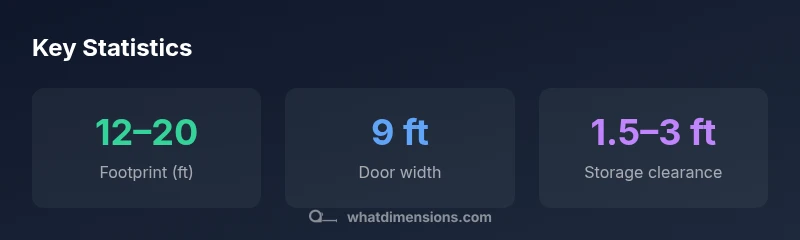
| Footprint (width × depth) | 12-20 ft × 20-24 ft | Baseline for car length plus clearance |
| Door width | 9 ft | Standard single-car overhead door |
| Parking space width | 9-10 ft | Space for car plus lateral clearance |
| Clearance for storage on one wall | 1.5-3 ft | Allows cabinets and door swing |
Quick Answers
What is the minimum garage size for a single car?
Most homes use a baseline of about 12x20 ft. Some cars may fit in a smaller space, but you’ll lose storage and working room. Always measure your car length and add clearance.
The typical minimum is around 12 by 20 feet, but measure your car to be sure.
Should I aim for extra space for a workshop?
Yes, reserve at least a 2–3 ft clear area on one side for a workbench, and consider overhead storage.
Yes—if you want a workshop, plan for extra room along one wall.
How do I measure my garage to compare to these guidelines?
Measure exterior width and depth or interior as applicable; subtract wall thickness; create a simple grid to compare to 12x20 or 12x22 baselines.
Measure the footprint and compare to the 12 by 20 baseline.
Are there universal standards for door sizes?
Single-car doors commonly run around 9 feet wide and 7 feet tall, with regional variations.
Most single-car doors are about 9 by 7 feet.
What if my car is oversized?
Consider a wider footprint, such as 14–16 feet wide, and deeper stalls up to 24 feet, or redesign with a larger space if needed.
If your car is larger, go wider and deeper within practical limits.
What storage configurations work best in a 1-car garage?
Install tall storage on one wall and use wall-mounted cabinets to keep the floor clear. Reserve a dedicated work zone if you frequently repair or modify items.
Use wall storage and a clear work area to maximize space.
“A well-sized 1-car garage should fit the vehicle with comfortable clearance for doors and storage. Plan space meticulously at the start to avoid costly changes later.”
Main Points
- Start with a 12x20 ft baseline for most cars
- Plan at least 3 ft of clearance on one side for storage
- Use a 9 ft wide door for accessibility and cost balance
- Measure your space and compare to What Dimensions guidelines