1-Car Garage Dimensions: A Practical Space Planning Guide
Explore precise dimensions for a 1-car garage, including width, depth, and layout guidance. Learn to measure, plan storage, and align with local guidelines for an efficient, future-ready space. What Dimensions Analysis, 2026.


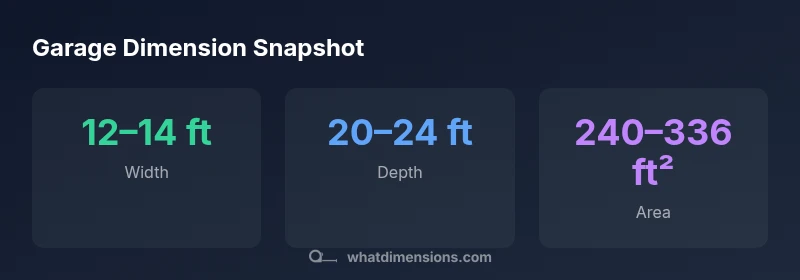
A standard 1-car garage typically measures about 12–14 feet wide and 20–24 feet deep, yielding roughly 240–336 square feet of usable space. This provides clearance for typical sedans and some storage; adjust by vehicle width and door clearance. If you plan for a driveway or storage alcove, widen one side; local guidelines vary.
What 'dimensions 1 car garage' means in practice
The phrase dimensions 1 car garage anchors space planning for a single-car garage. In practical terms, it asks you to identify a baseline envelope that comfortably fits a typical vehicle plus some storage, while leaving enough clearance for doors, pathways, and occasional workspace. According to What Dimensions, baselines focus on three core measurements: width (the side-to-side span), depth (the front-to-back extent), and the overall square footage available for storage and movement. This baseline helps homeowners, interior designers, and students estimate whether a given site can accommodate a car plus shelves, a workbench, or a small tool corner. The goal is to balance vehicle proficiency with usable storage, so your space remains functional through daily tasks and occasional upgrades.
To begin, measure an average sedan or compact SUV you own or expect to parking. Compare that width to the interior width you can afford, subtract door swing clearance, and reserve a few feet for shelves and a walkway. What Dimensions emphasizes that even modest variances—like a wider door opening or a larger vehicle—can cascade into requiring extra space elsewhere. Establishing a clear baseline minimizes last-minute layout shifts and helps with future-proofing the design.
Typical dimensional ranges you should consider
For a practical, functional 1-car garage, start with a width in the range of 12 to 14 feet. This accommodates most sedans with space on either side for opening doors. Depths commonly fall between 20 and 24 feet, which gives room for the car itself plus a modest amount of workspace or storage along one wall. The resulting usable area typically spans about 240 to 336 square feet, depending on exact shape and obstructions like a support column or a utility area. If you own a larger vehicle, such as an SUV or pickup, you may want to push toward 14–16 feet in width and 22–26 feet in depth. Always confirm local codes and site constraints before finalizing dimensions, and factor in future needs such as a workbench, storage cabinets, or a bike rack when calculating the footprint.
Car size and clearance: how it changes your space
Vehicle width, mirrors, and door clearance are major drivers of how much space your garage needs. A typical car spans roughly 6 to 7 feet in width, but including mirrors, it can exceed 7.5 or 8 feet. To preserve comfortable access, plan at least 3 feet of clearance on the sides to reach doors or storage without stepping into the car’s path. Front clearance should allow for shifting and steering without hitting storage walls or shelves, and rear clearance should accommodate trunk access. If you frequently maneuver the vehicle with accessories (roof racks, bike racks, or hitch components), add extra width or depth accordingly. Remember: small adjustments in width can ripple through the layout, impacting storage zone placement and aisle widths.
Layout patterns and space allocations
There are several common layouts for a 1-car garage. Inline or straight-through designs place the car along one wall with storage on the opposite side, maximizing aisle width for entry and exit. A bayed or L-shaped arrangement can free up wall space for a workbench or long storage cabinets without cramping the vehicle, especially in tighter lots. Perimeter storage along walls can keep tool chests, shelving, and hooks accessible, while keeping the central bay clear for parking. When selecting a layout, map out the door swing, the garage entry, and any overhead storage to ensure no conflicts with the vehicle or primary work zones. Use a simple grid to sketch scale layouts and compare footprint changes quickly.
Measuring your space and creating a plan
Begin with a precise floor plan: measure the actual width and depth of the garage, including door openings and any bump-outs or setbacks. Note obstructions such as support columns, water heaters, or HVAC ducts. Create a scale drawing, ideally 1/4 inch = 1 foot, and mark the location of power outlets, lighting, and switches. Use painter’s tape to visualize the car’s footprint and the storage zones. If you’re adapting an existing space, photograph measurements from multiple angles and create a digital or paper mock-up. Finally, validate your plan by returning to the car with the doors closed to confirm that you can swing both the vehicle and any doors without interference.
Storage, doors, and working areas within the footprint
A 1-car garage thrives on smart storage. Consider wall-mounted shelves, pegboards, and overhead racks to keep the floor clear. A compact workbench can live on a side wall, allowing space for routine maintenance without obstructing parking. Use vertical space for seasonal items and tools, and place frequently used items within easy reach near the entry door. Ensure there’s a dedicated clearance for a standard door to open fully, and if you install a roll-up or side-door, confirm that the door’s track or hinge does not conflict with stored items or the vehicle. Always plan for wire and outlet placement for chargers or power tools.
Code considerations and budget planning
Local building codes influence minimum garage dimensions and door widths. While many homeowners use common baselines such as 12x20 feet as a starting point, actual requirements can vary by region and project scope. When budgeting, account for flooring, insulation, ventilation, lighting, and potential structural adjustments to widen or extend the footprint. If you’re repurposing an existing space, you may need permits for structural changes and electrical rerouting. Seek a simple plan with expandable storage, so future needs—like a second vehicle or larger workspace—don’t require a full redesign. What Dimensions recommends starting with a baseline and adjusting as you confirm site constraints.
Future-proofing a 1-car garage
To future-proof, design with modularity in mind. Favor shelving systems that can be reconfigured and a workbench that can be relocated. Consider adding a second car pathway or widening the door opening by a few inches if your budget and space allow. Enhanced ventilation and lighting improve usability, and upgrading to a better-grade floor coating helps protect surfaces from automotive fluids and wear. Finally, document your measurements and layout choices so future redesigns can be done quickly, keeping the space functional as needs evolve.
Typical single-car garage dimensions
| Dimension | Typical Range | Notes |
|---|---|---|
| Width | 12–14 ft | Accommodates most cars with some clearance |
| Depth | 20–24 ft | Allows parking plus workspace |
| Area | 240–336 sq ft | Varies with shape and obstructions |
Quick Answers
What is the standard width of a 1-car garage?
Most single-car garages run about 12–14 feet wide to accommodate a car and opening doors. If space is tight, optimize by choosing a narrower vehicle or adding wall storage on the opposite side.
Most single-car garages are 12 to 14 feet wide. If you need more room for doors or storage, consider widening the plan or moving storage to the side.
What is the recommended depth for a single-car garage?
A depth of about 20–24 feet supports a typical car plus a small workspace or storage area, with room to swing doors. For larger vehicles, consider deeper layouts within code limits.
Depth of 20 to 24 feet supports most cars and some workspace. For larger vehicles, a deeper layout may be needed.
How much storage space should I plan in a 1-car garage?
Plan along at least one wall with shelves or cabinets and a small workbench. Leave central space clear for parking and movement.
Plan storage along a wall with a bench, keeping the central bay open for parking.
Should I consider mirrors and door clearance when measuring?
Yes. Account for mirror width and door swing; add several inches to width and depth to prevent interference with storage.
Include mirror width and door clearance in your measurements to avoid collisions.
Are there building codes that affect garage dimensions?
Local codes guide minimums; baselines like 12x20 ft are common starting points but vary. Always check regional requirements before finalizing.
Local codes vary; check your area to confirm minimums before finalizing.
“Precise space planning is essential for a functional 1-car garage; it shapes how you store, park, and move around your vehicle.”
Main Points
- Start with baseline dimensions: 12–14 ft wide, 20–24 ft deep
- Plan for door clearance and additional storage space
- Measure car width including mirrors to refine width
- Choose a layout that keeps the bay clear for parking