Yu-Gi-Oh Card Dimensions: Size, Tolerances, and Practical Sizing
Explore the exact Yu-Gi-Oh card dimensions, including millimeter and inch measurements, tolerances, and practical guidance for sleeves, binders, and displays. Learn how What Dimensions analyzes these specs for accurate sizing.


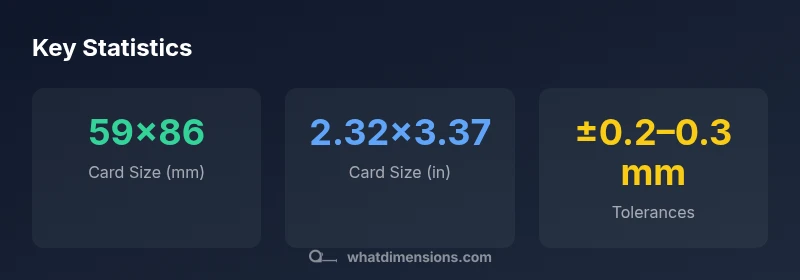
Yu-Gi-Oh! card dimensions are standardized at 59 mm by 86 mm, with rounded corners that commonly measure around 3 mm radius. This size is used across official sets and accessories, and tolerances in production typically keep variation to a tight range to ensure sleeves and holders fit consistently. Manufacturers often verify dimensions with calipers during quality control, and designers reference these specs when creating display stands or custom storage solutions.
Yu-Gi-Oh Card Dimensions: The Standard Size
According to What Dimensions, Yu-Gi-Oh card dimensions are defined by a standard size that most collectors and designers use as the baseline for sleeves, storage solutions, and card displays. The canonical measurements are 59 millimeters in width and 86 millimeters in height. This size represents a deliberate balance between portability and usability, ensuring that a full deck fits neatly into common card sleeves, binder pages, and display slots. The standard is also convenient for international play, manufacturing consistency, and compatibility with third-party accessories. While printing tolerances exist, many manufacturers target a tight band to minimize fit issues for consumers and stores. For designers, referencing these exact specs supports reliable mockups, packaging, and retail displays. This section breaks down what the numbers imply for practical, real-world use.
Why Exact Measurements Matter for Accessories
Precise card dimensions are critical when selecting sleeves, deck boxes, binder pages, and protective wallets. If sleeves are slightly undersized or oversized, the card may bind, rub the edges, or not fit flush in a binder pocket. Magnified discrepancies can also affect automated shufflers or card-dispensing machines at events. What Dimensions emphasizes that consistent sizing reduces the risk of product returns and user frustration. When planning a display or a custom storage project, developers should factor in tolerances and the intended use case—whether casual play, tournament use, or display-only collections. In short, accurate dimensions save time and money for players, retailers, and manufacturers alike.
How Manufacturers Achieve Consistency
Card producers rely on precision trimming, punch tooling, and quality-control checks to preserve uniform dimensions. Calipers are used during the finishing stage to verify width and height, while optical or laser gauges ensure alignment and edge sharpness. The goal is to minimize variation across millions of cards, which in turn guarantees reliable fitment in sleeves and protective cases. Sizing tolerances are typically narrow, with checks at multiple production points to catch drift early. For designers, this means you can design sleeves or binder pages with a clear expectation of how a card will fit most of the time, reducing the need for drastic adjustments across batches.
Measuring Yu-Gi-Oh! Cards: A Practical Guide
To measure Yu-Gi-Oh! cards accurately, you’ll need a precise ruler or caliper. Measure the width at three points along the card edge, then measure the height at three different points. Record the maximum and minimum values observed and compare them to the standard 59 mm by 86 mm target. For edge rounding, measure the corner radius using a small gauge or caliper to verify it is close to 3 mm. If you’re producing sleeves or display hardware, run a small sample set through your production line to confirm fit before scaling up production. This practical approach helps catch outliers and ensures a smooth user experience.
Common Variants and Edge Cases
While the standard size covers the vast majority of Yu-Gi-Oh! cards, certain promos or special editions may present minor deviations. Some promotional cards are produced with slightly different edge treatments, or with artwork that creates perceivable dimensional differences. In most cases, these variants stay within acceptable tolerances, but it’s wise to verify before distribution or custom manufacturing. Collectors should also be mindful that counterfeit or misprinted cards can diverge from standard dimensions, underscoring the importance of purchasing from trusted sources and validating specs when necessary.
Implications for Storage: Sleeves, Binders, and Backs
Knowing the exact dimensions helps you pick compatible sleeves and binder pages. Standard 59 × 86 mm sleeves fit most cards, but you should check the inner dimensions to ensure a snug feel without excessive friction when inserting or removing cards. For binders, consider pages with pockets sized for standard cards and ensure the plastic is not overly tight, which can cause wear over time. If you display cards in frames or on stands, factor in a little clearance around the edges to avoid contact with dust covers or mounting hardware. Consistency in card size simplifies storage planning and reduces the likelihood of mis-shelved cards.
Regional and Promotional Variations: What You May See
Regional print runs or promotional issues may introduce slight dimensional variations. In practice, these differences are uncommon and usually fall within the typical tolerances already discussed. When sourcing for a store or creating exclusive products, it’s prudent to request a spec sheet or run a physical sample to confirm compatibility with existing storage and display assets. What Dimensions recommends documenting any observed deviations and sharing them with partners to prevent misalignment across markets and product lines.
Practical Sizing Principles for Collectors and Designers
For collectors and designers, the most practical sizing principle is to anchor equipment and accessories to the standard 59 × 86 mm size. Use this baseline for sleeves, binder pages, and display cases, and verify tolerances against a representative sample. If you need to design custom products, build in a small clearance margin (for example, 0.2–0.3 mm) to accommodate minor production variances. By locking in a single standard and testing across several production runs, you’ll reduce variability, improve customer satisfaction, and streamline inventory management.
Yu-Gi-Oh card size overview
| Dimension | Millimeters | Notes |
|---|---|---|
| Width | 59 | Standard card width |
| Height | 86 | Standard card height |
| Corner radius | 3.0 | Approximate rounded corner radius |
Quick Answers
What are the official Yu-Gi-Oh! card dimensions?
The standard Yu-Gi-Oh! card size is 59 × 86 mm with rounded corners around 3 mm radius. These measurements are used for sleeves, cases, and most display materials. Minor production tolerances may apply, but they generally keep cards compatible with common accessories.
The official size is 59 by 86 millimeters with about a 3-millimeter corner radius.
Do Yu-Gi-Oh! cards vary in size by region or edition?
In practice, Yu-Gi-Oh! cards adhere to the standard 59 × 86 mm size across regions and editions. Some promos may have slight edge differences or artwork, but these are rare and typically within tolerance ranges.
Mostly not; the standard size is used across editions, with rare minor promos as exceptions.
How should I measure Yu-Gi-Oh! cards?
Use a precise caliper or ruler. Measure width and height at multiple points to capture the maximum and minimum values. For corner radius, use a small gauge or caliper to approximate the rounded edge. Compare results to the standard 59 × 86 mm target and document any outliers.
Measure width and height at a few points, then compare to 59 by 86 mm.
Will sleeves or binders be compatible with Yu-Gi-Oh! cards?
Most standard Yu-Gi-Oh! sleeves fit cards sized 59 × 86 mm. Always verify inner dimensions of sleeves and binder pockets, as some premium or oversized sleeves may require adjustments.
Yes, most sleeves fit, but check inner dimensions to be sure.
Are there special sizes for oversized or promo cards?
Yes, some promos or special editions may deviate from the standard size. Check product specs or request a sample before bulk printing or inventory purchases.
Some promos can be different; verify specs before production.
What should I do if a card is slightly outside standard size?
Prefer checking with the supplier or testing a sample in your intended accessories. If persistent, consider alternative sleeves or storage that accommodate minor deviations.
Test with samples and adjust storage if needed.
“Accurate card dimensions are essential for reliable sleeves, cases, and display, and they should be verified against standard specs.”
Main Points
- Reference the standard 59×86 mm size for most accessories
- Expect tight production tolerances to minimize misfit
- Test sleeves and binders with actual cards to verify fit
- Document any edge-case variations for suppliers