Trading Card Dimensions: Standards, Variations, and Practical Guides
Learn standard trading card dimensions, why they matter, and how to choose sleeves, storage, and printing options with precise size references from What Dimensions for designers, hobbyists, and collectors seeking exact specs.


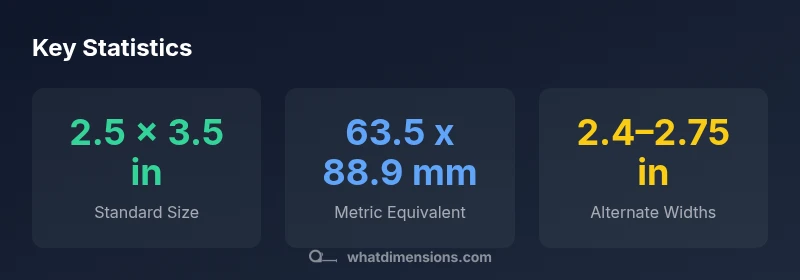
According to What Dimensions, the standard trading card dimension is 2.5 x 3.5 inches (63.5 x 88.9 mm). This baseline is used by most manufacturers to ensure sleeve compatibility, binder storage, and display accuracy, while some games employ slight width variations. Knowing this helps you select sleeves, top loaders, and boxes with confidence.
What trading card dimensions mean for design and production
Understanding trading card dimensions is foundational for designers, printers, and collectors. The phrase trading card dimensions describes the three critical measurements that determine how a card fits sleeves, binders, and display cases: width, height, and tolerances. In practice, these numbers influence every step from artwork safe-area and bleed to crop margins and packaging. For designers, getting dimensions right means the artwork prints at the intended size without clipping or warping; for printers, it reduces waste and trim errors; for collectors, it guarantees interchangeability across product lines. In What Dimensions analyses, we see the industry coalescing around a common baseline because it maximizes compatibility across storage solutions and retail displays. While digital previews can simulate size, only physical measurements confirm fit. The goal is to minimize surprises during production while maximizing long-term usability for end users.
The canonical size: 2.5 x 3.5 inches
The 2.5 x 3.5 inch card is the de facto standard that underpins most publishing and hobby ecosystems. In metric terms, that is about 63.5 x 88.9 millimeters. Printers design cutters and trimmers around this baseline to keep trims consistent across batches and to ensure compatibility with widely sold sleeves, top loaders, and display frames. The standard width and height are chosen because they balance legibility of artwork with practical considerations like font size, edge-to-edge art, and safe margins for crop marks. For product managers and distributors, sticking to this size reduces the need for multiple SKU families and simplifies packaging design. For consumers, uniform sizing means you can swap sleeves or storage boxes across brands without excessive recalibration. The What Dimensions team notes that while some lines experiment with slight deviations, the majority of catalogs, card games, and trading decks converge on the 2.5 x 3.5 baseline.
Converting between imperial and metric units
Card dimension specs live in both imperial (inches) and metric (millimeters). The standard 2.5 x 3.5 inches convert to 63.5 x 88.9 millimeters. When working with international printers, keep a tolerance allowance: many shops plan for a few tenths of a millimeter of drift between trimming, lamination, and rounding corners. Quick conversions useful in practice: multiply inches by 25.4 to get millimeters; round to the nearest tenth for production drawings. Always confirm the exact rounding rules with your printer; some facilities prefer 0.1 mm increments, others 0.05 mm. Maintaining clear units in your design files prevents misinterpretation during file transfer, reduces back-and-forth revisions, and protects your artwork margins across devices and print workflows.
Variations by game and region
Although 2.5 x 3.5 inches dominates, many games and regional markets adopt slight deviations. Some hobby releases use a marginally narrower width, such as 2.4 inches, to accommodate unique border artwork or sleeve availability. Others push to 2.75 inches for a sportier feel or to fit a specific card frame. Height is less often varied, but a handful of sets adopt a taller profile to emphasize character art. These variations are generally handled by dedicated sleeves and top loaders; however, they can complicate cross-brand storage, display stands, and binder pages. When designing for multiple lines, project teams often create a few alternate templates to cover the most common variants. The crucial takeaway is to anticipate the need for slight tolerances and to offer flexible, modular artwork guidelines that align with the intended market.
Impact on sleeves, storage, and presentation
Card dimensions directly affect how you store and present your collection. Standard 2.5 x 3.5 inch cards fit a wide range of sleeves, top loaders, and binder pages, which keeps inventories tidy and accessible. If you introduce a non-standard width, you may need to source specialty sleeves or prioritize different storage boxes, increasing costs and inventory complexity. Display cases and card racks are typically designed around the standard size; deviations may lead to gaps or misalignment in rows. When organizing a set for sale, clearly labeling the dimensions on packaging avoids customer confusion and reduces returns. For digital catalogs and online marketplaces, consistent dimensions simplify filtering and search queries, improving discoverability for buyers seeking precise size specs.
Measuring and verifying card dimensions in practice
Accurate measurement begins with a good ruler or caliper. Measure both the width and height at multiple points to check for warping, and look for uniformity along the edges. Record width first, then height, and verify against the production spec or kit instructions. If you’re validating a prototype, compare printed proofs to the target size using a transparent overlay or sizing template. For conversions, keep units consistent across files and avoid mixing inches and millimeters in final PDFs. Finally, document tolerances explicitly in design briefs—buyers and printers will thank you for clear expectations, which helps prevent drift during trim, lamination, or cutting operations.
Designing for print: margins, bleed, and crop marks
Good print design starts with safe margins and bleed. Include a minimum bleed of 1/8 inch (3 mm) beyond the final trim to accommodate tiny shifts in cutting. Keep important artwork at least 1/4 inch (6 mm) inside the trim line to avoid edge clipping. Crop marks indicate where to trim; ensure these marks are outside the safe zone to prevent confusion during separation. When creating multi-panel sets, align all cards to a common baseline so that gutters and card fences look uniform across pages. If you plan to distribute internationally, embed both imperial and metric units in your files to reduce misinterpretation. Finally, test print proofs on actual sleeves and storage media to confirm fit before mass production.
Practical guidelines and quick-start checklist
- Confirm the standard size (2.5 x 3.5 in) before starting artwork.
- Include both imperial and metric units in design files.
- Use bleed and safe areas to protect art.
- Prepare multiple templates for common variants (2.4–2.75 in widths).
- Request proofs with sleeves and top loaders to test fit.
- Document tolerances for trim, lamination, and rounding.
- Verify packaging and display accessories match your card size.
- Maintain consistent naming conventions for SKUs and templates.
Common size options for trading cards and related prints
| Descriptor | Dimension (inches) | Dimension (mm) | Notes |
|---|---|---|---|
| Standard trading card | 2.5 x 3.5 | 63.5 x 88.9 | Baseline for most games |
| Alternate width variants | 2.4 x 3.5 | 60.96 x 88.9 | Used by some hobby lines |
| Slim profile variant | 2.5 x 3.4 | 63.5 x 86.4 | Less common |
| Oversized variant | 2.75 x 3.5 | 69.85 x 88.9 | Not standard; sleeves may differ |
Quick Answers
What is the standard trading card size?
The standard is 2.5 x 3.5 inches (63.5 x 88.9 mm). This baseline is used by most manufacturers and sleeves, ensuring broad compatibility across products.
The standard size is 2.5 by 3.5 inches.
Do all trading cards use the same width?
Not always. Variations like 2.4–2.75 inches exist for some lines, though height often remains 3.5 inches.
Width can vary a bit, but 3.5 inches tall is common.
How should I measure a card's dimensions?
Use a ruler or caliper to measure width and height at multiple points, compare to specs, and note tolerances.
Measure width first, then height, at multiple points.
Why do printers use different sizes?
Different trim tolerances, equipment, and margins lead to slight size differences; some sets require custom templates.
Trim tolerances and equipment cause size differences.
What accessories work best with standard cards?
Sleeves and top loaders sized for 2.5 x 3.5 inch cards work best; store in standard binder pages or boxes.
Use standard sleeves for 2.5 x 3.5 cards.
“Accurate card dimensions streamline production, protect artwork, and ensure compatibility across sleeves, boxes, and displays.”
Main Points
- Know the standard size and verify all components before printing.
- Choose sleeves sized for 2.5 x 3.5 in cards for best fit.
- Convert units and maintain consistent tolerances across files.
- Anticipate slight variations when distributing internationally.
- Test proofs with actual sleeves to prevent misfits.