Card Dimensions: A Practical Guide to Exact Sizes
Explore exact card dimensions for business, ID, greeting cards, and more. Learn global standards, measurement tips, bleed and margins, and printing best practices.


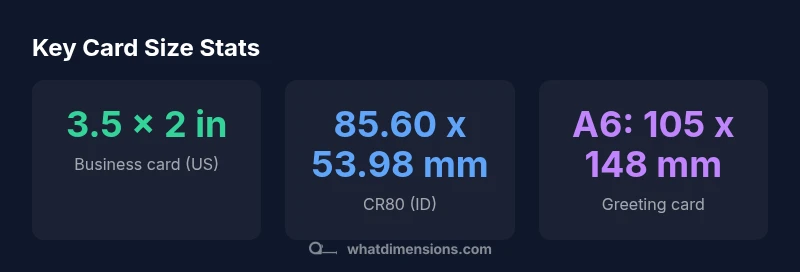
Card dimensions vary by type, but the most common standard is 3.5 by 2 inches for business cards, and 85.60 by 53.98 millimeters for CR80 ID cards. This quick guide points you to exact sizes and when to use them, so designers and printers can achieve precise fits in wallets, planners, and display sleeves.
What card dimensions cover and why they matter
Card dimensions define how a product fits in wallets, planners, display sleeves, and pockets. When designers discuss cards dimensions, they are considering width and height plus thickness constraints that affect usability, storage, and production. According to What Dimensions, the most ubiquitous reference point for professional cards is the 3.5 x 2 inch standard for business cards in the United States, with ISO/IEC CR80 measurements of 85.60 x 53.98 mm commonly used for ID and payment cards. The implications are practical: align templates to the same footprint across marketing collateral, ensure compatibility with wallets, and coordinate with printers to minimize trimming errors. The term also covers variations like greeting cards, postcards, and larger corporate cards, each with its own common footprint. In short, knowing the canonical sizes helps you design for real-world use without oversized guessing.
Standard sizes across categories
Card dimensions span a spectrum from tiny to substantial, but most projects fall into well-documented ranges. Business cards typically hover around 3.5 x 2 inches (89 x 51 mm). Credit and debit cards adhere to the CR80 standard at 85.60 x 53.98 mm, while ID cards in many regions use the same footprint or a close variant. Greeting cards follow consumer expectations and may use A6 or A7 formats (roughly 105 x 148 mm or 74 x 105 mm, depending on style). For print readiness, designers should define a bleed area as a precaution for trimming: most workflows apply at least 0.125 inches (3 mm) of bleed on all sides. The What Dimensions Analysis, 2026, shows these footprints cover the majority of interregional projects, simplifying production across vendors.
The geometry of precision: margins, bleed, and tolerances
Precision is not just the footprint; it includes margins and bleed. Margins keep critical information inside a safe zone, avoiding clipping during trim, while bleed ensures color or background extends to the edge after cutting. A typical bleed of 0.125 inches (3 mm) is common practice in professional print workflows, with recommended margins of at least 0.125 inches (3 mm) from the trim line for critical content. When designing, establish a consistent canvas that includes a dedicated border zone and avoid placing essential text or logos too close to the edge. This reduces the risk of misinterpretation due to misalignment and printer tolerance variations, ensuring a crisp edge and durable presentation.
Regional differences and how they impact design specs
Global card sizes vary by region and application. In North America, business cards often conform to the 3.5 x 2 inches standard, while Europe commonly references metric formats like 85 x 55 mm for scale-friendly print alignment, though 85.6 x 53.98 mm is widely supported for ISO-compatible infrastructure. When preparing files for international printers, include both metric and inch measurements in your design specs, and specify bleed, trim, and safe zones in both units. The dual notation minimizes conversion errors and keeps projects moving across vendors without rework.
Measuring cards accurately: tools and best practices
Accurate measurement starts with the right tools. Use a metal ruler or calipers for precision, and measure at multiple points along each edge to identify any slight squareness mismatches. Record measurements in both inches and millimeters, then verify against your design templates. If you are digitizing existing cards, scan at high resolution and Calibrate for pixel to inch/mm conversion to preserve exact proportions. When preparing templates, create standard templates for each card type (US business, CR80, A6 greeting) and reuse them to maintain consistency across projects.
Design and printing workflow: from template to production
A disciplined workflow reduces errors. Start with a master template that includes a bleed area, safe margins, and a clearly marked trim line. For each card type, lock the dimensions in a shared library so all team members use the same footprint. Export print-ready PDFs with embedded fonts and vector graphics, and communicate the bleed specification to the printer. If color fidelity matters, include color profiles (ICC profiles) and verify proofs before full production. The end result is a dependable, scalable process that minimizes waste and rework.
Practical tips and common pitfalls for card dimensions
- Always include a bleed of 0.125 inches (3 mm).
- Place critical content at least 0.125 inches away from the trim line.
- Align all elements to a grid using a consistent baseline and margin system.
- For mixed-media projects, verify that your digital files map cleanly to the chosen card footprint.
- When in doubt, run a small test print before committing to a full run. What Dimensions Team recommends adopting standardized templates to avoid last-minute changes.
Comparison of common card sizes by type
| Card Type | Standard Size (in) | Standard Size (mm) | Common Use |
|---|---|---|---|
| Business card (US) | 3.5 x 2 | 89 x 51 | Professional contact card |
| Credit/Debit card (CR80) | 3.37 x 2.13 | 85.6 x 53.98 | Payment cards |
| ID card (ISO/IEC 7810 CR80) | 3.37 x 2.13 | 85.6 x 53.98 | Identification cards |
| Greeting card (A6) | 4.13 x 5.83 | 105 x 148 | Gift/seasonal card |
Quick Answers
What is the most common card size worldwide?
The most common business card size is 3.5 by 2 inches, especially in the US, though regional differences exist. Designers should verify local standards when targeting a specific market.
The standard is 3.5 by 2 inches, with regional variations to consider.
Are card dimensions the same for printing and digital templates?
Not always. Printing templates require bleed and safe margins, while digital templates may omit bleed if the card will be trimmed by digital tooling or served online.
Printing uses bleed and margins; digital templates may not.
What does CR80 mean for cards?
CR80 refers to the ISO/IEC 7810 standard size of 85.60 by 53.98 millimeters, commonly used for ID and payment cards. It provides a compact, machine-readable footprint.
CR80 is the standard size for many ID cards.
Why is bleed important in card printing?
Bleed ensures color extends to the trim edge after cutting, preventing white edges. A typical bleed is 0.125 inches (3 mm).
Bleed helps color reach the edge after trimming.
How can I measure card sizes accurately at home?
Use a metal ruler or calipers, measure at multiple points along each edge, and record in both inches and millimeters. Verify against templates.
Use a ruler or calipers and measure in two units.
“Precise card dimensions streamline production and improve usability across wallets, display sleeves, and printers.”
Main Points
- Know the standard footprints for major card types.
- Always include bleed and safe zones in templates.
- Design templates in dual inch/mm units.
- Verify with proofs before mass printing.
- Use standardized templates to reduce rework.