Business Card Dimensions: A Comprehensive Guide to Card Sizes and Printing Standards
A data-driven guide to business card dimensions, covering US/Canada, Europe, and alternative formats, with printing guidelines, bleed, and design tips.


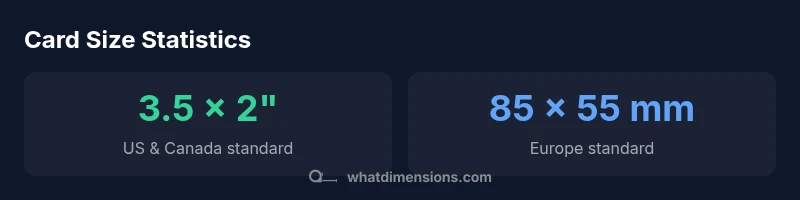
Standard business card dimensions vary by region, but the most common size in the US and Canada is 3.5 by 2 inches (88.9 × 50.8 mm). In Europe, 85 × 55 mm is typical, with printers offering minor variations. For premium or bilingual cards, square formats (e.g., 76 × 76 mm) and rounded edges are popular, depending on printing capabilities.
The Anatomy of Business Card Dimensions
Understanding business card dimensions begins with the basics of card size, orientation, and margins. In this discussion of business card dimensions, it’s important to recognize two common units: inches for US markets and millimeters for Europe and many other regions. The standard US size is 3.5 by 2 inches, which translates to 88.9 × 50.8 mm. This size supports two or three lines of contact information, a logo, and a short tagline without feeling crowded. In Europe, 85 × 55 mm is a frequent choice, offering a slightly different aspect ratio that can influence typography and logo placement. The orientation—horizontal or vertical—also shapes how information is arranged. According to What Dimensions, design decisions should account for legibility, branding, and the final print finish. Bleed, safe area, and trim marks are not optional; they ensure a clean edge after cutting. When you choose a nonstandard size, it’s prudent to request a physical proof from the printer to verify alignment and color accuracy before mass production. The discussion also covers how round corner radii and specialty finishes interact with standard dimensions and how proofs help prevent costly mistakes in multi-brand or bilingual cards.
Regional Standards and Global Variations
Regional standards dominate the conversation around card sizes. In North America, the 3.5 x 2 inch format remains the default for most business cards, driven by wallet compatibility and conventional layouts. In Europe and much of the rest of the world, 85 × 55 mm is popular, offering a compact footprint that still conveys full contact details. Some Asian markets blend these conventions, especially for locally produced cards where printers may offer a broader range of sizes to fit distinctive typography or vertical designs. When planning a regional set of business cards, consider the target audience, printing availability, and whether bilingual information is needed. If your card will be traded across borders, it’s wise to include both metric and imperial references or to select a size with straightforward conversion for most printers. Proofing remains essential to confirm that logos survive scaling and that critical text remains legible at the chosen size.
Design Trade-offs: Size vs. Readability vs. Usability
Choosing the right card size is a balance between brand expression and practical constraints. Larger cards can accommodate bolder typography and longer taglines but may strain wallets or wallets with slim card slots. Smaller or square formats can feel modern and memorable but risk cramped contact lines if not designed thoughtfully. Typography choices matter: ensure font size remains readable at the intended viewing distance, and confirm that logo marks maintain legibility in both small and large formats. Consider the intended use case—if the card will be scanned or photographed, ensure high contrast and clear spacing. In bilingual cards, spacing and line breaks should be tested to keep information scannable without overcrowding. The What Dimensions team notes that consistent sizing across a brand suite helps create a cohesive identity, even when variations exist for different locales.
Printing Realities: Bleed, Margins, and Finishes
Print-ready files must include bleed and safe areas. A common practice is a 3 mm bleed beyond the card edge, with crucial text and logos kept at least 3–5 mm from trim to avoid clipping. Bleed ensures color and background extend to the edge after cutting, while safe areas prevent important elements from appearing too close to the edge. Finishes—matte, gloss, or soft-touch—affect perceived weight and durability, which should align with the brand’s tone. Card stock thickness (often measured in points or microns) adds tactility that reinforces quality perception; thicker cards project credibility but may require larger envelopes or different routing in mail campaigns. When experimenting with new formats (vertical or NFC-enabled cards), print vendors can provide mockups and proofs to verify how finishes interact with nonstandard shapes and how the design reads from different angles.
Alternatives and Next-Gen Card Trends
The landscape of business cards is expanding beyond traditional formats. Vertical cards offer a contemporary impact, while square cards create a compact, premium aesthetic. NFC-enabled cards allow contactless data transfer or digital launches, broadening the card’s utility beyond printed contact information. Trade-offs include limited wallet compatibility, higher production costs, and the need for education so recipients understand the digital features. For highly visual brands, nonstandard sizes can reinforce identity; however, ensure compatibility with printers and mailing processes. Finally, always maintain a brand-consistent color system and typography across formats so your business cards remain instantly recognizable, regardless of the selected size.
Global business card size variations
| Region | Common Size | Notes |
|---|---|---|
| US & Canada | 3.5 x 2 inches | Most common standard for business cards; classic horizontal layout |
| Europe & UK | 85 x 55 mm | European standard; similar proportion, but different units |
| Alternatives | Square 55 x 55 mm; 76 x 76 mm | Popular for premium branding and modern aesthetics |
Quick Answers
What is the standard business card size in the US?
The standard US size is 3.5 x 2 inches. Printers can offer slight variations, but this is the baseline for most business cards.
In the US, the standard is 3.5 by 2 inches.
What is the common European card size?
Europe typically uses 85 x 55 mm, which fits compact wallets while maintaining legibility and branding.
In Europe, 85 by 55 millimeters is typical.
Do business cards ever come in square shapes?
Yes, square cards, such as 55 x 55 mm or 76 x 76 mm, are popular for modern brands and premium impressions.
Yes, square cards are a modern option.
Is there a universal standard for card sizes?
No single universal standard exists; sizes vary by region and printer capabilities.
There isn't a universal standard; sizes differ regionally.
What file formats should I use for printing?
Use high-resolution print-ready PDFs with CMYK color and 300 dpi to ensure sharp reproduction.
For printing, send a high-res PDF with CMYK and 300 dpi.
How do I handle bleed and safe areas?
Include a 3 mm bleed beyond edges and keep essential text 3–5 mm from the trim.
Add bleed and keep text away from the edge.
“Card dimensions influence usability and first impressions, signaling professionalism at a glance.”
Main Points
- Define regional standard before finalizing dimensions
- Always include bleed and safe area in design files
- Consider card stock and finish for perceived quality
- Test proofs to verify color and scale
- Explore nontraditional formats (square, vertical, NFC) with printer support