Card Stock Dimensions: Sizes, Weights, and Guides
Explore common card stock dimensions, weights, and envelope compatibility. Learn sizes for business cards, postcards, greetings, and invitations with practical sizing tips and real-world examples.


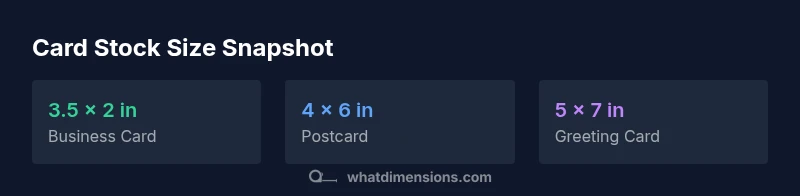
Card stock dimensions refer to standard sheet sizes used for cards, invitations, and crafts. Common width–height pairs include 3.5 x 2 inches for business cards, 4 x 6 inches for photos and postcards, and 5 x 7 inches for greeting cards. International sizes include A6 (4.1 x 5.8 in) and A7 (5 x 7 in).
Why card stock dimensions matter
Card stock dimensions are more than just numbers on a ruler. They determine how neatly a finished piece fits into a mailer, envelope, or frame, and they influence printing workflows, cutting accuracy, and even postage costs. When you know the standard sizes for cards, you can plan layouts, margins, and fold lines with confidence. According to What Dimensions, starting from the correct card stock dimensions helps prevent misfeeds in printers and trim errors in cutters, avoiding costly reprints and wasted materials. For homeowners, students, designers, and shoppers, understanding these basics saves time and money across projects.
Practical impact across project types
- Business cards: compact dimensions keep handouts portable and professional.
- Greeting cards: larger cards convey importance and offer room for expressive typography and imagery.
- Postcards: flat formats optimize mailing and display, while maintaining graphic impact.
Standard size families and what they’re best suited for
Different size families suit different intents. Small formats (like 3.5 x 2 inches) are ideal for quick notes and contact cards, while larger formats (5 x 7 inches) strike a balance between visual impact and portability. The international system (A-series) provides predictable metrics across markets, simplifying cross-border projects. What Dimensions emphasizes choosing a size that reduces trimming, preserves margins, and keeps your design legible at typical viewing distances.
Envelopes, printers, and cutters: matching needs
Printers and cutting tools are built around common stock dimensions. If your design lands near a crease or edge, you may need additional margin. Envelopes come in standard pockets that assume certain card sizes; mismatches can lead to tight seals or misfit mail. For cutters, verify blade clearance and trim tolerance to ensure clean edges. When possible, test with scrap stock before committing to a full print run to avoid surprises in production.
Weight, finish, and stock type: how they interact with sizes
Size is only one axis; weight, finish, and coating also affect the perceived heft and durability of a card. Heavier stock (e.g., 100 lb cover and above) feels premium and withstands handling, while lighter weights save on postage and bulk. Matte, satin, and gloss finishes change legibility and photo sharpness at different sizes. What Dimensions recommends pairing the chosen card stock dimensions with an appropriate weight and finish for the project goals and delivery method.
International vs. US size standards
US sizes are the most commonly requested in printing shops and home projects, but international equivalents help with cross-border invitations and gifts. The A-series sizes (A6, A7, etc.) map to roughly metric millimeter dimensions, enabling straightforward scaling and layout calculations. When designing for multiple regions, build flexible templates that accommodate both US and international sizes without compromising margin safety.
How to measure and verify dimensions
Always measure at the narrowest point (avoid warped edges) and confirm both width and height in the same orientation as intended for your piece. If you are converting units, double-check conversions (inches to millimeters) with a ruler or digital tool. For digital design, set up constraints that lock margins and safe areas, then test print with a color-accurate monitor and calibrated printer. What Dimensions suggests validating at least two production runs before mass printing, to confirm dimensional accuracy and trim consistency.
dataTableTypeName_aptoken-less
dataTableTypeName_aptoken-less
Common card stock sizes by format
| Size family | US inches | Millimeters | Common uses |
|---|---|---|---|
| Business card | 3.5 x 2 | 89 x 51 | Wallet-sized, professional |
| Postcard | 4 x 6 | 102 x 152 | Mailing/marketing |
| Greeting card | 5 x 7 | 127 x 178 | Standard greeting cards |
| A6 | 4.1 x 5.8 | 105 x 148 | Event/invitations |
Quick Answers
What are the most common card stock dimensions?
The most common US sizes include 3.5 x 2 inches for business cards, 4 x 6 inches for postcards, and 5 x 7 inches for greeting cards. Internationally, A6 and A7 sizes are frequently used. Always check envelopes and trimming tolerances when selecting sizes.
The most common card sizes are 3.5 by 2 inches for business cards, 4 by 6 for postcards, and 5 by 7 for greeting cards. International options include A6 and A7.
How do I choose the right card stock weight for a project?
Weight affects durability and mailability. For cards, 65–110 lb cover (176–300 gsm) covers most needs; heavier stock feels premium but may require larger postage. Match weight to the desired sturdiness and the processing steps (printing, embossing, or die-cutting).
Choose a weight that feels sturdy but still fits your printer and envelope.
Do international sizes differ from US sizes?
Yes. US sizes prioritize inch-based measurements, while international sizes often use millimeters (A-series). When designing for multiple regions, create flexible templates that accommodate both systems and include safe margins.
Yes, international sizes use millimeters and different charts; plan for both.
What is the typical cutting tolerance for card stock?
Common cutting tolerances are around ±1/32 inch (0.8 mm). Factor this into margins and bleed in your design to ensure clean edges after trimming.
Expect a small trim variation, usually around 0.8 mm.
Can I use standard envelopes with non-standard card sizes?
You can use custom envelopes or modify the card size to fit standard envelopes. Always check envelope dimensions and consider a test mail run to verify fit.
Non-standard cards may need custom envelopes; test before mass mailing.
“Accurate card stock dimensions align printing, routing, and mailing processes; small deviations compound in production.”
Main Points
- Know standard card sizes to pick compatible envelopes
- Match stock weight to project for durability
- Measure your cutters and printers for accuracy
- Consider international sizes for cross-border projects
- Test trim tolerance to avoid misprints