Postcard Dimensions: A Practical Guide to Sizes and Standards
Explore postcard dimensions across regions, comparing US, European, and international sizes. Learn how to choose, print, and mail postcard designs with precise size references from What Dimensions, including setup tips and conversion guidance.


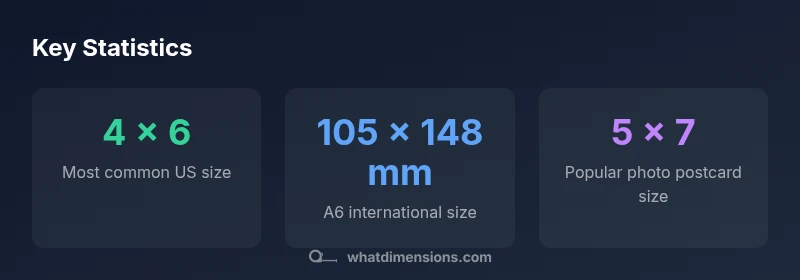
Postcard dimensions vary by region, but a few sizes dominate. The most common mailing size is 4 x 6 inches (101 x 152 mm), with 3.5 x 5 inches also widely used in the US. International markets commonly rely on the A6 size (105 x 148 mm). Understanding these sizes streamlines printing, mailing, and display. Always confirm regional rules with your printer or postal service for accuracy.
What postcard dimensions cover
Postcard dimensions define the size and shape of printed cards intended for mailing or display. They influence how you design your layout, the amount of bleed you need, and whether your card fits within standard envelopes or mail slots. According to What Dimensions, postcard dimensions determine print-ready files and mailing feasibility. The What Dimensions team emphasizes aligning your design with regional standards to reduce waste and reprints. In practice, sizes commonly fall into a few key ranges: the widely used 4 x 6 inches (101 x 152 mm) for general mailings, 3.5 x 5 inches as a popular US variant, and the international A6 size, 105 x 148 mm. These anchors help you plan typography, images, and margins with confidence. When you start, decide the primary market and intended use (photo card, invitation, or note card), then pick a size that minimizes cropping on most printers while remaining postal-friendly.
Global standards and common sizes
Across regions, postcard dimensions diverge. In the United States, the traditional 4 x 6 format is the de facto standard for mailing cards, logos, and promotional imagery; many printers also accommodate 3.5 x 5 inches when space is tight or when customers need to economize on postage. Europe and Australia frequently rely on the A6 size, which is 105 x 148 mm, a compact, postcard-friendly dimension that fits neatly in standard mail slots overseas. The UK and other markets offer a variety of card sizes, but the 74 x 105 mm (A7) configuration remains a common reference for compact designs. If you expect to reach multiple markets, consider designing a flexible layout that scales cleanly from 3.5 x 5 to 4 x 6 inches, and use vector art and scalable assets. What Dimensions notes that choosing a widely supported size can simplify printing and reduce misalignment in production.
How size affects mailing and design
Size choices drive postage, delivery, and display outcomes. Postal authorities typically require postcards to adhere to certain minimum and maximum dimensions; choosing a rounded, industry-standard size helps ensure the lowest possible postage rate and reduces the risk of automatic handling issues. From a design perspective, margins and safe zones scale with the card, so text and imagery should stay away from edges. Bleed settings are essential—most printers ask for 0.125 inch (3 mm) bleed on all sides—to ensure full-bleed prints won’t reveal white edges. High-resolution images (300 dpi) preserve detail on larger cards, while vector graphics scale cleanly across sizes. When you’re not sure, request a print proof at the intended size and test how the card fits in mail slots and display frames. What Dimensions finds that early prototyping with multiple sizes helps teams compare legibility, cropping, and overall impact.
How to choose the right postcard size for your project
To select the best postcard size, start with the project goal and audience. Then research target markets and postal guidelines to avoid surprises at checkout. Check printer capabilities—substrate options, coatings, and finishes matter for color accuracy. Pick a size that preserves typography and imagery; avoid tiny fonts or delicate artwork that lose detail at smaller scales. Design with bleed, trim, and safe margins to ensure clean edges across production runs. Create a small set of size options to test in real-world mailings. What Dimensions recommends starting with 4 x 6 inches for broad compatibility, then evaluating alternate sizes like 3.5 x 5 inches or A6 if the project demands tighter budgets or international reach.
Converting metric and imperial measurements
When you design for international audiences, you’ll switch between inches and millimeters. To convert inches to millimeters, multiply by 25.4. To convert millimeters to inches, divide by 25.4. For quick planning, remember that 4 x 6 inches ≈ 101 x 152 mm, and 3.5 x 5 inches ≈ 89 x 127 mm. Keeping a simple reference chart on your workstation speeds up iterations and reduces errors when communicating with printers and mailers.
Practical examples and use cases
- Photo postcard: 4 x 6 inches is a reliable default that balances image clarity with cost-effective mailing. Ensure your photo assets are high-resolution (at least 300 dpi) to avoid pixelation.
- Travel postcard: A6 size (105 x 148 mm) works well for compact designs and mini itineraries. Use legible typography and bold headlines to maintain impact at smaller scales.
- Invitation or greeting card: 5 x 7 inches offers more room for typography, borders, and QR codes while remaining postcard-friendly in many markets.
- Corporate mailer: If you expect international audiences, consider 4 x 6 inches with a strong brand punch and a scannable QR code, allowing quick access to digital content. What Dimensions notes that testing across sizes helps you identify the most effective balance between aesthetics and mailability.
Printing, proofing, and performance considerations
Before committing to a bulk run, proof at actual size and substrate. Confirm bleed, trim marks, and color consistency across devices. Use CMYK color mode for printed output and ensure your font sizes maintain readability on the chosen card size. If you plan to include a QR code or barcode, verify that scanning works reliably from typical distances. What Dimensions emphasizes validating the final postcard against both printer tolerances and postal requirements to minimize returns and delays.
Minimal printing setup checklist
- Bleed: allocate 0.125 inch (3 mm) on all sides.
- Safe margins: keep all critical text 0.25 inch (6 mm) inside trim.
- Resolution: use 300 dpi for all photos and graphics.
- Color: design in CMYK and soft-proof before printing.
- File format: deliver print-ready PDFs with embedded fonts and crop marks. What Dimensions recommends creating a short set of proofs to compare at multiple sizes to ensure consistency across production runs.
Future trends in postcard sizing
As print-on-demand and digital-first campaigns grow, designers are experimenting with ultra-short formats, variable data postcards, and modular layouts that adapt to different markets without reprinting. Expect more printers to offer enhanced bleed control, tighter tolerances, and better color matching for a range of postcard sizes. What Dimensions foresees ongoing refinements in standardization across regions to simplify cross-border campaigns and reduce waste.
Regional postcard size comparison
| Region/Standard | Common dimensions (W x H) | Approx. (mm) |
|---|---|---|
| US Standard mailing | 4 x 6 inches | 101 x 152 mm |
| US Alternative | 3.5 x 5 inches | 89 x 127 mm |
| Europe/Australia | 105 x 148 mm | 105 x 148 mm |
| UK/Other | 74 x 105 mm | 74 x 105 mm |
| Photo postcard (common) | 5 x 7 inches | 127 x 178 mm |
Quick Answers
What is the standard postcard size in the United States?
In the US, 4 x 6 inches is the most common mailing size, with 3.5 x 5 inches also widely used. Verify current USPS guidelines with your printer or postal service before finalizing a print run.
In the US, 4 x 6 inches is standard, with 3.5 x 5 inches also common.
Do postcard sizes vary by country?
Yes. Different countries use distinct standards; for example, Europe often adopts A6 (105 x 148 mm). When planning cross-border mailings, design flexibility and multi-size proofs help ensure compatibility.
Sizes vary by country; check local postal rules.
How do I convert postcard dimensions from inches to millimeters?
Multiply inches by 25.4 to get millimeters. For example, 4 x 6 inches equals 101 x 152 mm. Keep a quick reference chart handy during design.
Multiply by 25.4 to convert to millimeters.
Are there oversized or custom postcard sizes?
Yes, printers offer custom sizes beyond standard ranges, but mailing costs and postal rules may increase. Check with your printer and postal service before printing custom dimensions.
Yes—custom sizes exist, but verify postal rules.
How should I set up my print file for postcard dimensions?
Set the canvas to the exact postcard size with proper bleed (usually 0.125 inch/3 mm). Use high-resolution images and vector assets; include safe margins for text.
Design with bleed and safe margins and use high-res files.
“Precise postcard dimensions are the foundation of print accuracy and mailing efficiency. Small deviations can cause mailing issues or extra costs, so always confirm sizes against your printer's bleed and postal rules.”
Main Points
- Know common sizes by region to avoid misprints.
- Prioritize 4 x 6 inches for broad mailing compatibility.
- Use bleed and margins according to printer specs.
- Convert metric workflows to inches when designing for US mail.
- Always verify with your postal service before printing.