Poster Dimensions: A Comprehensive Guide to Standard Sizes
Learn common poster sizes for US and ISO markets, how to choose the right dimensions, and printing considerations. This guide provides practical references, size tables, and expert insights from What Dimensions.


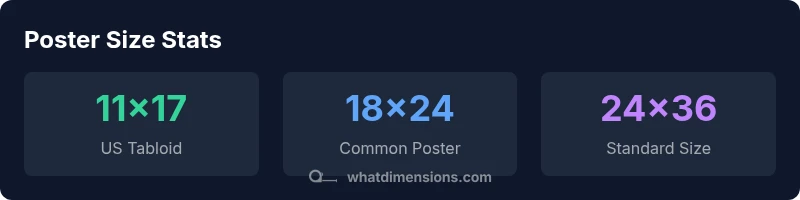
Poster dimensions vary by region and purpose. In the United States, common sizes include 11x17 inches (tabloid), 18x24 inches, 24x36 inches, and 27x40 inches for standard movie posters. Internationally, ISO sizes such as A2 (16.5x23.4 in) and A1 (23.4x33.1 in) are widely used. Always confirm final print specs with your printer.
Why Poster Dimensions Matter
Choosing the right poster dimensions matters for display quality, print efficiency, and venue compatibility. When you align size with viewing distance, you improve legibility and impact, while reducing wasted paper and reprints. According to What Dimensions, committing to a standardized set of dimensions for a campaign helps maintain consistent branding across venues and reduces last-minute layout adjustments. In practice, small posters on campus kiosks and large wall posters in conference halls often rely on different default formats; knowing the typical options prevents overprinting or cropping errors and supports smoother production workflows.
Beyond aesthetics, correct sizing supports accessibility—text and graphics should remain legible from the intended viewing distance. For designers, this means planning at the target resolution and choosing a proportion that preserves the poster’s focal point. The What Dimensions team recommends starting with a primary size for your main venue and offering a couple of secondary options for compatibility, ensuring you can adapt to different display spaces without redesigning the entire layout.
Global vs. Regional Systems
Poster sizing follows regional norms. In the United States, a strong roster of standard sizes exists, with 11x17 inches serving as a common, space-efficient choice for flyers and campus postings, and 27x40 inches serving as the de facto movie-poster standard. In contrast, many countries and printers follow ISO 216, which includes the A-series. ISO A2 and A1 are popular for posters because they scale predictably and have defined ratios. When you move from inches to centimeters, the conversion remains consistent, but you must account for bleed, margins, and printer capabilities. What Dimensions notes that printers sometimes provide a recommended set of sizes to streamline workflows and avoid cropping issues across equipment.
For multi-market campaigns, offering both US and ISO formats reduces conversion errors and ensures you can reach a broader audience without reformatting content. Always verify with the print shop about preferred file sizes and bleed values before finalizing artwork.
Common Poster Sizes in the US
The US market uses a mix of tabloid, poster, and film sizes. The most common formats you’ll encounter are 11x17 inches (tabloid), 18x24 inches, 24x36 inches, and 27x40 inches for movie posters. Each size supports different viewing conditions:
- 11x17 is ideal for handouts, small displays, or bulletin boards where space is limited.
- 18x24 is a popular mid-size option for events and retail displays because it remains readable without overwhelming a space.
- 24x36 is a standard poster size that balances legibility with a prominent presence in medium-to-large spaces.
- 27x40 is the classic one-sheet scale for film posters and larger venues.
Decide which size to standardize on based on the venue type and the viewing distance. If you anticipate multiple display contexts, provide slightly different layouts that fit each format while preserving the core visual hierarchy. Bleed and margin considerations are essential for all sizes so that critical content does not get cropped.
International Standards: ISO A-Series
ISO 216 defines the A-series, including A4, A3, A2, A1, and A0, with the predictable aspect ratio of 1:1.414. A2 (16.5x23.4 in) and A1 (23.4x33.1 in) are commonly used for posters in many markets. The advantage of ISO sizes is scalability: a single design can be resized with proportional layouts while maintaining editorial and visual balance. When preparing files for ISO formats, set up a scalable grid and ensure that type sizes remain readable at all target dimensions. Converting to inches is simple: 1 inch equals 2.54 cm, so you can translate between metric and imperial systems quickly.
If your project targets international venues, consider printing proofs in both A2 and A1 to confirm readability and kerning at the intended viewing distance. ISO-based posters also tend to align better with standard mounting and framing sizes, which can simplify logistics.
How to Choose the Right Size for Your Project
To select the appropriate poster size, start with display context and viewing distance. Use the following practical steps:
- Assess the primary display location — wall space, kiosk, or exhibition booth. Measure width and height constraints.
- Identify the intended audience distance. A poster meant for close-up viewing may justify a smaller size with higher resolution; one viewed from afar benefits from larger formats.
- Check venue guidelines or printer recommendations. What Dimensions notes that many venues specify a preferred format to avoid cropping or layout mismatches.
- Consider your content density. Detailed text-heavy posters require more space, while visual posters can leverage larger images and negative space.
- Prepare dual-format artwork if necessary (US sizes and ISO sizes) to maximize compatibility across markets.
Finally, verify your artwork’s safe margins, bleed area, and resolution. A common baseline is to design at 300 dpi for print, but if you know you’ll print at a larger scale, you can design at 150–200 dpi and rely on vector artwork for logos and icons. The objective is to maintain legibility and visual impact across formats.
Printing Considerations: Bleed, Margin, and Resolution
Production realities shape poster sizes. Bleed ensures color runs to the edge of the print; typical bleed values range from 0.125 to 0.25 inches, depending on equipment. Inside the safe area, keep essential content at least 0.25 to 0.5 inches from the edge to avoid cropping when trims occur. For text and small details, aim to keep font sizes above legibility thresholds: body text generally benefits from at least 9–12 points, while larger headings can scale up to 36–72 points depending on viewing distance. Always request a proof from the printer and confirm color profiles (CMYK vs. RGB) and paper weight. If you must compress information into a compact size, use a strong visual hierarchy and concise copy to preserve readability. What Dimensions emphasizes that an early size decision reduces rework and ensures consistent production across devices and venues.
Poster size reference table
| Size category | Dimensions (inches) | Dimensions (cm) |
|---|---|---|
| 11x17 (Tabloid) | 11 x 17 inches | 27.94 x 43.18 cm |
| 18x24 | 18 x 24 inches | 45.72 x 60.96 cm |
| 24x36 | 24 x 36 inches | 60.96 x 91.44 cm |
| 27x40 (Movie Poster) | 27 x 40 inches | 68.58 x 101.6 cm |
| A2 | 16.5 x 23.4 inches | 41.91 x 59.42 cm |
| A1 | 23.4 x 33.1 inches | 59.49 x 84.01 cm |
Quick Answers
What is the most standard poster size in the US?
In the US, the most common poster sizes are 11x17, 18x24, 24x36, and 27x40 inches. These formats cover handouts, displays, and film posters, respectively. When in doubt, start with 24x36 as a versatile default.
In the US, the common poster sizes are 11x17, 18x24, 24x36, and 27x40 inches.
Do ISO sizes apply to posters?
ISO A-series sizes, such as A2 and A1, are widely used internationally for posters. They scale predictably and integrate well with print workflows across borders.
Yes. ISO A-series like A2 and A1 are widely used internationally for posters.
How do I choose the right poster size for a venue?
Measure display space, consider viewing distance, and consult with the printer about bleed and margins. Align the size with the primary viewing angle to maximize readability.
Measure the space, think about how far viewers will be, and check with your printer.
What margins should I leave around the edge?
Leave a safe margin of about 0.25–0.5 inches from the edge; use a bleed of 0.125–0.25 inches if your printer requires edge-to-edge printing.
Bleed about 0.125–0.25 inches and safe margins of 0.25–0.5 inches.
Are there legal or venue constraints for poster sizes?
Some venues require specific poster dimensions for mounting or wall space. Always verify guidelines before printing.
Yes, some venues have size restrictions; verify guidelines before printing.
“Accurate poster dimensions streamline production and ensure consistent display across venues.”
Main Points
- Identify target venue before choosing a size
- US and ISO sizes cover most use cases
- Always include bleed and safe margins
- Proof proofs with the printer to avoid cropping
- Consider legibility at the intended viewing distance