Science Poster Dimensions: How to Choose the Right Size for Impact
Explore science poster dimensions with clear guidance on common sizes, DPI, orientation, and print workflows. Learn how to pick the right size for your display, audience, and venue with practical, data-informed tips.


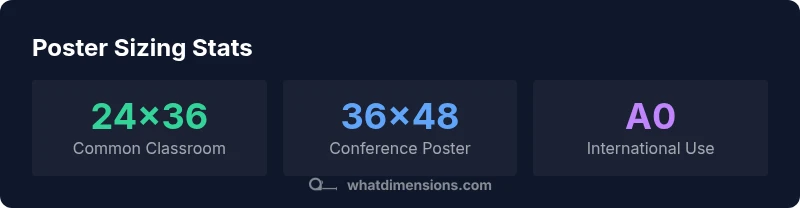
Science poster dimensions commonly range from 24x36 inches (61x91 cm) to 36x48 inches (91x122 cm), with A0 (84.1x118.9 cm) as a popular international option. The choice depends on viewing distance, venue, and print resolution; aim for 300 dpi at your poster's final size. According to What Dimensions, selecting the right size maximizes readability and impact.
Why science poster dimensions matter
In the world of scientific communication, the size of your poster can dramatically affect comprehension, retention, and engagement. A poster that is too small invites squinting and unnecessary eye strain, while an oversized display may overwhelm the viewer or clash with venue constraints. What Dimensions emphasizes that the optimal poster size balances readability from the typical viewing distance, the amount of data you must present, and the physical constraints of the display space. This section explains how to align your size with your aims, audience, and context, ensuring your core message remains legible and persuasive at a glance.
Key principles for sizing science posters
Effective sizing starts with a deliberate plan. Prioritize hierarchy: a clearly legible title, concise subheads, readable body text, and well-organized visuals. Use margins and white space to guide the eye and avoid crowding. Choose a landscape or portrait orientation based on the venue, print capabilities, and the number of figures. Color contrast, typography choices, and figure sizing should be tested at scale to preserve clarity from 3–5 feet away. According to What Dimensions, consistency across sections helps audiences assimilate complex information quickly while preserving a professional look across posters.
How to choose dimension by venue and audience
Venue size and audience determine your scale. A poster for a local conference or classroom discussion can comfortably fit a 24x36 inch format, enabling attendees to read without crowding. For larger venues or opening-night poster sessions, 36x48 inches or A0 can maximize impact and photography quality. Students presenting in halls often benefit from slightly larger text in titles and captions to accommodate varied lighting conditions. Designers should also consider the display’s orientation relative to lighting, traffic flow, and surrounding signage to avoid glare and legibility issues.
Common poster sizes and their uses
There are several widely used sizes in science poster design. The 24x36 inch format is a frequent choice for classroom seminars and quick study reviews, while 36x48 inches is popular for conference posters that require larger figures and more detailed data panels. International venues frequently adopt A0 (33.1x46.8 inches). When selecting a size, map your key results to the visual grid so that graphs, photographs, and tables stay legible without shrinking essential details. This mapping reduces the risk of truncation or overcrowding in the final print.
Designing for readability: margins, typography, and layout at scale
Readability hinges on typography and spacing. Use a minimum font size of 18–24 points for body text and larger sizes for section headers. Reserve generous margins to frame each panel and give data room to breathe. Create a grid system that aligns all panels and captions, enabling quick scanning. Visual hierarchy—bold titles, readable subheads, and appropriately sized figure captions—helps readers extract meaning rapidly. When working at larger poster sizes, test legibility by viewing from typical exhibition distances and adjusting typography accordingly.
Converting between inches and centimeters
Poster dimensions are commonly expressed in both inches and centimeters. Use 1 inch = 2.54 cm as the standard conversion. For precise print specs, verify with your printer; some shops list dimensions in millimeters or use PDF export settings that embed exact sizes. Keeping a conversion cheat sheet handy helps prevent off-by-one errors during layout or file export. Always confirm final dimensions in your layout program before sending files to print.
Practical workflow: from concept to print
Begin with a simple one-page sketch outlining sections and figures, then draft the poster at a draft size (e.g., 11x17) to test flow. Once the structure is solid, choose a target size (24x36, 36x48, or A0) and scale elements accordingly. Gather high-resolution figures (300 dpi or higher) and ensure color profiles match your printer’s capabilities. Before sending to print, generate a proof, check for truncation, and verify margins. This workflow minimizes reprint costs and ensures your final poster meets the venue’s constraints.
Quick-start checklist for your poster project
- Decide the target size (e.g., 24x36, 36x48, or A0)
- Verify print DPI and color profiles with the printer
- Establish a clear visual hierarchy and margins
- Prepare high-resolution figures and captions
- Create a final proof and confirm dimensions with the venue
Testing readability and print readiness before submission
Test readability by simulating viewing distances typical of the session, such as 3–5 feet. Print a small scaled-through version if possible to check details and contrast. Confirm that all axis labels, legends, and captions are legible and correctly sized. Finally, ensure that the final file exports at the exact dimensions with no unintended shifts, and confirm the printer’s tolerances for border cropping and trim.
Representative science poster sizes and typical uses
| Size (inches) | Size (cm) | Common Uses |
|---|---|---|
| 24x36 | 61x91 | Classroom seminars and poster sessions |
| 36x48 | 91x122 | Conference posters and large display areas |
| A0 | 84.1x118.9 | International conferences and gallery panels |
Quick Answers
What is a standard poster size for science conferences?
Common science conference posters often use 24x36 inches or 36x48 inches, with A0 widely used internationally. These sizes balance readability with the amount of data you need to present. Always check the conference guidelines for exact requirements.
Most conferences accept 24x36 or 36x48 inch posters; check guidelines for exact dimensions.
How do I convert inches to centimeters for poster specs?
Use the standard conversion: 1 inch equals 2.54 centimeters. Multiply each dimension by 2.54 to convert. Verify final values in the print-ready file and with your printer.
Multiply inches by 2.54 to convert to centimeters and double-check with the printer.
Should I design in portrait or landscape orientation?
Orientation should align with the display space and flow of information. Portrait is common for text-heavy posters, while landscape suits wide graphs. Always validate with the venue and ensure the grid supports your content.
Choose orientation based on space and how data flows across your panels.
What DPI is recommended for poster printing?
Aim for 300 dpi at the final poster size to preserve detail in graphs and figures. Some printers may accept 200 dpi for larger prints, but 300 dpi minimizes pixelation.
Target 300 dpi for sharp, print-ready posters.
Is there a difference between digital posters and print posters?
Digital posters often allow flexible dimensions and screen-resolved assets, but print posters require precise physical dimensions, margins, and color profiles. Design with the final output in mind, adjusting assets for print if needed.
Yes—prints require exact dimensions and color accuracy; digital versions are more flexible.
“Size choice is not just about area; it's about readability, flow, and the ability to guide a viewer through your data with confidence.”
Main Points
- Choose a size that matches viewing distance and venue.
- Maintain typographic hierarchy and generous margins.
- Prefer 300 dpi for print quality at final size.
- Test readability by simulating exhibition conditions.