Invitation Dimensions: A Practical Guide for Card and Envelope Sizing
Explore invitation dimensions, standard sizes, margins, and envelope compatibility. This What Dimensions guide helps homeowners, students, designers, and shoppers pick the right size for invitations, RSVPs, and inserts.


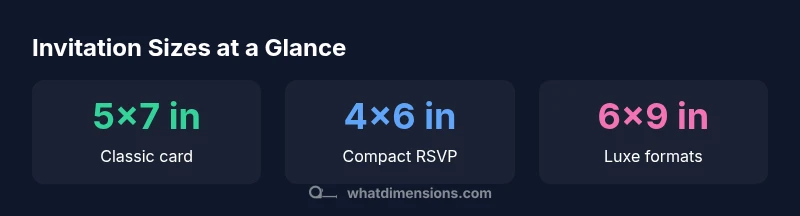
The most common invitation dimensions in practice are 5x7 inches for standard cards, paired with a matching envelope, while smaller formats like 4x6 inches and larger formats around 6x9 inches are used for RSVP cards or formal inserts. This sizing balance supports readability, mailing feasibility, and a cohesive guest experience.
Understanding Invitation Dimensions
Invitation dimensions govern more than the look of an invite; they influence mailing costs, production workflow, and guest experience. In practical terms, the size of the card determines how much content you can include, how much margin the printer requires, and which envelope you should order. According to What Dimensions, invitation dimensions are typically driven by a balance between aesthetics, readability, and mailability. Designers often start with a target envelope size and work backward to a card that fits neatly, including margins and optional inserts. When you choose a size, consider the relationship to your event type: formal affairs often favor more traditional shapes and thicker stock, while casual gatherings allow for lighter formats and more creative geometry. Across genres, a clear understanding of invitation dimensions helps you avoid printing errors, late shipments, and misfit envelopes.
Common Sizes in Practice
Most invitations fall in a familiar range: the classic 5x7 inch card is the default for wedding and formal events, paired with an A7-style envelope in many markets. Smaller options, around 4x6 inches, are frequently used for RSVP cards or save-the-date pieces when you want a compact mailer. For larger statements or multi-piece suites, sizes near 6x9 inches are chosen, though they require broader mailings or special handling. Square formats (such as 5x5 inches) can suit modern, minimalist themes but may incur different postage and packaging considerations. When selecting sizes, you’ll also weigh paper stock, print method, and whether you’ll include inserts like RSVP cards, reception details, or maps. When you maintain consistency around a primary size, your invitation suite looks cohesive and professional.
How to Choose the Right Size for Your Event
Formality and venue set the tone for invitation dimensions. Formal weddings often adopt the 5x7 card with a matching envelope because it reads as traditional and provides ample space for elegant typography. For events with eco or budget constraints, a 4x6 card can deliver essential details in a crisp, approachable way. If you plan multiple inserts, consider a slightly larger card, such as 5x7 or 6x9, to maintain legibility without crowding. Think about mailing realities: bulky formats may require extra postage or non-machinable handling in some regions. Finally, test your layout with a sample print to confirm margins, bleed, and color accuracy before running a full batch. By starting with invitation dimensions that suit your content and mailing scenario, you minimize print errors and ensure guests receive a well-crafted invitation.
Layout and Bleed: Getting Print-Ready
Printing templates rely on precise measurements. Bleed ensures color and design extend to the edge after trimming, typically around 0.125 inches beyond the final trim. Safe margins should keep important text well inside the trim line, usually at least 0.25 inches from the edge. When planning layout, work on a grid that aligns typography, alignment, and any decorative elements. For two-piece suites (invitation card plus RSVP card) or insert panels, confirm that the combined assembly fits within the chosen envelope size. For readability, consider a font scale that remains legible at drop-ship sizes and print methods—digital printers may handle subtle lines differently than letterpress or foil stamping. By addressing bleed, margins, and alignment for your invitation dimensions, you minimize post-print trimming surprises and ensure a polished final product.
Envelopes, Inserts, and Mailing Considerations
Envelope choice is inseparable from invitation dimensions. A standard invite pairs a card with an envelope sized to accommodate the card plus a few millimeters for a smooth insert. If you include an RSVP card or map, think about a pocket or a nested insert within the same mailer, which may require a larger envelope or a slightly reduced card size to maintain balance. Some planners choose a pocket fold or a gatefold to present information in layers; these formats demand careful measurement of opened dimensions and internal panels. At the point of purchase, verify gummed seals, pre-creased edges, and compatibility with your chosen printing method. Finally, remember that mailing costs rise with size and weight, so you’ll want to optimize your invitation dimensions for both aesthetics and budget.
Printing Methods and Material Considerations
Different printing methods interact with invitation dimensions in distinct ways. Digital printing offers flexibility for a broad range of sizes and stocks, but color consistency can vary with very light or dark papers. Letterpress, foil, or thermography impart tactile depth that often benefits from simple, clean card shapes. Stock thickness (measured in point or gsm) influences perceived value; thicker stocks look premium but add mailing weight. Some papers have natural textures that affect ink coverage; always request a proof to verify how the ink sits on your chosen grain. When you select a print method, also consider finishing options like rounded corners or foil accents, which change the effective dimensions slightly and should be accounted for in your design template. The bottom line: your invitation dimensions should harmonize with your printing method to deliver readability, impact, and cost efficiency.
International Standards and Quick Reference
While the US dominates wedding invitations, other regions have their own typical dimensions. In metric terms, common card sizes translate roughly to 100x140 mm for smaller notes and 180x230 mm for larger, formal pieces. If you work with international guests or printers, compare your chosen invitation dimensions to local envelope sizes and postal requirements to avoid extra postage or misfit mail. A practical rule is to standardize on one primary size and provide scaled versions for different markets. If you need precise conversions, consult your printer’s template or use a reliable reference conversion table. Tracking these invitation dimensions across markets helps ensure consistency and reduce production errors.
Cost, Sustainability, and Practical Tips
Balancing cost with design often centers on invitation dimensions. Larger formats, premium stocks, and specialty finishes raise printing and postage costs, while smaller, simpler formats reduce waste and transit expenses. If sustainability matters, choose recyclable materials and avoid foil or plastic embellishments that complicate recycling streams. Request digital proofs to catch layout issues before production and consider standardized sizes to simplify inventory. For multi-piece suites, plan the most efficient sequence: primary invite, RSVP card, and map or directions may share a template, reducing setup time and waste. Finally, work with your printer on a recommended maximum trim tolerance and confirm your final invitation dimensions align with their capabilities to avoid misprints.
Designer Checklist: Quick Reference
Create a concise pre-production checklist: confirm primary card size, ensure envelope compatibility, set bleed and margins, finalize typography, prepare inserts, and verify postage implications. Use a single, unified template for all pieces to maintain consistent invitation dimensions across the suite. Run a proof with the chosen stock, print method, and finishing options. Only then approve the batch for production to ensure a flawless, cohesive look from invite to envelope.
Representative invitation sizes and their typical uses
| Size category | Example dimensions | Notes |
|---|---|---|
| Standard invitation | 5 x 7 inches | Most common size with A7 envelope |
| RSVP insert | 4.25 x 5.5 inches | Fits inside a typical mailer |
| Square option | 5 x 5 inches | Casual events or modern themes |
| Larger formal | 6 x 9 inches | For luxe projects and multi-insert suites |
Quick Answers
What is the most common invitation size?
The most common invitation size is 5x7 inches, a balance between space for typography and imagery and practical mailing. It remains the default for formal events.
The most common size is 5x7 inches, great for formal invites. It balances space and mailability.
Do envelopes always match the card size?
Envelopes are typically chosen to fit the card size with a small margin for sealing. Always verify with your printer’s recommended envelope.
Yes, pick an envelope that fits your card with a small margin.
What is bleed and why is it important for invitation dimensions?
Bleed is extra area beyond the final trim where colors extend. It prevents white edges after trimming and is typically about 0.125 inches.
Bleed prevents edges from showing white after trimming.
Are square invitations popular for weddings?
Square formats are stylish but may affect postage and handling. They work well for modern themes if your budget allows.
Square invites look modern but check postage costs.
How should I convert invitation dimensions for international guests?
Provide metric and imperial references and confirm local mail rules with printers. Consider dual-format versions for cross-border guests.
Offer both metric and imperial references and check mail rules.
What should I consider for RSVP cards and inserts?
Keep RSVP cards compact and cohesive with the main invite. Ensure total weight and size fit your chosen envelope.
Keep RSVP inserts compact and match the invite design.
“Size matters in invitation design; the right invitation dimensions create a cohesive, tactile experience from first glance to RSVP.”
Main Points
- Choose sizes that balance readability and mailability
- Match card size to envelope type for professional results
- Allow for bleed to avoid white edges in printing
- Budget for extra postage if it’s a larger format
- Consider guest experience when selecting non-traditional shapes