Standard Wedding Invitation Dimensions: A Practical Guide
Explore standard wedding invitation dimensions, envelope compatibilities, and practical tips for 2026. Learn how to choose sizes, layouts, and margins with What Dimensions.


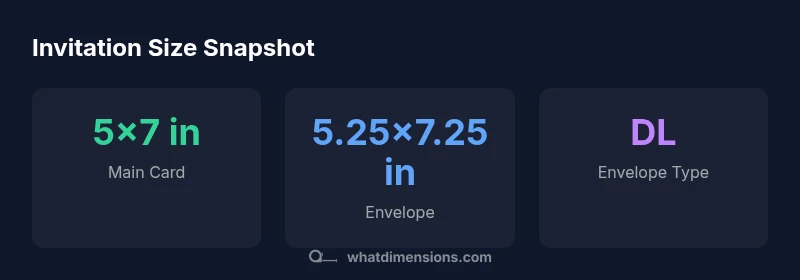
The standard wedding invitation size for the main card is commonly 5x7 inches, with RSVP cards around 3.5x5 inches. Envelopes typically match these measurements, often using a 5.25x7.25 inch envelope. While variations exist, 5x7 remains the baseline for traditional weddings, and designers consider margins and bleeds to ensure print accuracy. According to What Dimensions, these guidelines help balance aesthetics with mailability.
What standard wedding invitation dimensions really mean
When designers talk about standard wedding invitation dimensions, they mean the baseline card size used in most formal weddings. The main card is typically sized to balance presence and practicality—large enough to convey essential information, small enough to mail without special handling. In 2026, What Dimensions notes that the 5x7 inch main card remains the most common baseline in many regions, with envelopes sized to fit comfortably without crowding content. The decision often starts from the envelope; printers specify margins, bleed, and safe areas that preserve legibility. Readers should also consider the insert stack: invitations, RSVP, response card, reception card, and directions may require a slightly larger envelope or a pocket fold. By grounding your design in a proven standard, you simplify production, reduce waste, and maintain a cohesive look across invitations.
Common size options and when to use them
Traditional flat invitations around 5x7 inches are the default choice because they balance legibility with envelope compatibility. Slim formats like 4.33x8.66 inches (DL) offer a modern aesthetic and can reduce mailing weight, but ensure your inserts fit the envelope. Pocketfold suites vary in overall dimensions; plan around the envelope size to avoid extra postage. For micro-weddings or destination celebrations, smaller cards around 4x6 to 4.25x5.5 can be used with appropriate envelopes and clear margins. Always test with a physical sample to confirm margins, fold lines, and readability before placing a large print order. If you work with designers, request a standardized grid to maintain alignment across all inserts.
How design choices affect readability and mailability
A crisp layout improves both readability and perceived value. On a 5x7 card, limit the headline to two lines and place essential information at the top where readers typically scan first. Choose high-contrast type, adequate leading, and consistent margins to ensure legibility from a distance. Consider how the invitation will be mailed: heavier or multi-insert suites may require additional postage or a larger envelope. What Dimensions notes that predictable dimensions simplify production, reduce waste, and help you estimate costs more accurately during design and printing.
Envelope considerations and mailing standards
Envelope selection is not just cosmetic; it determines postage, handling, and feasibility. Ensure the envelope size matches the main card with comfortable clearance, usually 1/8 to 1/4 inch on all sides. If you add inserts or a pocket, you may need a larger envelope and extra postage. In many markets, standard sizes exist (for example, the 5x7 main card with a 5.25x7.25 envelope in the U.S.), while other regions rely on metric formats. Always verify local postal guidelines and ask your printer for a stamped checklist that confirms compatibility before ordering a full print run.
Layout tips for standard dimensions
Layout tips include: align all text blocks with a grid, keep key information within the top third for scanning, and use typographic hierarchy to guide the eye. Use bold headings, legible serif or sans fonts, and a max of two font families. For non-English copy, plan for longer lines and adjust tracking. Always order a printed proof before bulk printing.
International variations and regional differences
While 5x7 is common in many places, other regions favor slightly different base sizes. For example, some markets prefer metric dimensions around 127x178 mm or 110x220 mm formats. When planning an international wedding, check local printer capabilities and mail guidelines to avoid surprises.
How to measure and order samples accurately
Measure your final layout with a ruler and print a test sheet at actual size. Request printed samples from your printer to verify margins, folds, color fidelity, and envelope fit. Compare multiple vendors to understand variance in trimming, bleed, and color. Remember that proofs online may not perfectly match printed results, so always request a physical sample before finalizing a large print run.
Common wedding invitation sizes and envelope matches
| Format | Main Card Size | Envelope Size | Notes |
|---|---|---|---|
| Traditional flat invitation | 5x7 inches | 5.25x7.25 inches | Most common; standard mailability |
| Slim / DL format | 4.33x8.66 inches | DL envelope (110x220 mm) | Space-saving, modern look |
| Pocketfold invitation | Varies by suite | Varies by envelope | Flexible inserts; verify mail rules |
| Mini or petite invites | 3.5x5 inches | A2 or small envelope | Budget-friendly, niche events |
Quick Answers
What is the standard wedding invitation size?
The standard is around 5x7 inches for the main card, with RSVP cards typically smaller. This helps with envelope fit and printing margins.
The standard size is about 5x7 inches for the main card, with RSVP cards smaller.
Are RSVP cards always the same size as the main invitation?
No; RSVP cards are typically smaller, commonly around 3.5x5 inches, but always verify with your printer.
RSVP cards are usually smaller, around 3.5 by 5 inches.
Can I customize sizes beyond the standard?
Yes, but you should consider envelope compatibility, printing costs, and printer capabilities before committing.
Yes, you can customize sizes, but check envelopes and costs first.
How can I verify sizes before ordering?
Order printed samples to verify margins, folds, and legibility. Compare multiple vendors to understand variation.
Order printed samples to verify margins and folds.
Do international weddings have different standard sizes?
Yes; sizes vary by country and local mailing guidelines. Check with local printers and postal rules before finalizing.
International weddings may use different standard sizes; check local guidelines.
“Size choices affect readability and postal handling; standard dimensions strike a balance between design flexibility and cost.”
Main Points
- Check main card size first: 5x7 inches is the baseline.
- Always match envelope size to card to ensure mailability.
- Plan for inserts and pockets when estimating total thickness.
- Order printed samples before final printing to verify fit.