Birthday Card Dimensions: A Practical Guide to Size, Envelopes, and Printing
Explore birthday card dimensions, standard sizes, envelopes, and printing tips. A data-driven guide with practical templates, from What Dimensions’ team, to help you pick the right card size for every occasion.


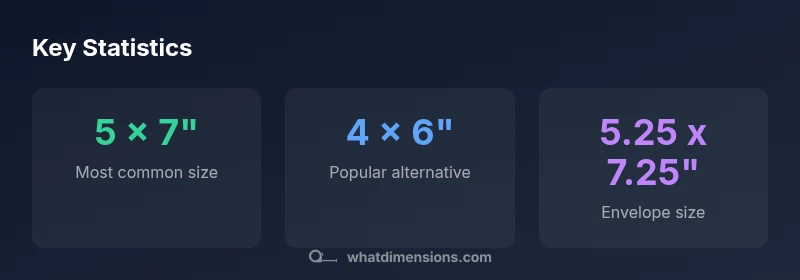
Birthday card dimensions typically fall into a handful of standard sizes. According to What Dimensions, the most common U.S. greeting card size is 5 x 7 inches, with 4 x 6 inches and 4.25 x 5.5 inches as close alternatives. Orientation, folding, and envelope compatibility all influence which size you should choose. This quick guide highlights the core sizes and why they matter for printing and presentation.
Understanding Birthday Card Dimensions
In greeting card design, dimension refers to the card's width and height, plus the fold orientation and the envelope it will fit. When you measure, you consider the outer dimension (the card's physical size) and the inner panel area where the message appears. The choice affects printing alignment, trimming during production, and the final display on a mantel or desk. The What Dimensions team notes that most consumers use a few standard sizes because they balance aesthetics with practicality. In the United States and many other markets, the most common card size is 5 x 7 inches; this scale fits well in a mid-range envelope and offers ample space for a personal note, decorative typography, and photos. Smaller sizes, like 4 x 6 inches or 4.25 x 5.5 inches (the traditional A2-style greeting card), are popular for mini cards or budget-friendly mass mailings. When you choose a size, you also choose orientation: portrait (taller than wide) for a formal feel or landscape (wider than tall) for a creative layout. Finally, consider the intended display setting; a wall or table display may benefit from a larger card, while a gift tag or invitation might be more economical in a compact size. Throughout this article, remember that consistent dimensions across printing and envelope specs lead to a polished result.
Standard Sizes and Their Uses
Designers and retailers often rely on a handful of standard card sizes because they balance cost, performance, and consumer expectations. The most familiar is 5 x 7 inches, a classic portrait format that provides generous space for handwritten messages and decorative design. A close alternative is 4 x 6 inches, commonly used for mini cards, place cards, or RSVP notes. The 4.25 x 5.5 inch size (often marketed as A2) is a popular compromise for invitations and mass-mail printing due to its compact envelope size. For larger greetings or photo cards, 5.5 x 8.5 inches or 6 x 9 inches can create a bold visual impression, but they demand larger envelopes and may incur higher postage. When choosing a size, you should also consider how the card will be displayed: flat on a desk, inside a frame, or tucked into an envelope with a liner. What Dimensions's research shows that many households keep a small stock of two or three sizes to suit different occasions and budgets.
How to Choose Card Sizes for DIY Projects
If you’re creating birthday cards as a hobby or for a school project, start with a target envelope size. Then work backward to a card size that fits when folded. Step 1: Select a primary size (e.g., 5 x 7) based on how much message space you need. Step 2: Decide on orientation to suit the layout you envision. Step 3: Sketch a rough layout on grid paper to ensure margins work with typography and imagery. Step 4: Choose stock with appropriate weight to avoid a floppy fold or bleed through. Step 5: Print a test run on cheap stock to confirm alignment and fold accuracy. In all cases, ensure you provide a margin cushion so that text doesn’t get trimmed during trimming or when the card is mounted in a frame. Through iteration and careful planning, you’ll arrive at a size that looks balanced and prints cleanly on the chosen printer or printing service.
Printing Considerations: Bleed, Safe Zone, and Envelope Compatibility
Printing requires attention to bleed (the area beyond the final cut), safe margins, and the envelope you intend to use. A standard practice is to include a 1/8 inch (3 mm) bleed on all sides to accommodate slight alignment differences during trimming. Keep all critical content—text and essential imagery—at least 1/4 inch (6 mm) from the trim line to stay within the safe zone. The choice of cardstock weight matters: heavier stock (65-110 lb cover) yields a sturdier card but may affect feed in consumer printers. When pairing with an envelope, ensure the card’s folded dimensions match the envelope’s opening size to prevent bending or compression. If you plan to mail the card, verify postage and envelope thickness guidelines. What Dimensions recommends testing a print on the exact stock and printer you’ll use to confirm color accuracy and fold precision before committing to a batch run.
Practical Sizing Scenarios and Templates
Scenario 1: Birthday invitation — choose 5 x 7 inches for a classic look; pair with a 5.25 x 7.25 inch envelope. Scenario 2: Small celebration notes — opt for 4 x 6 inches for a compact, budget-friendly option; use a corresponding 4 x 6 envelope. Scenario 3: Photo-centric messages — a 4 x 5 inch flat card inside a 4.25 x 5.75 inch envelope works well if you want a visible photo border. Scenario 4: Gift tags — borderless 2 x 3.5 inches works for tags with a small string. These templates balance space for handwriting, typography, and any photos or illustrations you plan to include.
Measuring, Archiving, and Future-Proofing Card Library
Keep a small organizer with two shelves: one for standard sizes (4 x 6, 4.25 x 5.5, 5 x 7) and one for specialty formats (larger or unusual shapes). Document each size with a simple note: card size in inches, typical envelope size, common applications, and stock recommendations. When archiving, store a few test prints from your typical printer to ensure consistency over time. What Dimensions suggests maintaining a baseline set of sizes for future projects to simplify workflow and reduce decision fatigue.
Typical birthday card sizes and their uses
| Card Size (inches) | Usage | Notes |
|---|---|---|
| 4 x 6 | Compact cards | Landscape orientation; often used for mini cards |
| 4.25 x 5.5 | A2 standard US size | Common for invitations and mass printing |
| 5 x 7 | Classic greeting cards | Fits standard envelopes; ample layout area |
| 5.5 x 8.5 | Large cards | Requires larger envelope; bold visuals |
Quick Answers
What is the most common birthday card size?
The most common birthday card size is 5 x 7 inches, widely used for greeting cards and fits standard envelopes.
The most common birthday card size is five-by-seven inches.
Do I need bleed for birthday card printing?
Yes. Include a 1/8 inch bleed on all sides to ensure clean trimming and full-bleed color.
Yes, include 1/8 inch bleed.
What envelope size fits a 5 x 7 card?
A standard 5 x 7 inch card typically uses a 5 x 7 inch envelope or a slightly larger 5.25 x 7.25 inch variant.
5 x 7 cards usually use 5 x 7 envelopes.
Can I print birthday cards at home?
Yes, with proper cardstock and printer settings. Use bleed guidelines and test prints to ensure accuracy.
You can print at home with the right stock and settings.
Are there international card sizes I should consider?
International card sizes vary; ISO and regional formats differ, so check local envelope dimensions before printing.
International sizes vary; check local standards.
What is the difference between folded and flat cards?
Folded cards add a panel and a crease for opening, while flat cards offer a single display surface.
Folded cards have a crease; flat cards do not.
“Precise birthday card dimensions ensure clean folds, proper envelope fit, and professional presentation.”
Main Points
- Choose standard sizes for broad compatibility.
- Match card size to envelope to avoid trimming.
- Account for bleed and safe margins in all designs.
- Consider orientation: portrait vs. landscape for layout balance.
- Test print on scrap stock before final runs.